

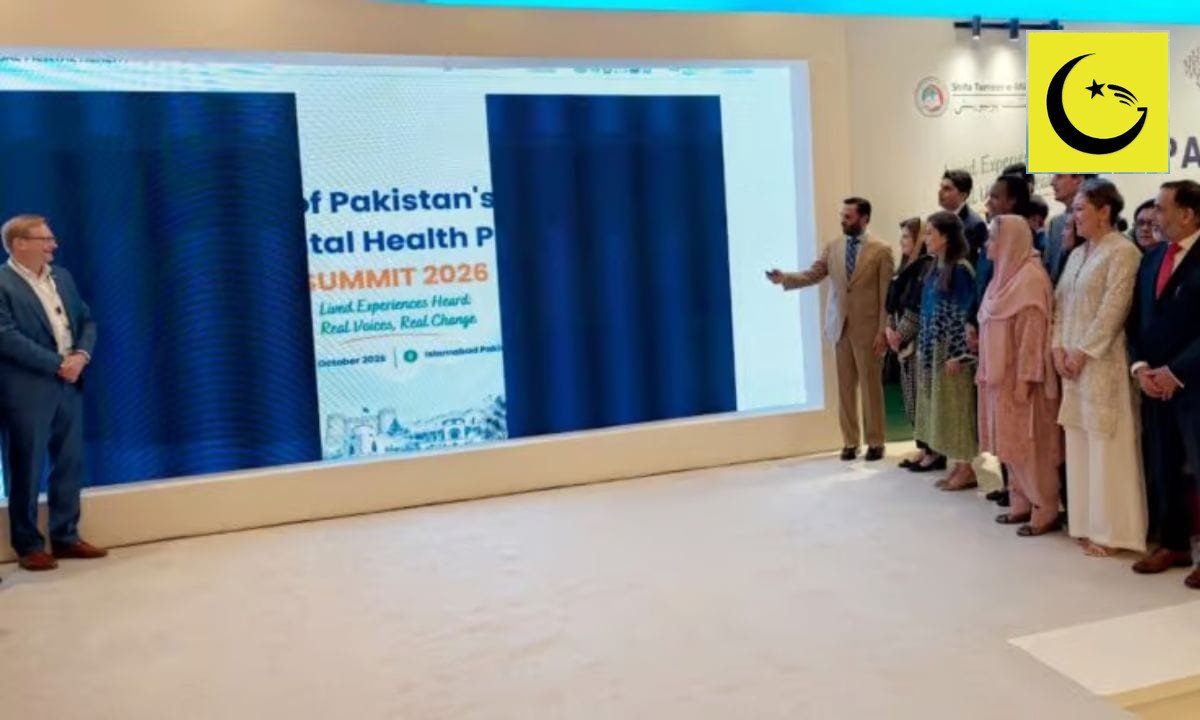
Pakistan has launched its National Mental Health Policy 2026-2035, a ten-year roadmap unveiled by Federal Health Minister Syed Mustafa Kamal at the Pakistan Global Mental Health Summit in Islamabad on October 1. Developed with the World Health Organization and UNICEF, the policy aims to close one of the country’s starkest care gaps: an estimated 32.4 million Pakistanis need mental health support, yet only about five percent can access it.
The two-day summit at the Serena Hotel brought together 800 participants in person and online, including mental health experts, academics, policymakers, parliamentarians, young people and people with lived experience. Its theme, “Building Climate-Resilient and Future-Ready Mental Health Systems for Children, Young People and Communities in Pakistan,” set the tone for a policy that puts prevention and community care first.
The 95 Percent Treatment Gap
The numbers behind the policy are sobering. A World Health Organization estimate puts the number of Pakistanis needing mental health care at 32.4 million, with roughly a 95 percent treatment gap. Pakistan has only 0.19 psychiatrists per 100,000 people, compared with about seven per 100,000 in high-income countries; in absolute terms, around 500 psychiatrists serve a population of 250 million.
Minister Kamal did not mince words at the launch: “Mental health is an emergency in Pakistan. It is national security issue. It is a national economic issue. We need to bring everyone together, including every ministry and every individual.” WHO Director-General Dr. Tedros Adhanom Ghebreyesus, addressing the summit by video, added an economic case: “Investing in mental health is a smart investment. Every dollar invested in addressing conditions including depression and anxiety yields four dollars in returns… there is no health without mental health.”
What the National Mental Health Policy Promises
The policy covers the full continuum of care: promotion, prevention, early identification, treatment, rehabilitation and recovery. Its most consequential commitment is the integration of mental health into primary healthcare and community-based services, so that support is available at the local clinic rather than only at distant specialist hospitals.
Other pillars include mental health support during floods and emergencies, workforce capacity building, and the expansion of digital health and telemedicine to reach underserved areas. To turn paper into practice, letters of understanding are to be signed with provincial health and education departments alongside an Islamabad Declaration for Mental Health, with the provinces, Gilgit-Baltistan and Azad Jammu and Kashmir developing their own implementation plans with federal technical assistance.
Children at the Heart of the Plan
Children and young people sit at the center of the new framework, with schools, families and health services tasked to work together on early identification. “Mental health and well-being are fundamental to children’s ability to learn, develop and thrive,” said Pernille Ironside, UNICEF Representative in Pakistan. Dr. Syed Usman Hamdani, founding director of the Global Institute of Human Development at Shifa Tameer-e-Millat University, noted that “effective mental healthcare can be delivered through primary healthcare, schools and communities,” a shift the policy now formalises.
Minister of State for Health Dr. Malik Mukhtar Ahmad Bharath described the policy as “a shared commitment to bring care closer to every family… so that people can access support early, with dignity and respect.” The summit also saw the launch of the South Asia Child and Adolescent Mental Health Landscape Analysis and sessions on suicide prevention, substance use and climate-resilient systems, with organisers positioning the gathering as Pakistan’s flagship international mental health platform for years to come.
Policies are judged by what changes on the ground, and the real test of the National Mental Health Policy will be whether a mother in a flood-affected village or a student in a crowded classroom can actually reach help. But for the first time, Pakistan has a decade-long plan, provincial buy-in on paper, and the world’s two biggest health institutions at the table. That is a genuine starting line.
Sources
- PID: National Mental Health Policy launched (official press release)
- TechJuice: Pakistan launches National Mental Health Policy 2026-2035

Umar is an engineer by profession and a passionate writer by passion. He has a deep interest in sharing good news related to Pakistan and has been working hard to promote the positive image of his homeland. Umar has written numerous articles on various topics related to Pakistan, such as technology, sports, culture, and economy.