

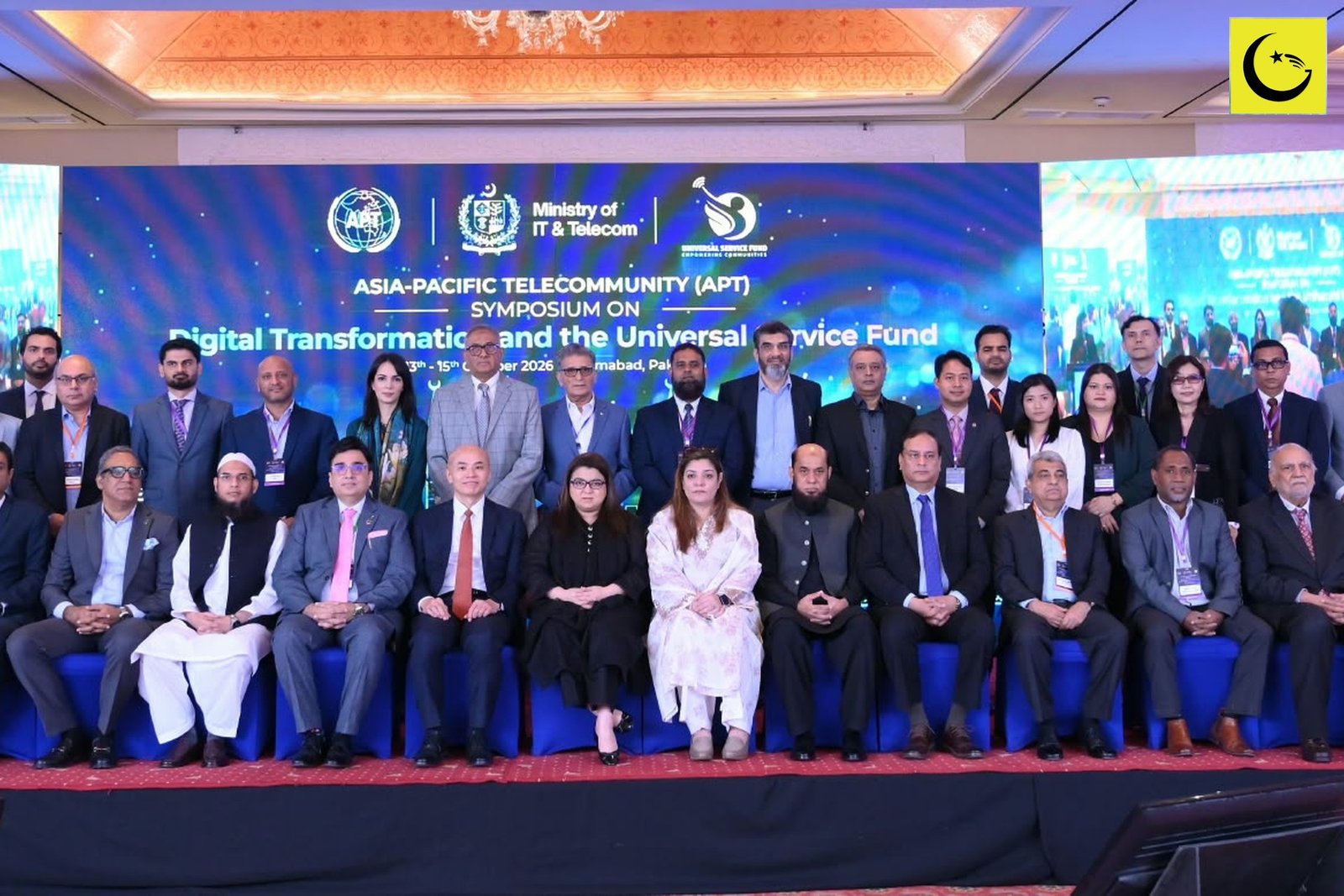
Islamabad became the center of Asia-Pacific telecom policy this week as the APT Symposium Islamabad opened on October 13, 2026, bringing ministers, regulators and industry leaders together to chart a shared roadmap for digital inclusion. The three-day forum, organized by the Asia-Pacific Telecommunity (APT) and co-hosted by Pakistan’s Ministry of Information Technology and Telecommunication (MoITT) and the Universal Service Fund (USF) Pakistan, opened with a headline announcement: Pakistan’s USF has crossed $1.054 billion in deployed contracted subsidies, a milestone the federal IT minister described as historic for the country’s digital journey.
Photo: The World Ambassador
What the APT Symposium Islamabad Means for the Region
The APT Symposium Islamabad is the region’s highest-level gathering this year on the future of universal service, the policy idea that everyone deserves affordable access to modern connectivity. Delegates from across Asia-Pacific, including Bangladesh, Papua New Guinea, Bhutan, Malaysia and Samoa, joined Pakistani officials, telecom operators and technology vendors at the Islamabad Serena Hotel for three days of panels and technical sessions running from October 13 to 15.
The symposium builds on the Tokyo Statement adopted at the APT Ministerial Meeting in 2025, which committed member states to harnessing emerging technologies for sustainable, inclusive and equitable digital transformation. According to the event’s concept note, 48 percent of the Asia-Pacific population remains offline, and new tools such as low-earth-orbit satellites and high-altitude platforms can help close the gap only if policy and regulation keep pace.
For Pakistan, hosting the APT Symposium Islamabad is both a recognition of its own universal service record and a platform to help shape the region’s connectivity rules.
Delivering the chief guest inaugural address, Federal Minister for IT and Telecommunication Shaza Fatima Khawaja said Pakistan treats digital access as an engine of economic empowerment and social mobility, and is modernizing its policy landscape to bring high-speed fiber backhaul, affordable smartphones and localized AI capabilities to rural communities. Her central announcement was the funding milestone:
“I am proud to announce a landmark milestone today: USF Pakistan has officially crossed the threshold of over $1 billion in deployed contracted subsidies, playing a vital, historic role in advancing digital transformation across the country.”
A $1 Billion Milestone for Pakistan’s Universal Service Fund
The $1 billion figure represents contracted subsidies deployed through USF Pakistan, the state-backed fund that finances telecom infrastructure in commercially unviable areas. USF CEO Chaudhry Mudassar Naveed told the gathering that 158 out of 185 awarded projects have been completed so far, utilizing more than PKR 169 billion in subsidies and directly benefiting over 38.4 million people.
Naveed, a telecom industry professional with more than 25 years of experience, said the fund’s own yardstick has changed over time:
“For decades, USFs were measured by tower counts in remote regions. Today, meaningful connectivity demands high-speed fiberization, active infrastructure sharing, and demand-side inclusion.”
He added that USF Pakistan has connected 41 million people with mobile services across 23,530 villages and laid 21,100 kilometers of optical fiber cable. The fund is now leading regional discussion on buy-now-pay-later device financing frameworks, low-cost right-of-way policies and resilient middle-mile networks. The announcement made the APT Symposium Islamabad a showcase for Pakistan’s own connectivity record as well as a regional policy forum.
Inside the APT Symposium Islamabad Agenda
The APT Symposium Islamabad program is structured around three themed days. Day one featured an executive panel on future-proofing universal service for sustainable digital transformation, with leadership from MoITT, Papua New Guinea’s regulator NICTA, Jazz and Nayatel discussing 5G readiness, open-access fiber and right-of-way rationalization. A keynote by MoITT Additional Secretary Rafique Ahmed Buriro addressed digital transformation policy in a rapidly changing world.
Day two turns to infrastructure extension, affordability and governance, with technical sessions on connectivity in extreme terrain, solar-powered green infrastructure, active network-sharing models and targeted digital empowerment for women. Day three covers rural AI compute readiness, subsea cable and middle-mile resilience, and early warning systems, concluding with the formal adoption of regional policy recommendations.
Four Pillars of the Digital Inclusion Roadmap
The roadmap emerging from the APT Symposium Islamabad repositions universal service funds as drivers of socio-economic development across four pillars:
- Accelerating gigabit broadband: expanding fiber backhaul and last-mile connectivity to unserved and low-income areas.
- Integrating emerging technologies: leveraging AI, LEO satellites, 5G and 6G, cloud and the Internet of Things to bridge the digital divide.
- Sustainable funding and governance: advancing transparent device-financing models, streamlined right-of-way frameworks and long-term fund sustainability.
- Multi-stakeholder collaboration: aligning governments, regulators, fund administrators, operators, vendors and local communities.
APT Secretary General Dr. Masanori Kondo told the opening session that the nature of digital exclusion has changed:
“As the Asia-Pacific advances rapidly into the age of 5G, satellite constellations, and artificial intelligence, the risk of digital exclusion has shifted from a lack of physical coverage to a lack of quality, capability, and digital readiness.”
He said universal service funds must evolve into agile, outcome-oriented frameworks, and that regional cooperation and harmonized regulation are key to ensuring no country, island or remote community is left behind. Hosting the APT Symposium Islamabad also reflects the scale of Pakistan’s own universal service program. Beyond the headline numbers, USF’s footprint includes thousands of telecom towers in commercially unviable zones and a growing focus on demand-side programs such as device affordability and digital skills. The Ministry of IT has approved a USF budget outlay of PKR 32.90 billion for fiscal year 2026-27 to expand connectivity in unserved and underserved areas, with PKR 24.89 billion for ongoing projects and PKR 6.56 billion earmarked for new initiatives.
The symposium also highlights Pakistan’s growing role in regional technology governance. The country has been positioning itself as a digital services exporter, with IT exports surging and recognition from institutions such as the World Bank for digital services. Research institutions are part of the same push, including the human-centered AI lab at Punjab University working on locally relevant artificial intelligence.
What Comes Next
The policy recommendations adopted as the APT Symposium Islamabad concludes on October 15 are expected to feed into national frameworks across member states. For Pakistan, the event caps a week in which its digital ambitions were on display before a regional audience, and the $1 billion USF milestone gives the government a concrete achievement to point to.
If the roadmap agreed in Islamabad translates into harmonized rules on satellite connectivity, device financing and infrastructure sharing, the benefits could extend well beyond the region’s capitals to the villages and islands where the digital divide is still measured in missing towers and unaffordable handsets. For now, the APT Symposium Islamabad has put Pakistan at the center of that conversation.
Sources
- Teletimes International: Regional telecom leaders unveil strategic roadmap for digital inclusion at international APT Symposium in Islamabad
- PhoneWorld: Pakistan’s USF Crosses $1 Billion in Subsidies as Telecom Leaders Discuss Digital Inclusion at APT Symposium
- The World Ambassador: USF Pakistan Crosses Historic $1 Billion Subsidy Milestone as International Telecom Leaders Gather in Islamabad

Umar is an engineer by profession and a passionate writer by passion. He has a deep interest in sharing good news related to Pakistan and has been working hard to promote the positive image of his homeland. Umar has written numerous articles on various topics related to Pakistan, such as technology, sports, culture, and economy.