

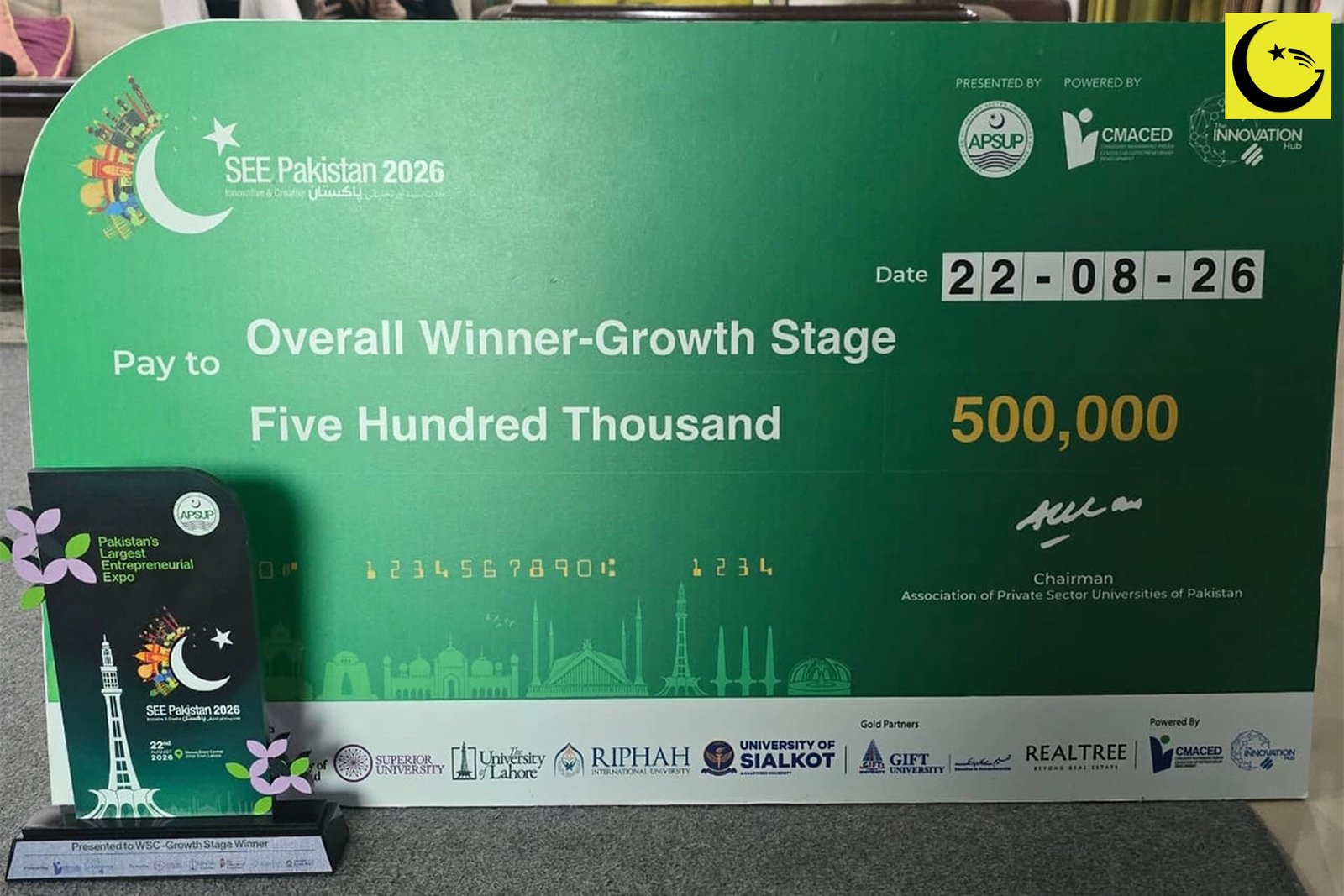
A university space team has taken the top growth stage honour at see pakistan 2026: the Space Research Center of the University of Central Punjab (SRC-UCP), incubated at the National Incubation Center for Aerospace Technologies (NICAT), won the overall growth stage award and a cash prize of Rs500,000 at the expo billed as Pakistan’s largest entrepreneurial expo. The win, reported on October 20, 2026, put a Lahore based space technology team ahead of a national field that began with more than 4,000 applicants, according to DealBeat’s reporting of the result.
The scale of the field is what makes the result stand out. The University of Central Punjab’s own announcement says the competition received around 4,000 applications nationwide and ran 17 regional rounds, from which the top 100 startups were selected for the final expo, and that SRC-UCP emerged as the overall winner at national level across six categories. The main event was held on August 22, 2026 at Expo Center, Lahore, and the oversized prize cheque photographed by the university is dated 22-08-26 and made out to the overall winner in the growth stage for five hundred thousand rupees.
See Pakistan 2026: A Long Road From 4,000 Applicants to the Top 100
Reaching the final of see pakistan 2026 meant surviving repeated filtering. Teams first competed in regional rounds, then the strongest 100 startups from across the country came together for the final expo in Lahore, where finalists competed across six categories. DealBeat reported that standing out in a process of that size required teams to succeed repeatedly, first in their own regions and then against the best ventures from other parts of Pakistan, working in very different sectors. SRC-UCP finished that run as the overall winner in the growth stage category, the track reserved for ventures that are already operating and growing rather than still at the idea stage.
That distinction matters for how the see pakistan 2026 award should be read. When applications opened for the World Startup Championship held under the see pakistan 2026 umbrella, the growth stage was described as being for startups that had been operating in the market for at least one year and had generated a minimum annual revenue of $5,000, while the separate ideation stage was aimed at students and early teams with a validated prototype. A growth stage title is therefore not a prize for a promising concept. It is a judgement that a working venture, with real activity behind it, held up against national competition.
Real Hardware, Real Signals and Real Data
What the judges saw from SRC-UCP was working technology, not slides alone. The university’s research office said the center was recognised for a practical and innovation driven approach built around real hardware, real signals, real data and real mission experience, and the achievement was shared by Dr Muhammad Kamran Saleem, Founder and Director of SRC-UCP. Reporting on the team’s own account of the final added detail: the presentation showed a hands on space technology education ecosystem, with systems already designed, developed, tested and operated locally, supported by live telemetry streams, radio frequency communication links, antennas, software and ground station infrastructure.
That working base is visible in the center’s public record. The Space Research Center’s own site at UCP showcases its Floating Satellite (FloatSAT) prototype, its CanSAT work described as a first step into space, and a CanSAT ground station, with Dr M. Kamran Saleem listed as Director. In other words, the see pakistan 2026 pitch rested on hardware the team could point to and operate, in a field where many competitors were selling software, services or consumer products. For a student and researcher led space team, demonstrating live signals and ground station capability at a general entrepreneurship expo is an unusual and memorable thing to put in front of judges.
The University and Aerospace Incubator Behind the Win
SRC is, first, a university research center: the Space Research Center of the University of Central Punjab in Lahore, whose students, research assistants, interns and collaborators the university credited for the result. At the same time, the team is incubated at NICAT, the National Incubation Center for Aerospace Technologies, which is why coverage of the same win describes it in two ways: DealBeat framed the winner as a team from NICAT, while UCP and other reports name it SRC-UCP. Both descriptions point to the same team, a university space research center developing inside Pakistan’s specialist aerospace incubator. Both identities were on display at see pakistan 2026.
The incubator’s backing helps explain the support structure around the team. NICAT describes itself as Pakistan’s national incubator for aerospace technologies, envisioned by the Ministry of Information Technology and Telecommunication, funded by Ignite National Technology Fund and led by NETSOL in partnership with NASTP, Air University and Pakistan Aeronautical Complex Kamra, and housed at NASTP Alpha in Rawalpindi. UCP’s research office also noted that SRC-UCP acknowledged the support of the Ministry of Planning, Development and Special Initiatives, the Prime Minister’s Innovation Support and Startup Grants, SUPARCO, RESOLVE and NICAT for their mentorship and technical guidance. NICAT, for its part, celebrated the see pakistan 2026 result and urged the team to keep pushing boundaries.
Why a Space Team Winning a General Startup Title Matters
Pakistan’s startup headlines are usually dominated by fintech, commerce and software, so a space research center taking the overall growth stage title at see pakistan 2026, the country’s largest entrepreneurial expo, sends a different signal: deep technology built in a university laboratory can compete with, and beat, hundreds of commercial ventures on a general stage. It also fits a wider pattern Good News Pakistan has been tracking, from a Lahore medtech winning the Pakistan final of the Startup World Cup 2026 to Pakistani firms showcasing at TechCrunch Disrupt 2026 and the growth behind Pakistan’s technology exports: local teams building specialised, exportable expertise rather than only consumer apps.
The Rs500,000 prize itself is modest next to venture funding, and no one should pretend otherwise. Its value lies in what it can fund at this stage, such as prototype development, pilot work and operating costs, and in the credibility a national title gives a young team in its next conversations with investors, customers and research partners. For SRC-UCP, the durable prize from see pakistan 2026 is the proof point: more than 4,000 applicants, 17 regional rounds, six categories and a top 100 final, and at the end of it, a Lahore space team holding the growth stage cheque.
Sources
- DealBeat: SRC From National Incubation Center for Aerospace Technologies Wins SEE Pakistan 2026 Growth Stage, October 20, 2026
- UrduPro: SRC-UCP Wins SEE Pakistan 2026, Space Research Center Takes Top Honour
- University of Central Punjab: SRC-UCP Top Spot at SEE Pakistan 2026
- ORIC, University of Central Punjab: SRC-UCP Secures Overall 1st Position at SEE Pakistan 2026
- NICAT: National Incubation Center for Aerospace Technologies, official site
- Space Research Center, University of Central Punjab (SRC-UCP), official site
- DealBeat: World Startup Championship 2026, SEE Pakistan Opens Applications for Startups (growth stage criteria)
- Superior University News: Registration Deadline for SEE Pakistan 2026 Extended to 15 June (main event, 22 August 2026, Expo Center, Lahore)
- Photo: University of Central Punjab (ORIC-UCP)

Umar is an engineer by profession and a passionate writer by passion. He has a deep interest in sharing good news related to Pakistan and has been working hard to promote the positive image of his homeland. Umar has written numerous articles on various topics related to Pakistan, such as technology, sports, culture, and economy.