

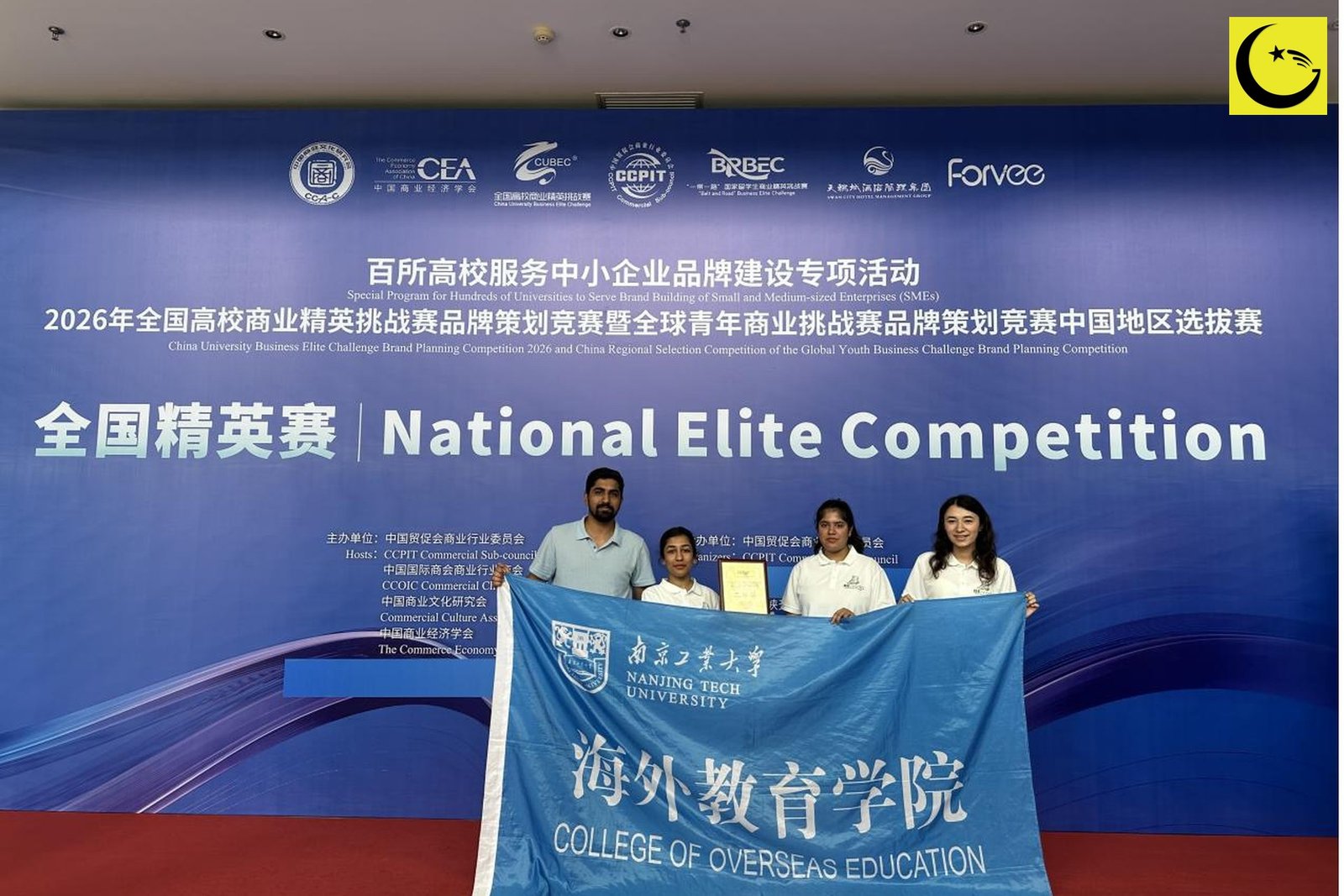
A team of Pakistani students at Nanjing Tech University in China has won second prize at the Belt and Road Business Elite Challenge, one of the largest student business competitions in the world, for a plan to bring affordable 3D-printed orthopedic products to patients in Pakistan.
The team, called BE-FLEX, brought together three Pakistani students from computer science, pharmacy and mechanical engineering programmes and a Tajik master’s student of business administration, supervised by their teacher Liu Yun. Their performance at the Belt and Road Business Elite Challenge (BRBEC) Brand Planning Competition finals in Sanmenxia, Henan province, earned them second prize in a field that drew more than 500 international students from 54 countries.
A Belt and Road Business Elite Challenge entry aimed at Pakistani patients
The team’s proposal was built around Basinlead, a Chinese company that specialises in digital orthopedic 3D printing. BE-FLEX designed a brand and market-entry plan for introducing the company’s products in Pakistan, focusing on two items that remain rare in the local market: 3D-customised foot insoles and back braces. The students pointed out that even where insoles are sold in Pakistan, none use the 3D TPU lattice structure that their proposal offers, a design that lets each insole be shaped to the patient’s own foot.
The need is real. Diabetes and orthopedic problems are widespread in Pakistan, and diabetic foot complications are a leading cause of disability, yet custom orthotic products are expensive or simply unavailable outside a few big-city clinics. A printed, made-to-measure product promises a cheaper and faster alternative. Pakistani team member Faria Rashid said the competition was an excellent opportunity to stimulate thinking, showcase the team’s ideas and exchange views with peers from around the world, and she noted that the core mission of the proposal was the well-being of people, a principle that guided the whole planning process.
Why 3D printing fits Pakistan’s orthopedic gap
Orthopedic and prosthetic care in Pakistan has historically depended on a thin network of specialist centres, such as the Pakistan Institute of Prosthetic and Orthotic Sciences in Peshawar and a small number of hospital workshops, many of them serving patients injured by accidents, disease or conflict. Traditional custom devices are made by hand, which makes them slow to produce and hard to afford for families outside the major cities. Digital manufacturing changes the economics: a foot can be scanned, the insole designed on a computer and printed to order, which cuts both the waiting time and the cost. Pakistan also carries one of the largest diabetic populations in the world, and foot care is one of the most neglected parts of diabetes management, so a business plan that starts with diabetic and orthopedic demand is aiming at a genuine and growing need. The judges at the finals evaluated entries on innovation, market strategy and practical application in global industries, and it was this combination of a real product, a real gap and a credible route to market that carried BE-FLEX to second prize.
A competition with serious scale
The Belt and Road Business Elite Challenge is organised by the Commercial Industry Committee of the China Council for the Promotion of International Trade, and it has been included in China’s National University Discipline Competition Ranking for five consecutive years, a marker of its standing. Judges at this year’s finals said the entries from international students studying in China showed innovative concepts closely aligned with global trends, with original thinking in brand building, localised operations and marketing strategy. Students from Indonesia, Malaysia, Thailand, Russia and Serbia were among those taking part alongside the Pakistani team.
The result adds to a growing list of achievements by Pakistani students in China, a community tens of thousands strong. We have previously covered their successes in our story on a Pakistani AI student winning the ‘River Messenger’ honour in China, the innovation in our report on Lahore medtech startup Byonyks winning the Pakistan final of the Startup World Cup, and the ideas on show in our coverage of YES-Pakistan 2026 at Bahria University.
For BE-FLEX, the prize is a plan on paper for now. But it is the kind of plan Pakistan’s health system genuinely needs, and its designers, a pharmacist, an engineer and a computer scientist working across two countries, are exactly the people to build it.
Sources
- Independent News Pakistan
- The Daily CPEC
- Gwadar Pro (original report)
- Photo: provided to Gwadar Pro

Umar is an engineer by profession and a passionate writer by passion. He has a deep interest in sharing good news related to Pakistan and has been working hard to promote the positive image of his homeland. Umar has written numerous articles on various topics related to Pakistan, such as technology, sports, culture, and economy.