


Pakistan’s highest-ranked university has held its place among the best in the world. The Quaid-i-Azam University QS ranking for 2027 places the Islamabad institution at 381st in the world, making it the No. 1 university in Pakistan in the QS World University Rankings 2027, a table that assesses more than 1,500 universities across the globe.
Quaid-i-Azam University (QAU) is joined in the world top 400 by the National University of Sciences and Technology (NUST) at 384th, and 18 Pakistani universities appear in the full QS list, a sign of how far the country’s research sector has come. For students and families choosing where to study, the Quaid-i-Azam University QS ranking is the clearest international benchmark Pakistan has, and QAU continues to lead it.
The Quaid-i-Azam University QS ranking and the full Pakistani list
The QS World University Rankings 2027, published by the British education company Quacquarelli Symonds, placed Pakistani institutions as follows:
- Quaid-i-Azam University, Islamabad: 381
- National University of Sciences and Technology (NUST), Islamabad: 384
- Pakistan Institute of Engineering and Applied Sciences (PIEAS), Islamabad: 560
- University of the Punjab, Lahore: 588
- Lahore University of Management Sciences (LUMS): 608
- University of Agriculture, Faisalabad: 629
- COMSATS University Islamabad: 639
- Government College University, Faisalabad: 691
- University of Engineering and Technology (UET), Lahore: 791 to 800 band
- Aga Khan University and the University of Peshawar: 951 to 1,000 band
PIEAS recorded one of the biggest climbs by a Pakistani institution, rising from the 721 to 730 band in the previous edition to 560th. In the 2026 edition of the table, QAU stood at 354th and NUST at 371st; both moved down a few places in 2027 as the list grew larger and more competitive, yet both defended a position inside the world’s top 400, where only a small fraction of the world’s universities sit.
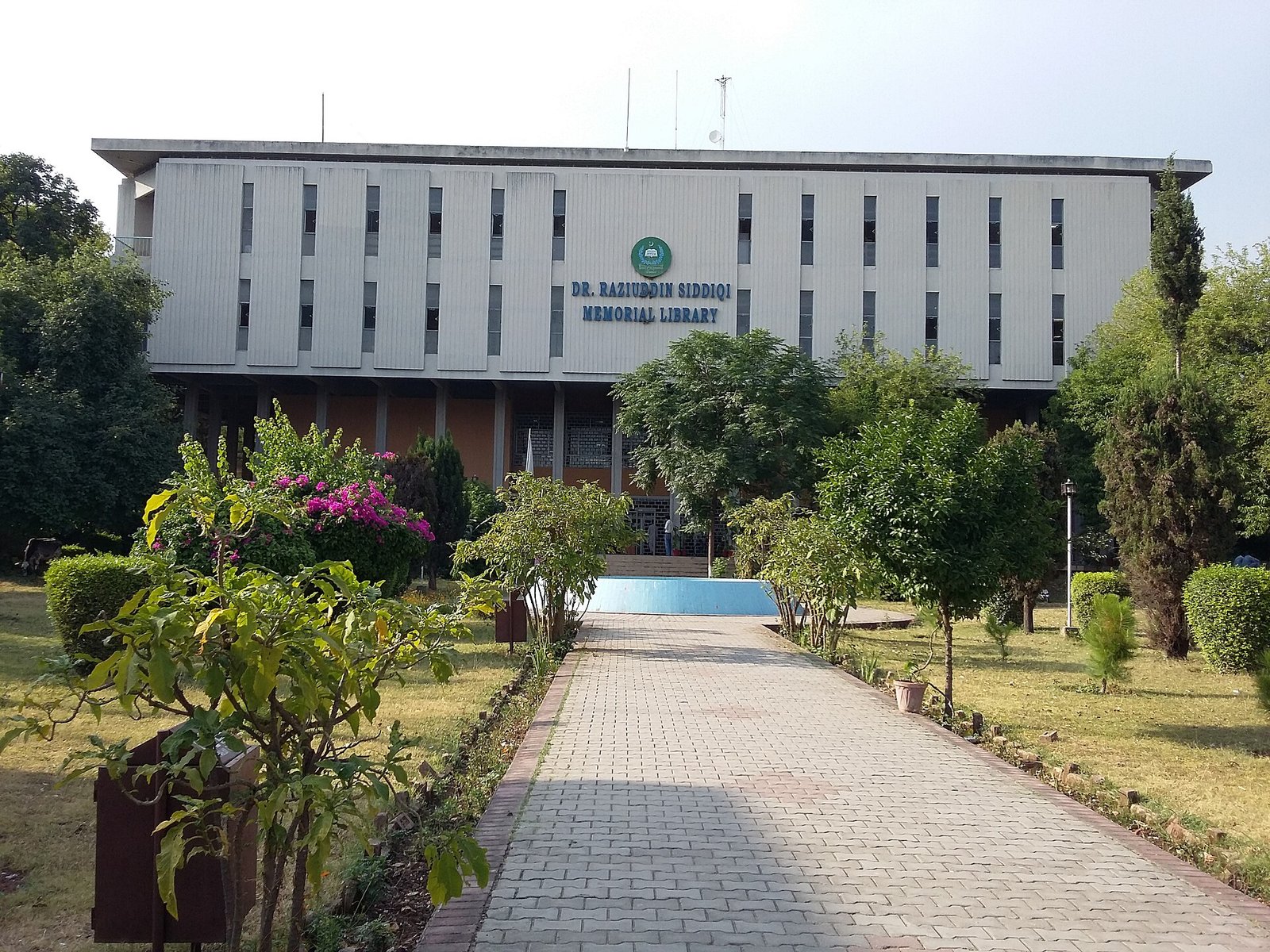
The Central Library at Quaid-i-Azam University, Islamabad. Photo: Izharkasi, CC BY-SA 4.0, via Wikimedia Commons
What the QS rankings actually measure
QS scores universities on the strength and reach of their research and teaching. The largest share of the score comes from academic reputation, gathered from a global survey of scholars, and from citations per faculty member, which measures how often a university’s research is used by other scientists around the world. Employer reputation, the ratio of students to faculty, international research partnerships, the mix of international students and staff, employment outcomes for graduates, and sustainability complete the picture.
That mix rewards universities whose work is read, cited and trusted internationally. It is the area where QAU has built its reputation over decades: a research-first public university whose papers in the natural sciences, mathematics and social sciences travel far beyond Pakistan. One recent analysis of the QS data, published in the Pakistan Journal of Medical Sciences, counted around 27,000 research articles and some 785,000 citations attached to QAU, the deepest research footprint of any university in the country.
A research university at the foot of the Margalla Hills
QAU was founded in 1967 as the University of Islamabad and later renamed in honour of Quaid-i-Azam Muhammad Ali Jinnah. Set against the Margalla Hills in the capital, it began as a postgraduate institution and grew into a comprehensive university teaching everything from physics and biological sciences to economics, international relations and computer science.
Its location in the capital, close to national research institutes and government laboratories, has helped it attract scholars and build the citation record that global rankings reward. Generations of Pakistani scientists, civil servants and academics passed through its departments, and its alumni teach and research at universities across the world.
Why a top 400 place matters for Pakistan
Rankings are not the whole story of a university, but they shape real decisions. International students use them to shortlist destinations, foreign universities use them when choosing partners for joint degrees and research, and employers use them as a quick signal of quality. Every year that Pakistani names hold places in the top 400, those doors open a little wider for Pakistani graduates.
The wider list matters too. Eighteen Pakistani universities in the QS table, from Faisalabad’s agriculture specialists to Karachi and Peshawar institutions in the top 1,000, show that the improvement is not confined to one campus in the capital. The challenge now is to push more of them upward, through research funding, international collaboration and the citation impact that QS rewards most.
Pakistani students keep proving the talent is there, from the Pakistani AI student honoured as a River Messenger in China to the hundreds of startup ideas showcased at YES-Pakistan 2026 at Bahria University and the medical innovation behind Byonyks winning the Pakistan final of the Startup World Cup. With universities climbing beside them, the next generation has stronger platforms to stand on.
Sources
- QS TopUniversities, Quaid-i-Azam University profile and QS World University Rankings 2027: topuniversities.com
- Pakistan Journal of Medical Sciences (July 2026), analysis of Pakistani universities in the QS World University Rankings: pjms.org.pk
- Photo: the Central Library at Quaid-i-Azam University, by Izharkasi, CC BY-SA 4.0, via Wikimedia Commons

Umar is an engineer by profession and a passionate writer by passion. He has a deep interest in sharing good news related to Pakistan and has been working hard to promote the positive image of his homeland. Umar has written numerous articles on various topics related to Pakistan, such as technology, sports, culture, and economy.