

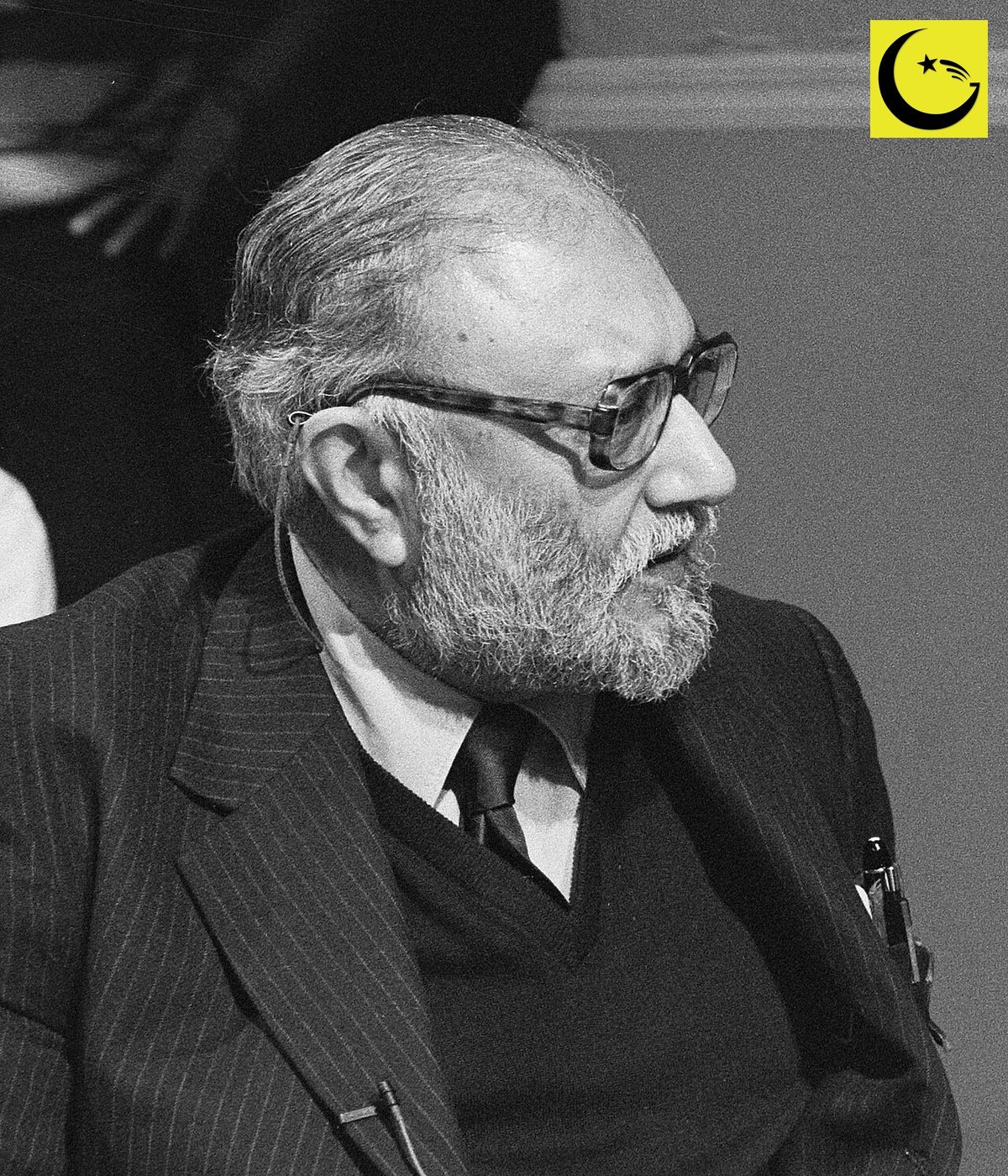
In 1979, a physicist from a small Punjab town did something no Pakistani had ever done. The Abdus Salam Nobel Prize, awarded in Stockholm that year, made him the first Pakistani to win a Nobel Prize and the first Muslim scientist to receive one, an honour he shared for work that changed how science understands the basic forces of nature.
Salam shared the 1979 Nobel Prize in Physics with the American scientists Sheldon Glashow and Steven Weinberg. The prize recognised their combined work on the theory that unified two of nature’s fundamental forces, electromagnetism and the weak nuclear force, into a single electroweak theory. Nearly half a century later, the Abdus Salam Nobel Prize remains the only Nobel awarded for work by a Pakistani scientist, and it anchors Pakistan’s place in the history of world science.
A boy from Jhang who loved mathematics
Abdus Salam was born on 29 January 1926 in Jhang, in what is now Pakistan’s Punjab province. He was a standout student from childhood, winning scholarships that took him to Government College Lahore and then to St John’s College, Cambridge. At Cambridge he achieved the rare feat of double first-class honours, in mathematics and in physics, before completing his doctorate in theoretical physics.
In 1951, with his career in Britain open before him, Salam chose to come home. He taught at Government College Lahore and headed the mathematics department at the University of the Punjab, determined to build science in the young country. The research infrastructure he hoped for barely existed, and in 1954 he returned to Cambridge and then to Imperial College London, where he became a professor of theoretical physics in 1957 and built one of the world’s leading theory groups. Pakistan, however, was never far from his desk.
The work behind the Abdus Salam Nobel Prize
The question Salam, Glashow and Weinberg answered was one of the deepest in physics. Electromagnetism, the force behind light and electricity, and the weak force, which drives certain forms of radioactivity, appear completely different in everyday life. Their electroweak theory showed that the two are really one force, seen at different energies, and it predicted new particles and a phenomenon called weak neutral currents.
Experiments at CERN in Geneva went on to confirm those predictions, including the discovery of the W and Z particles in 1983, and the theory became a cornerstone of the Standard Model, the framework that still organises everything science knows about particles and forces. The Nobel Committee’s citation praised the laureates for their contributions to the theory of the unified weak and electromagnetic interaction between elementary particles, including the prediction of the weak neutral current.
Building science back home
Alongside his research, Salam served Pakistan directly. He was the government’s chief scientific adviser from 1960 to 1974, the founding chairman of the Pakistan Atomic Energy Commission in 1958, and in 1961 he founded the Space and Upper Atmosphere Research Commission (SUPARCO), Pakistan’s space agency, arguing that a developing country had to reach for modern science or be left behind.
He advised presidents, set up research institutes and pushed for science education, all while producing the research that would win the Nobel Prize. Few scientists anywhere have carried a national science programme and a world-leading research career at the same time.
The ICTP: his gift to the world’s scientists
Salam knew from experience what it meant to be a gifted physicist far from the centres of research: the isolation, the missing journals, the conferences on another continent. His answer was the International Centre for Theoretical Physics (ICTP), which he founded in Trieste, Italy, in 1964 with the support of the International Atomic Energy Agency, UNESCO and the Italian government.
The ICTP let scientists from developing countries spend part of each year working alongside the world’s best, through its famous Associateships, then return home refreshed instead of emigrating for good. Salam directed the centre until 1993, and after his death it was renamed the Abdus Salam International Centre for Theoretical Physics in his honour. It has trained and hosted tens of thousands of scientists from more than 100 countries, and it remains the clearest physical monument to his belief that science is the common heritage of humankind.
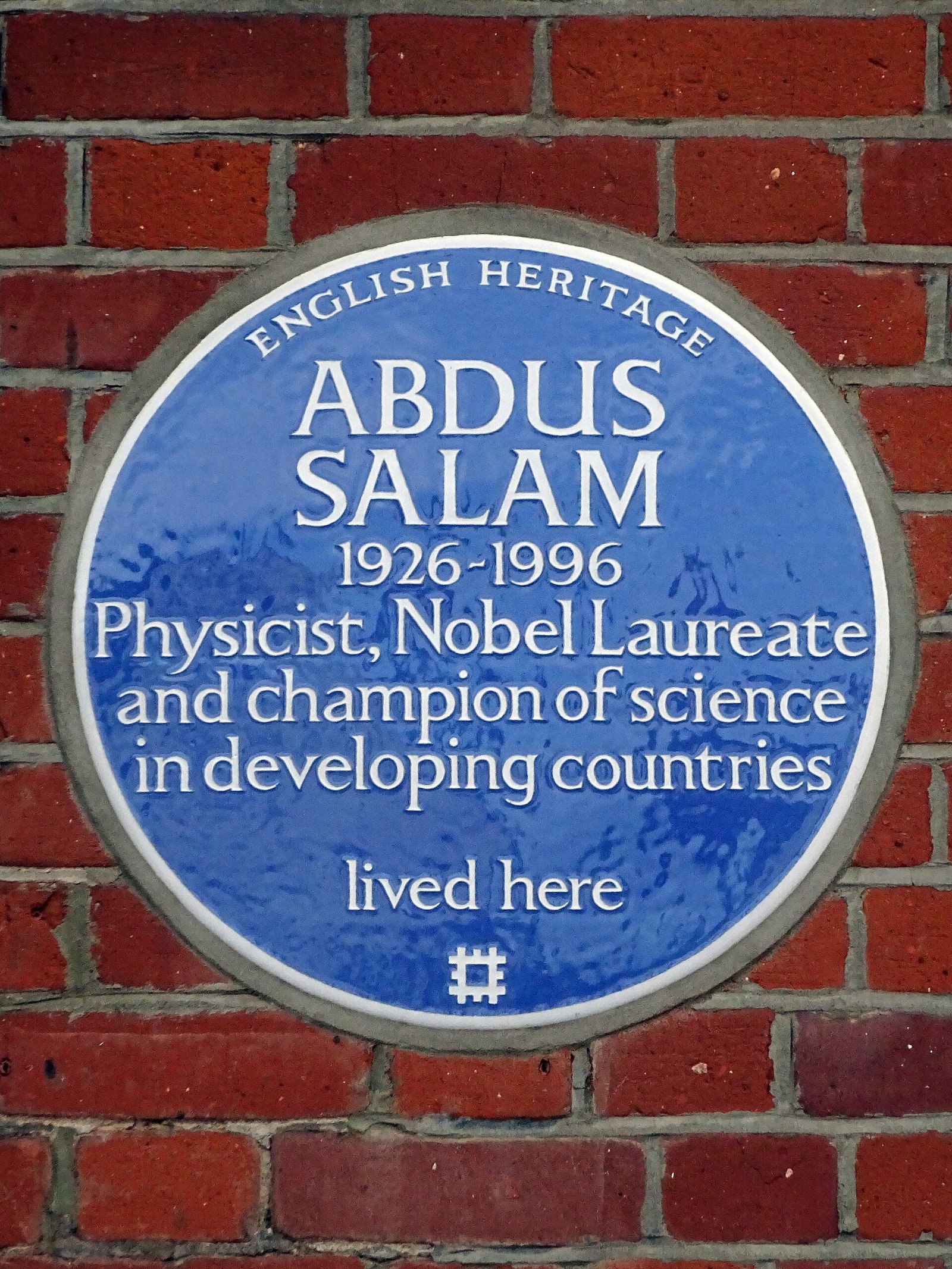
A blue plaque in Putney, London, marks the house where Abdus Salam lived. Photo: Spudgun67, CC BY-SA 4.0, via Wikimedia Commons
A legacy that still leads the way
Abdus Salam died in Oxford on 21 November 1996. By then he had collected the world’s highest scientific honours, and his name was attached to institutes, prizes and a generation of physicists across Asia, Africa and Latin America who had passed through Trieste. In Pakistan, the boy from Jhang who topped every examination he touched is still the standard against which scientific ambition is measured.
His story is retold whenever Pakistanis reach the top of world science and learning, from the honours won by a Pakistani-origin surgeon who received a Pride of Britain lifetime achievement award to a Lahore student who topped the world in IGCSE English and a Pakistani student honoured in China for an AI river-cleaning project. The Abdus Salam Nobel Prize showed, decades before any of them, exactly how far a Pakistani mind could go.
Sources
- Nobel Prize, Abdus Salam biographical entry: nobelprize.org
- Abdus Salam International Centre for Theoretical Physics (ICTP), Spirit of Abdus Salam Award: ictp.it
- Imperial College London, Professor Abdus Salam, Nobel Prize in Physics 1979: imperial.ac.uk
- Photo: the blue plaque at Abdus Salam’s former London home, by Spudgun67, CC BY-SA 4.0, via Wikimedia Commons

Umar is an engineer by profession and a passionate writer by passion. He has a deep interest in sharing good news related to Pakistan and has been working hard to promote the positive image of his homeland. Umar has written numerous articles on various topics related to Pakistan, such as technology, sports, culture, and economy.