

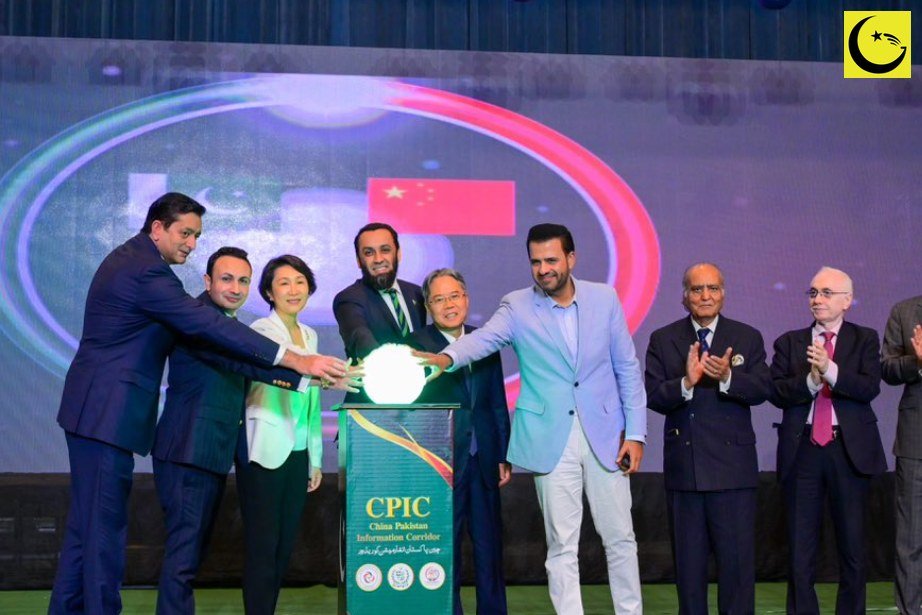
Pakistan and China have launched the China-Pakistan Information Corridor (CPIC), a new platform designed to deepen media cooperation, speed up the exchange of verified news and bring the people of the two countries closer, as they celebrate 75 years of diplomatic relations. The corridor was unveiled at a ceremony in Islamabad organised by the Ministry of Information and Broadcasting, where Information Minister Attaullah Tarar called it the next chapter of a partnership so far built on roads, power plants and ports under the China-Pakistan Economic Corridor (CPEC). Chinese Foreign Ministry spokesperson Mao Ning was the chief guest, and Chinese Ambassador to Pakistan Jiang Zaidong also attended.
The China-Pakistan Information Corridor: connecting minds, not just lands
Explaining the idea behind the launch, Atta Tarar said the initiative extends cooperation beyond physical infrastructure into information sharing, digital platforms, research, business, culture and youth engagement. “The first phase connected our lands; the next phase will connect our minds,” he said, describing the corridor as a bridge between the peoples of Pakistan and China. A formal secretariat has been established to run the corridor and support the exchange of information, ideas and perspectives between the two countries.
The launch coincided with the third round of the Pakistan-China Spokespersons’ Dialogue, led by Foreign Office spokesperson Sajjad Haider Khan and his Chinese counterpart Mao Ning, where both sides committed to closer coordination and regular consultations. Mao Ning said the relationship had grown beyond friendship into a strong strategic partnership, and she identified fake news and misinformation as major challenges in today’s information environment. Drawing a comparison with the Karakoram Highway, she described the corridor as part of an effort to build a digital highway between the two countries.
Four pillars, from newsrooms to universities
The China-Pakistan Information Corridor rests on four pillars: media; business and enterprise; think tanks; and culture, tourism and youth. Under the media pillar, a news exchange working group of 18 Pakistani and Chinese media organisations is already sharing verified news about bilateral cooperation. Its members include state broadcasters, private television channels and Chinese outlets such as Xinhua, China Media Group and People’s Daily. A dedicated fact-checking mechanism will track misleading narratives and respond to them with concrete facts, while the corridor will also work through trade portals, podcasts, social media channels and youth ambassadors.
The business and enterprise pillar has opened its first regional office in Karachi and is developing a trade portal to track trade, investment and foreign direct investment between the two countries. A podcast series is also in development to tell the stories of Chinese entrepreneurs working in Pakistan and Pakistani entrepreneurs working in China. The think tank pillar, led by the Pakistan-China Institute and involving leading research institutions, will promote joint dialogue, research and publications with Chinese counterparts.
Tarar called the fourth pillar, covering culture, tourism and youth, the heart of the corridor. Work is under way on a Xinjiang-Gilgit-Baltistan tourism corridor that would extend the journeys of Chinese travellers into the valleys of northern Pakistan, and a Pakistan-China friendship rally will be held during the anniversary year. The first cohort of CPEC youth ambassadors has been nominated from 13 universities across Pakistan, from Gilgit to Quetta and from Peshawar to Karachi, continuing a pattern of young Pakistanis engaging directly with China, much like the Pakistani students who won second prize at a Belt and Road business challenge in China.
What the corridor adds to CPEC
The corridor arrives as CPEC moves into its second phase. The first phase powered homes that once sat in darkness, laid highways across Pakistan’s provinces and opened a gateway to the world through Gwadar, alongside projects such as the 179 electric buses Pakistan received from China at Karachi Port and the first direct fibre-optic cable linking the two countries through the Khunjerab Pass. Prime Minister Shehbaz Sharif and President Xi Jinping have given the next phase a broader horizon of growth, livelihoods, innovation, green development and openness, and the information corridor is meant to give that phase a human connection.
Technology and young people sit at the centre of that plan. More than 68 per cent of Pakistan’s population is under 30, and Tarar argued that countries now have to tell their own stories in the digital space: “A nation that cannot tell its own story in the digital space will have its story told for it.” Pakistan’s digital ambitions have already drawn international notice, including the country being named Tech Destination of the Year at GITEX Global 2024 in Dubai. Through the corridor, Pakistani students are expected to learn more about contemporary China, while Chinese families see Pakistan as a warm and resilient country full of potential.
The launch ceremony closed with traditional cultural performances by Pakistani and Chinese artists. Ambassador Jiang Zaidong used his address to call for practical cooperation that delivers results for the people of both countries, while Tarar summed up the promise of the China-Pakistan Information Corridor as an initiative that would respond to falsehoods with facts, isolation with exchange and suspicion with trust. Where the Karakoram Highway was built of rock and carried on trucks, he said, this new highway is built of truth and carried through voices, taking the story of Pakistan-China friendship into homes in every language.
Sources
- Centreline (DNA News Agency): Atta Tarar says the corridor will deepen media cooperation
- The Daily CPEC: Information Corridor launched under CPEC 2.0
- CPEC Info: Information Corridor launched in Islamabad
- Photo: CPIC launch ceremony in Islamabad, via CPEC Info

Umar is an engineer by profession and a passionate writer by passion. He has a deep interest in sharing good news related to Pakistan and has been working hard to promote the positive image of his homeland. Umar has written numerous articles on various topics related to Pakistan, such as technology, sports, culture, and economy.