

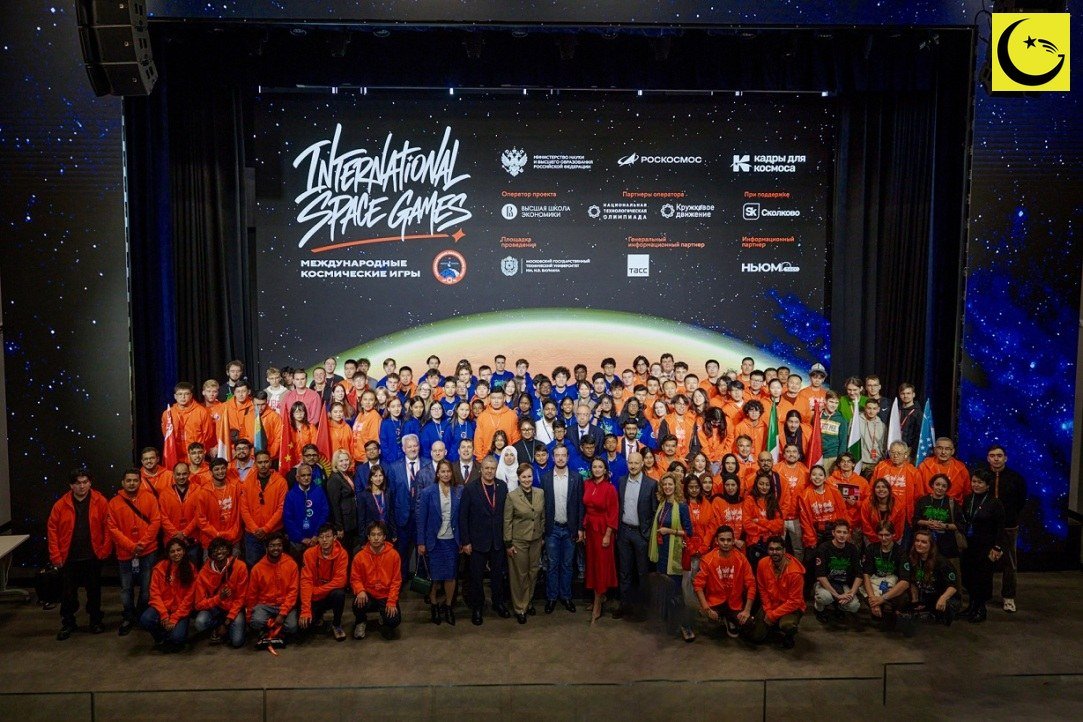
A Pakistan International Space Games team led by the Institute of Space Technology is competing in Moscow this week, joining teams from eight countries for hands on challenges in space engineering, robotics, artificial intelligence and mission operations at the first edition of the event, which runs from October 26 to November 1, 2026.
The Associated Press of Pakistan reported on October 28 that the delegation had begun its activities after the opening ceremony, including an immersive Mars habitat experience. The Pakistani crew is among the first groups to enter the simulation.
Pakistan International Space Games Team Takes Part in First Mars Mission Round
According to HSE University, the operator of the Games, the first mission began on October 27, with four national teams taking part in the first round: Pakistan, Mexico, Uzbekistan and Russia. For 48 hours, each crew operates in fully autonomous mode, tackling engineering tasks and technological challenges prepared by the organisers.
After that first round, the teams hand over their tasks to young engineers from China, India, Kazakhstan and Kyrgyzstan. HSE says the Games bring together more than 250 participants, including students and early career lecturers, and that the overall aim is cooperation as much as competition: to keep an autonomous settlement on another planet running sustainably, a task that can only be achieved through the joint efforts of different national teams.
Inside the Mars Habitat Simulation at Skolkovo
During the Games, crews live and work in specially equipped Martian research stations built for the event at the Skolkovo Innovation Centre, which is supporting the project. The Mission Control Centre is hosted at Bauman Moscow State Technical University and serves as the sole means of communication with Earth for the teams at the stations.
HSE University, which initiated the project, says participants face engineering challenges in several fields, from energy to artificial intelligence, and that each team member has a particular specialisation. The APP report lists the same broad areas for the Pakistani delegation: practical space engineering, mission operations, robotics and AI, alongside the Mars habitat work.
The format is close to a real mission. Crews must manage daily operations, respond to technical problems, and keep systems running without outside help during the autonomous period.
Meet the 11 Member Pakistani Team
The Pakistani team named in the APP report comprises 11 people, led by Dr Rehan Mahmood. The full list is:
- Dr Rehan Mahmood
- Maheen Zulfiqar
- Mohammad Daniyal Hasnain
- Talha Zubair
- Humail Amir Nawaz
- Syeda Maryam Murtaza Naqvi
- Ayesha Jamil
- Fakhar Arooj
- Alishba Tanveer
- Maheera Fatima
- Hafiz Muhammad Abdullah
Dr Mahmood is an Associate Professor at the Institute of Space Technology in Islamabad and Director of its Small Satellite Technology and Research Lab. His work has focused on CubeSats, satellite communications and space education, and he was one of the principal investigators for Pakistan’s lunar CubeSat mission.
Coverage of Pakistani students and scholars shows the same pattern across fields: practical projects often open doors that lectures alone cannot.
Why IST Brings Real Mission Experience to Moscow
The Institute of Space Technology is Pakistan’s specialist university for space science and engineering, based in Islamabad. It launched Pakistan’s first CubeSat, ICUBE-1, in November 2013, and it designed and developed ICUBE-Q, Pakistan’s first lunar mission, in collaboration with SUPARCO and Shanghai Jiao Tong University.
ICUBE-Q was launched on May 3, 2024, aboard China’s Chang’e-6 mission and deployed into lunar orbit, carrying two cameras to image the lunar surface. Around 100 IST students contributed to that project.
The habitat challenges draw on the same skills as a CubeSat programme: power, communications, data handling and fault response. It also connects with other Pakistani science stories, from the story of Abdul Raffay Paracha to COMSATS interdisciplinary science coverage.
How the Games Are Organised
The Pakistan International Space Games appearance is part of a wider programme coordinated by the Russian Ministry of Science and Higher Education and the Roscosmos State Corporation, as part of the Personnel for Space federal project within the Space national project. HSE University is the initiator and operator.
Alongside the main national team missions, the week includes:
- Orbita, an international space tournament for school and university students using educational satellite kits
- The Autonomous Systems League, called Dome, where students design a human agent control system for an autonomous station
- Daily video reports from the missions and an educational programme for online viewers
- A closing press conference at the end of the week to discuss outcomes
For the organisers, the point is training future space personnel through practice rather than theory alone.
What the Team Can Bring Home
The Games continue until November 1, so the final outcomes are still to come. Even before any closing assessment, the value for the Pakistani participants is clear: a full autonomous mission cycle, contact with peers from seven other countries, and experience of working through a Mission Control structure that mirrors real operations.
Skills practised in the habitat transfer directly to work at home, in university labs, satellite projects and robotics and AI research.
For Pakistan, the presence in Moscow also signals steady engagement in international space education. The Pakistan International Space Games story is not about a single trophy. It is about a group of young engineers and their mentor being trusted to run a Mars station for 48 hours, and learning how to keep it alive.
Sources
- Associated Press of Pakistan via Tez Khabar: IST led team participates in the Games in Moscow, October 28, 2026
- HSE University: From Moscow to Mars, First Games Get Under Way, October 26, 2026
- HSE University: Games to Bring Together Students from around the World, October 22, 2026
- Institute of Space Technology, Islamabad, official website
- Photo: International Games Organising Committee, via HSE University

Umar is an engineer by profession and a passionate writer by passion. He has a deep interest in sharing good news related to Pakistan and has been working hard to promote the positive image of his homeland. Umar has written numerous articles on various topics related to Pakistan, such as technology, sports, culture, and economy.