

Pakistan won its first Olympiad gold medal in July 2025, when Abdul Raffay Paracha, a student of Siddique Public School in Rawalpindi, took gold at the 36th International Biology Olympiad in Quezon City, the Philippines. After nearly two decades of silvers and bronzes at the world’s science Olympiads, the first Olympiad gold medal in the country’s history finally arrived, and it came in biology, against the best school students from more than 70 nations.
The Week in Quezon City
The International Biology Olympiad, held from 20 to 27 July 2025, is the world championship of school biology. Each country sends up to four students, chosen through national competitions, and the week mixes gruelling theoretical papers with practical laboratory examinations in subjects such as biochemistry, genetics, plant and animal anatomy and bioinformatics. Medals are awarded by score bands rather than podium places: roughly the top tenth of the field receives gold, the next fifth silver and the next third bronze, which means a gold medallist has outperformed hundreds of the strongest young biologists on earth in the same week, across both the theory papers and the laboratory benches.
Paracha’s gold was announced by the STEM Careers Programme, the joint initiative of the Higher Education Commission and the Pakistan Institute of Engineering and Applied Sciences that selects and trains Pakistan’s Olympiad teams. On his return, he was received by HEC Chairman Dr Mukhtar Ahmed, who congratulated him and urged students across the country to pursue scientific excellence. His mentor Osman Siddique, who has coached Olympiad students for years, wrote that he had thought he would never see the day, and that Paracha had defied all odds to become Pakistan’s first gold medallist in more than 20 years of Olympiads.
Paracha himself sounded almost surprised. In television interviews after his return he said he had never particularly expected that he would be the one to make history, and that when a person travels to such an event they do not assume the honour will be theirs. What he did trust, he said, was his preparation, which had gone well, and the feeling on winning was one of pride. It is a modest account of an immodest result: of the four students Pakistan sent to Quezon City, and the hundreds who competed from around the world, the Rawalpindi schoolboy finished in the gold band at his first attempt at the senior event, having already represented Pakistan at international level before.
A First Olympiad Gold Medal, 19 Years in the Making
The scale of the wait explains the emotion. The STEM Careers Programme says Pakistan has won 140 medals at the international science Olympiads since 2001, and more than 4,500 students have been trained through the programme. Pakistan has competed at the Biology Olympiad since 2006. In all that time, across physics, chemistry, mathematics and biology, the country’s students had collected silver and bronze medals by the dozen, but never a gold.
The near misses were getting closer. At the 2024 Biology Olympiad in Astana, Kazakhstan, Pakistan won two bronze medals through Zoha Asif of Nixor College, Karachi and Soban Safdar of FFC Grammar School, Mirpur Mathelo. The same summer brought a silver and a bronze at the Mathematics Olympiad in Bath, three bronzes at the Physics Olympiad in Isfahan, and a bronze at the Chemistry Olympiad in Riyadh. The pipeline was plainly producing world-class students in every science, a strength also visible in results like the nine global ACCA prizewinners Pakistan produced in a single session. What it had never produced was a champion. Paracha’s week in Quezon City changed that, and the achievement now sits on our Pakistan world rankings and records page alongside the country’s other global firsts.
How a Pakistani Student Reaches the Olympiad
Nobody is simply picked. The route begins with the National Science Talent Contest, which invites students from Matric, O Levels, FSc and A Levels to sit screening tests in physics, chemistry, mathematics and biology. The top performers, around 50 in each subject, are called to training camps run with the home institutes, where university teachers coach them through past Olympiad problems and laboratory work. The programme runs both online and in-person training for those top 50 students in each subject, and has brought in an international trainer to raise standards further, because the gap between school examinations in Pakistan and an Olympiad paper is wide: the questions assume a student can design an experiment, not just recall one. The final teams of four are chosen from those camps, and the standard is deliberately set at undergraduate level: an Olympiad practical can ask a school student to dissect, pipette and analyse like a researcher.
That structure matters for how this gold should be read. It was not a lone genius appearing from nowhere. It was the top step of a ladder that thousands of Pakistani students climb every year, most of them in ordinary public and private schools far from any elite laboratory. Paracha’s own school, Siddique Public School, is in Rawalpindi, and his success has already been used by the programme to recruit the next cohort: the contest’s call for the July 2026 Olympiads is open to exactly the classes he sat in two years ago. Stories like his, collected on our Pakistani students and scholars page, are the programme’s best advertisement.
One Detail Worth Getting Right: It Was the 36th Olympiad
Many Pakistani reports of the win described the event as the 35th International Biology Olympiad. The official record says otherwise. The Olympiad began in 1990, and the reports of other competing countries, including the United Kingdom, Türkiye and Taiwan, all describe the Quezon City event as the 36th edition. The distinction sounds small, but records are the point of a story like this one: Abdul Raffay Paracha is Pakistan’s first gold medallist, and he won it at the 36th International Biology Olympiad.
What the Gold Opens Up
A first gold changes what the next generation believes is possible. Coaches can now point to a Pakistani name at the top of the results list when a talented 15-year-old wonders whether the training camps are worth the effort. Universities abroad read Olympiad results closely, and a gold medal is among the strongest signals a school student can send. For the programme itself, the result strengthens the case for the patient funding that produced it: 140 medals over two decades, built one training camp at a time.
The reach of the result said plenty. The Associated Press of Pakistan carried the win on the day the medals were announced, and television channels that rarely cover school science gave the Rawalpindi student extended interviews on his return, a sign of how deeply a first gold registered beyond education circles.
The honest summary is that Pakistan’s science students were never short of talent. They were short of a gold medal to prove it. In Quezon City, Abdul Raffay Paracha supplied the proof.
Sources
- STEM Careers Programme: Paracha wins gold at the International Biology Olympiad, Philippines, 20 to 27 July 2025
- Pakistan TV: Pakistan’s scientific breakout year, on Paracha’s gold and the STEM pipeline
- UK Biology Competitions: Success at the 36th International Biology Olympiad 2025, Quezon City
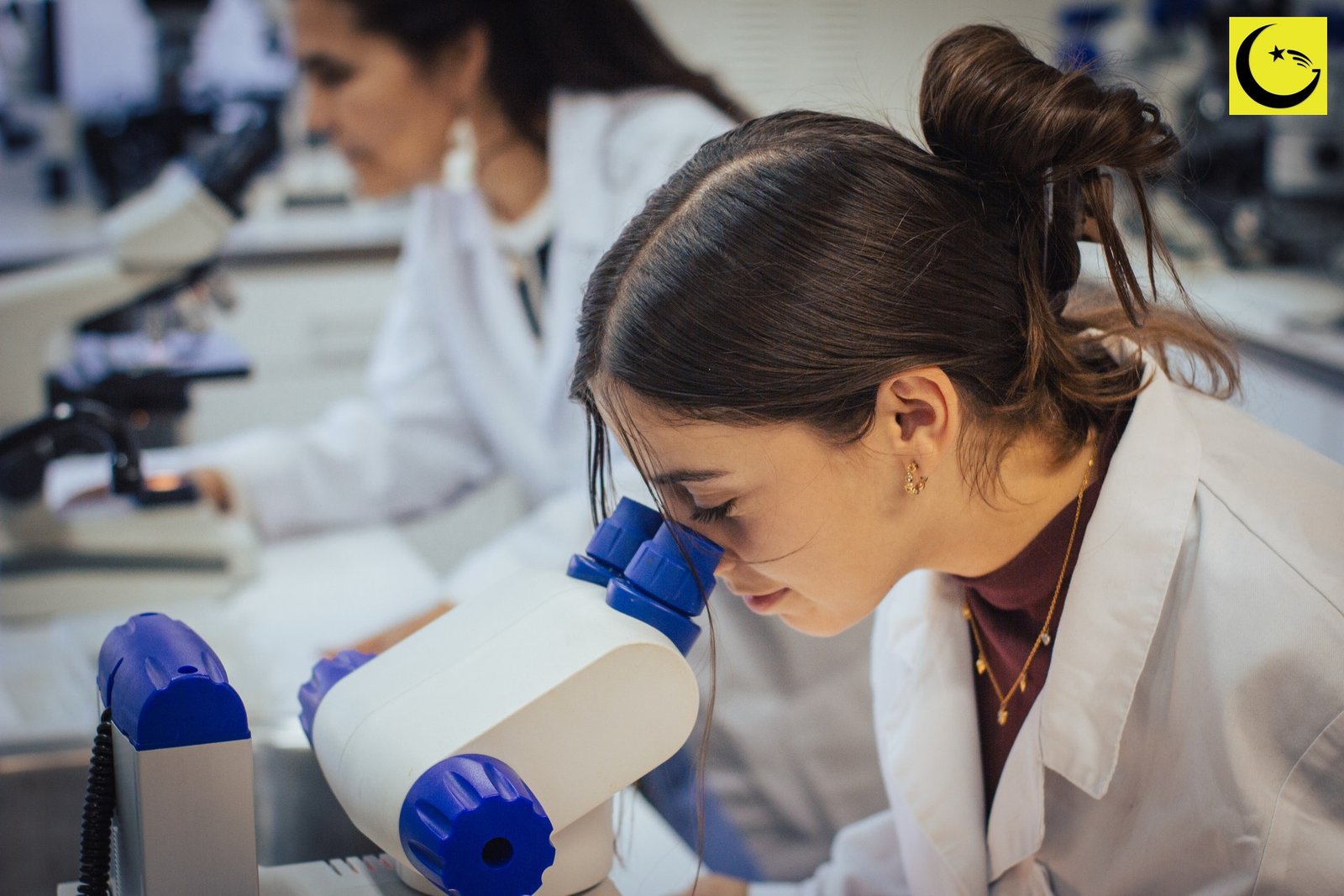
- Photo: A student examines a specimen under a stereo microscope, the kind of practical test set at the Biology Olympiad (Photo: Rmmramos via Wikimedia Commons, CC BY-SA 4.0)

Umar is an engineer by profession and a passionate writer by passion. He has a deep interest in sharing good news related to Pakistan and has been working hard to promote the positive image of his homeland. Umar has written numerous articles on various topics related to Pakistan, such as technology, sports, culture, and economy.