

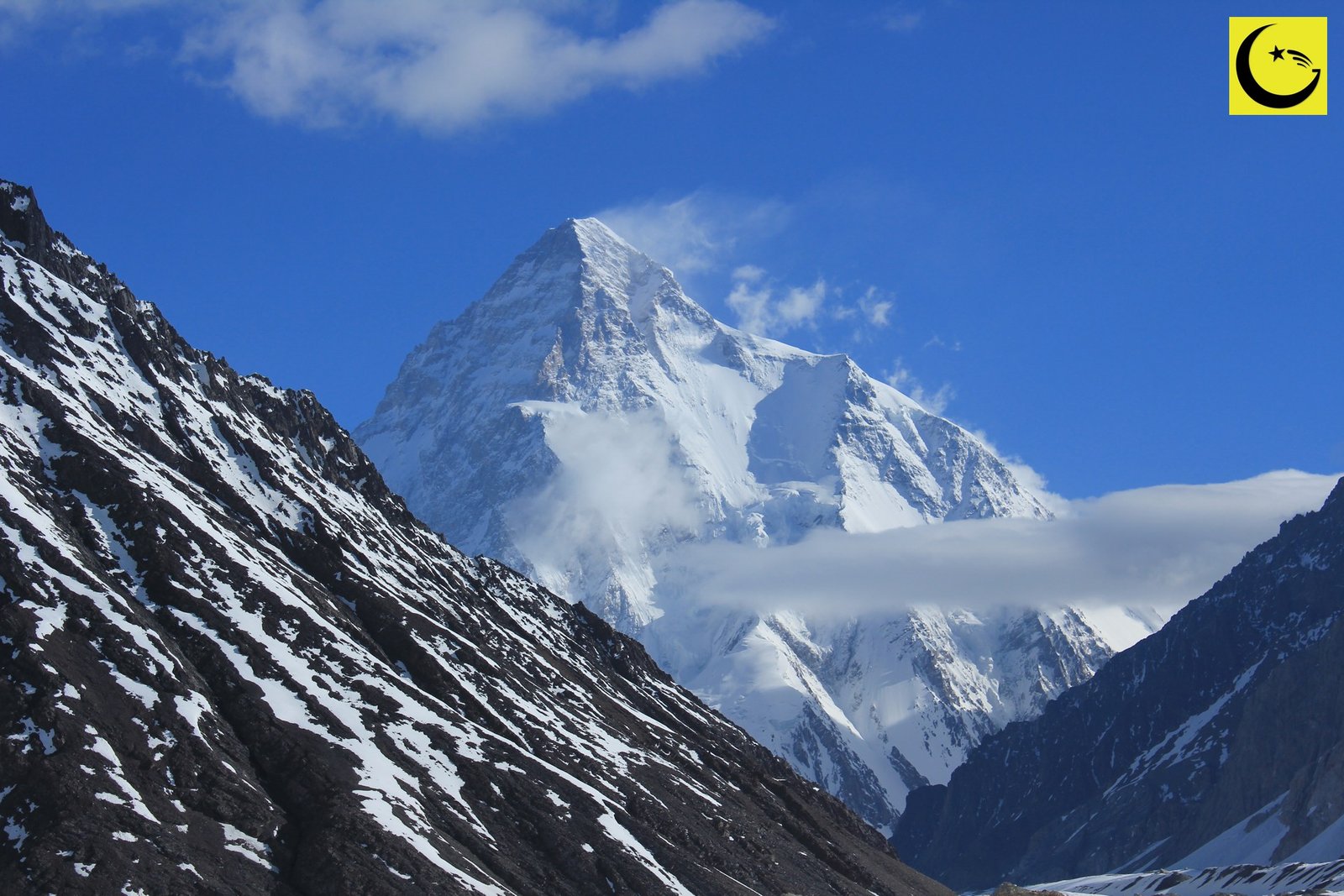
The second highest mountain in the world is not in Nepal. K2 rises 8,611 metres out of the Karakoram range in Gilgit-Baltistan, on Pakistan’s border with China, and among climbers it carries a reputation no other peak can match: the hardest mountain on Earth to climb. This article opens our Pakistan Facts series, a daily collection of true and timeless facts about Pakistan and Pakistanis, and it starts, fittingly, at the very top of the country.
In this article:
- K2 by the numbers
- Why the second highest mountain in the world is the hardest to climb
- The road to K2 runs through Pakistan
- One country, five giants
- What K2 means for Pakistan
K2 by the Numbers
- Height: 8,611 metres (28,251 feet), the second highest mountain in the world after Mount Everest, which stands about 8,849 metres.
- Where: the Karakoram range, on the border between Pakistan’s Gilgit-Baltistan region and China’s Xinjiang.
- The name: K2 was a surveyor’s label from the 1850s, marking the second peak measured in the Karakoram. In the local Balti language the mountain is Chhogori, which means great mountain, and it is also known as Mount Godwin-Austen.
- First climbed: 31 July 1954, by Achille Compagnoni and Lino Lacedelli, members of an Italian expedition.
One detail surprises many people: although the summit ridge marks the border, every established climbing route to the top of K2 starts from the Pakistani side. The expeditions, the porters, the base camp and the rescue services are all Pakistani, which makes K2, in every practical sense, Pakistan’s mountain.
Why the Second Highest Mountain in the World Is the Hardest to Climb
Everest is higher, but climbers almost universally rank K2 as the greater test. Its slopes are steeper and more technical from the first day, its weather turns faster and stays bad longer, and there is no route up it that anyone describes as easy. After an American expedition in 1953, climbers began calling it the Savage Mountain, a mountain that tries to kill you, and the name has stuck for seventy years.
The clearest measure of that difficulty is winter. For decades K2 stood as the only one of the world’s fourteen 8,000 metre peaks that had never been climbed in winter, long after Everest and the rest had fallen. That last great prize of mountaineering was finally taken on 16 January 2021, when a team of ten Nepali climbers reached the summit together in the coldest season, singing their national anthem near the top. Even that success underlined the point: the second highest mountain in the world was the very last of the giants to give up its winter summit.
The Road to K2 Runs Through Pakistan
Every K2 story begins in Skardu, the mountain town that serves as the gateway to the Karakoram. From there, jeeps carry expeditions up the Shigar Valley to Askole, the last village, and then the walking starts: roughly a week of trekking up the Baltoro Glacier, at about 63 kilometres one of the longest glaciers outside the polar regions.
The trek ends at Concordia, a vast junction of glaciers often called the throne room of the mountain gods, where four of the world’s fourteen highest peaks stand in a single panorama. Base camp sits further up the Godwin-Austen Glacier, in the shadow of the pyramid itself. Behind every foreign expedition on this route stands a small army of Pakistani high altitude porters, cooks and guides from the villages of Gilgit-Baltistan, whose strength at altitude is legendary in the climbing world.
One Country, Five Giants
K2 is not an isolated marvel. The international mountaineering federation, the UIAA, counts fourteen peaks on Earth above 8,000 metres, and five of them stand in Pakistan or on its border: K2 (8,611 metres), Nanga Parbat (8,126), Gasherbrum I (8,080), Broad Peak (8,051) and Gasherbrum II (8,035). By the same count, Nepal holds eight of the fourteen and China one, which means no country on Earth concentrates this landscape like Pakistan does.
Four of Pakistan’s five cluster together in the Karakoram around the Baltoro Glacier, while Nanga Parbat stands alone as the western anchor of the Himalaya. Climbing all fourteen is one of sport’s rarest achievements, and Pakistan’s own Shehroze Kashif has climbed every one of them, finishing the set in 2024 at the age of 22. More of these records and rankings are collected on our Pakistan World Rankings and Records page.
What K2 Means for Pakistan
For Gilgit-Baltistan, K2 and its neighbouring giants are livelihood as well as landscape. Each climbing season brings expeditions, trekkers and film crews to Skardu and the valleys beyond it, paying for permits, porters, hotels and transport in one of the most remote inhabited regions on Earth. For the rest of the country, the mountain is simpler than economics: it is the sharp white pyramid on the horizon of the national imagination, proof that the second highest mountain in the world, and the hardest of them all, calls Pakistan home.
Pakistan Facts is a daily series on Good News Pakistan. One verified fact about Pakistan or Pakistanis, from 1947 to today, published every day.
Sources
- Encyclopaedia Britannica: K2
- UIAA, the International Climbing and Mountaineering Federation: the 8,000 metre peaks
- Photo credit: K2 from Concordia by Sallahuddin Shah, via Wikimedia Commons (CC BY-SA 4.0)

Umar is an engineer by profession and a passionate writer by passion. He has a deep interest in sharing good news related to Pakistan and has been working hard to promote the positive image of his homeland. Umar has written numerous articles on various topics related to Pakistan, such as technology, sports, culture, and economy.