

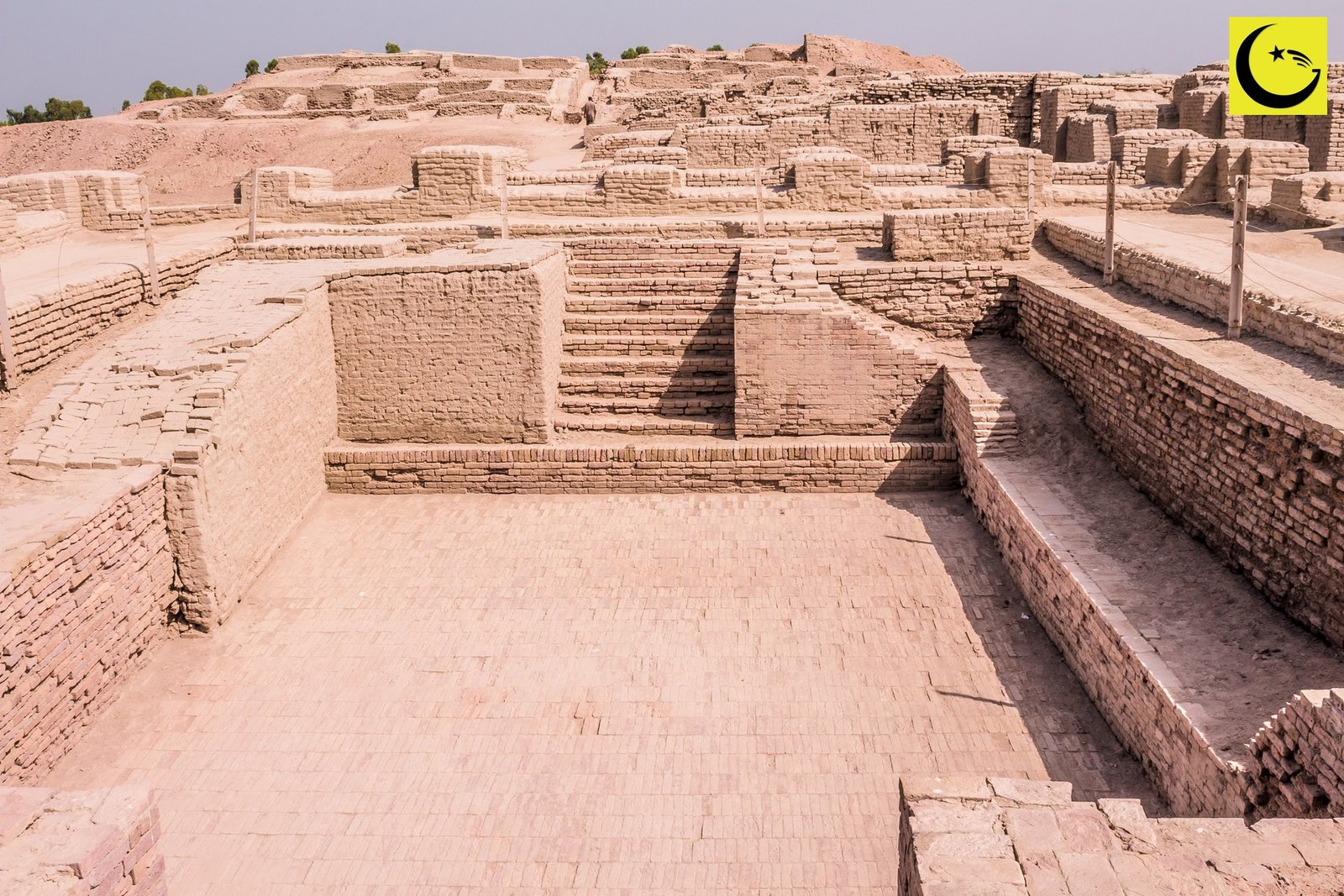
About 4,500 years ago, on the banks of the Indus in what is now Sindh, people built a city with straight streets laid out on a grid, houses connected to covered drains, hundreds of brick wells and a great public bath, centuries before Rome existed. The Mohenjo-daro planned city is still there to visit today: UNESCO calls it the best preserved urban settlement in South Asia from the beginning of the third millennium BC, and the most ancient planned city on the subcontinent.
In this fact file:
- A city on a grid
- The Great Bath
- Drains, wells and standard bricks
- The script no one can read
- Why the city emptied
- Protecting Mohenjo-daro today
A city on a grid: the Mohenjo-daro planned city
Mohenjo-daro stands on the right bank of the Indus River in Larkana District, Sindh, about 28 kilometres from Larkana city. UNESCO records that the city flourished as a metropolis of the Indus civilisation, which it ranks among the world’s three great ancient civilisations alongside Egypt and Mesopotamia. The site covers about 240 hectares of burnt brick structures, of which roughly a third has been excavated since the ruins were recognised in 1922.
The layout is the wonder. The city has two sectors: a raised citadel in the west, where a Buddhist stupa was built over the ruins in the second century AD, and a lower city to the east whose buildings line streets that intersect at right angles. This is the Mohenjo-daro planned city in its purest form: not a town that grew by accident around a market or a palace, but a settlement drawn to rules, with public baths, a great granary, wells and soak pits all part of one civic system. Population estimates for its peak, between about 2500 and 1900 BC, range from 40,000 people upward, making it one of the largest cities of its age anywhere on Earth.
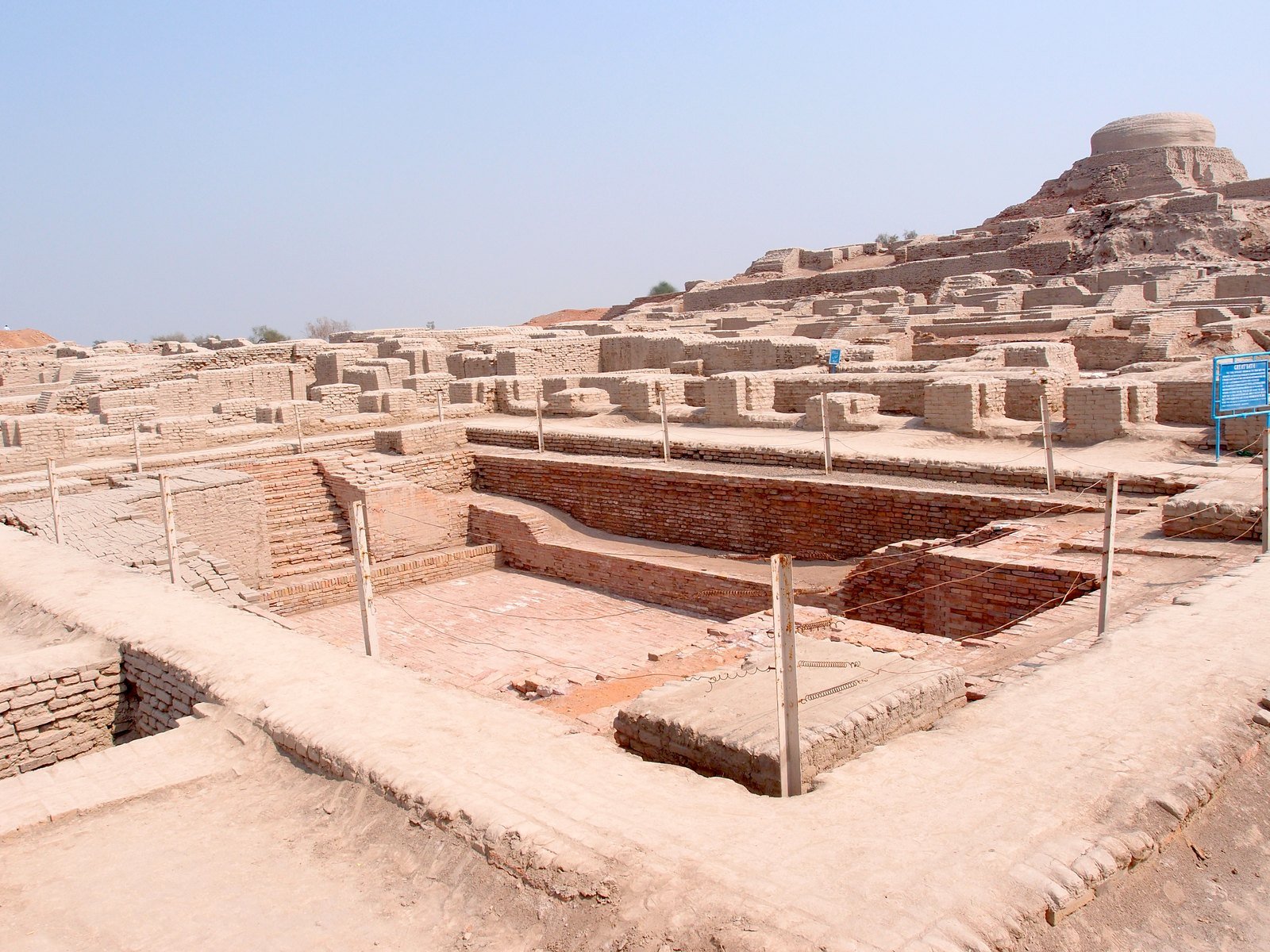
Photo: Saqib Qayyum, via Wikimedia Commons
The Great Bath
The most famous single building is the Great Bath, a sunken tank about 11 metres by 7 metres and some 2.4 metres deep, built of finely fitted fired brick and sealed with bitumen to hold water. Steps lead down into it from two sides, and small rooms surround the courtyard around it. Its exact purpose is still debated, but the most widely held view is ritual bathing, which would make it one of the earliest public water structures of its kind in the world. UNESCO’s own summary of the site singles out the public baths, the college of priests and the granary as evidence of a well organised civic, economic, social and cultural system.
Drains, wells and standard bricks
The everyday engineering is even more impressive than the monuments. Covered drains ran beneath the streets, houses had their own bathrooms connected to them, and more than 700 brick-lined wells have been counted across the excavated site, roughly one well for every three houses. That level of household sanitation was unmatched anywhere at the time and, in much of the world, was not equalled again for thousands of years. The same instinct for order shows in the bricks themselves, which follow a consistent ratio of 1 to 2 to 4 across the city, a standard that let thousands of builders work to one measure. The civilisation that built this city also created the river system story told in our fact file on the world’s largest irrigation system, which still follows the Indus today.
The city itself had been lost to memory for roughly 3,700 years. It came back to the world in 1922, when R. D. Banerji of the Archaeological Survey of India recognised that the Buddhist stupa on the mound stood over something far older, and large-scale excavation followed through the 1920s and 1930s. In the same years, Harappa, the civilisation’s other great city in Punjab, was also being uncovered, and together the two sites revealed an entire civilisation that no ancient text had ever mentioned.
The script no one can read
For all that can be measured, one thing cannot: the Indus script. The people of Mohenjo-daro wrote in a system of several hundred signs, carved mostly on small steatite seals, and despite a century of effort no one has deciphered it. There are no royal inscriptions and no great palace or temple dominating the ruins, which is why scholars describe a society that looks organised without looking ruled by kings in the Egyptian style. What the seals do prove is trade: Indus seals have been found in Mesopotamia, evidence that goods from the Indus valley reached the other great civilisation of the age.
Why the city emptied
Mohenjo-daro was abandoned around 1900 BC as the Indus civilisation declined. No single cause is proven. The explanations researchers weigh include a shifting climate and weakening monsoon, floods and changes in the course of the Indus, and the slow breakdown of the trade networks the city lived by. What is certain is that the city was never rebuilt on the same spot, which is precisely why its brick streets survived under the Sindh soil until excavators uncovered them in the 1920s.
Protecting Mohenjo-daro today
UNESCO inscribed the Archaeological Ruins at Moenjodaro on the World Heritage List in 1980, the first site in Pakistan to receive the honour, under criteria recognising both its influence on later urbanisation and its testimony to the Indus civilisation. The modern threat is salt: a rising water table pushes saline moisture into the ancient bricks, and conservation teams fight it with mud slurry, capping and careful repointing, under a management system now run by the Culture Department of the Government of Sindh. It remains the anchor site in our series of Pakistani heritage facts, alongside K2, the world’s second highest mountain, and the full series is collected on the Amazing Facts About Pakistan page.
Sources
- UNESCO World Heritage Centre: Archaeological Ruins at Moenjodaro (inscribed 1980)
- UNESCO: Mohenjo-daro, one of the earliest planned cities
- Cultural Heritage Online: Mohenjo-daro city guide (Great Bath dimensions, wells, brick ratio)
- Featured image: the Great Bath at Mohenjo-daro. Photo: Soban, via Wikimedia Commons
- In-body image: excavated streets of Mohenjo-daro. Photo: Saqib Qayyum, via Wikimedia Commons

Umar is an engineer by profession and a passionate writer by passion. He has a deep interest in sharing good news related to Pakistan and has been working hard to promote the positive image of his homeland. Umar has written numerous articles on various topics related to Pakistan, such as technology, sports, culture, and economy.