

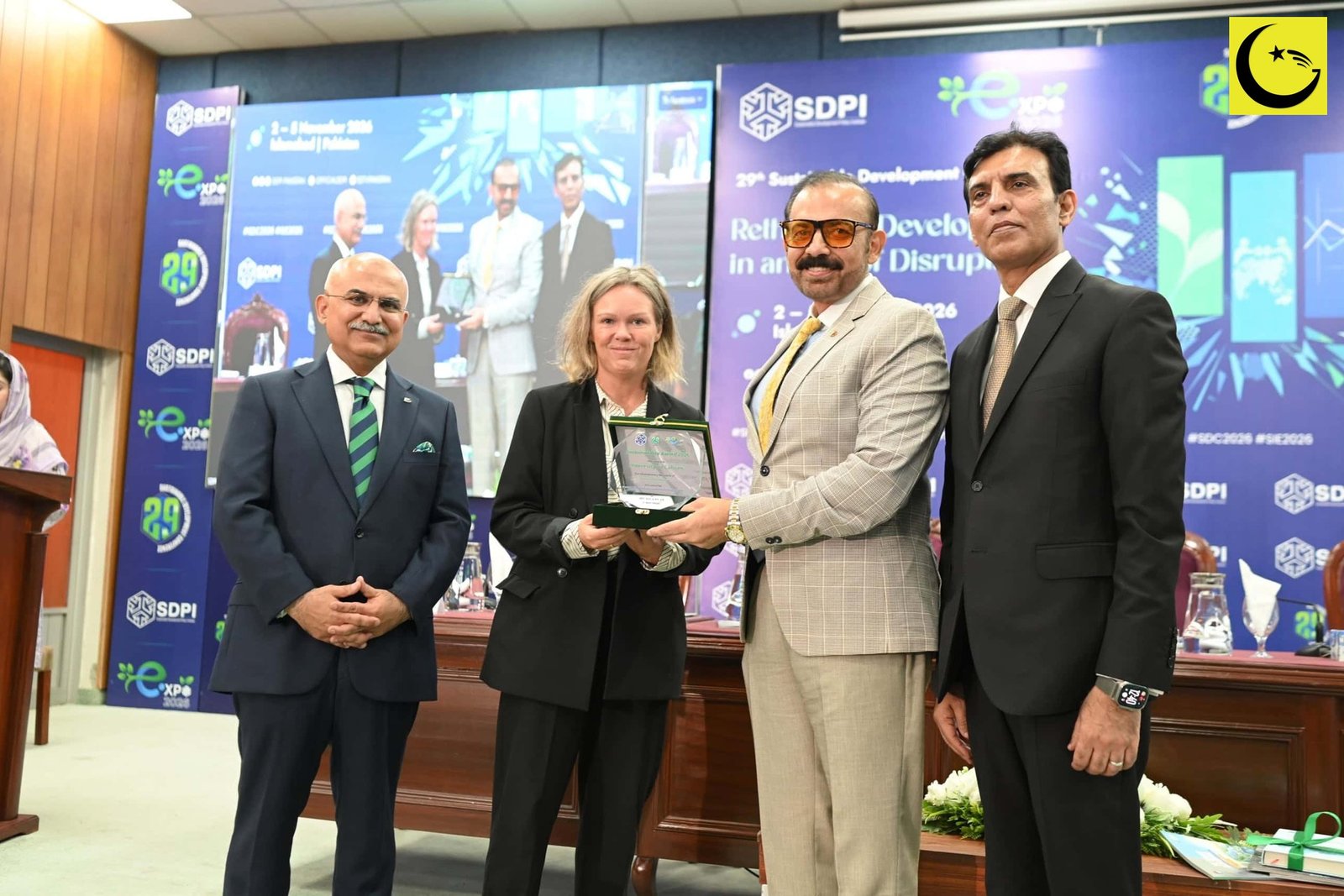
Pakistan’s first plastic road, the kilometre of Ataturk Avenue in Islamabad relaid with recycled plastic waste, has won Coca-Cola Pakistan the Sustainability Award at the Sustainable Development Policy Institute’s 29th Sustainable Development Conference. The award, in the Sustainable Cities and Built Environment category, was presented in Islamabad on 3 November 2026 during the conference and its accompanying 4th Sustainability Investment Expo.
- Award: Sustainability Award, Sustainable Cities and Built Environment category
- Event: SDPI’s 29th Sustainable Development Conference and 4th Sustainability Investment Expo, theme: Rethinking Development in an Age of Disruption
- Presented by: Maja Derrous Mortensen, Ambassador of Denmark to Pakistan, and Romina Khurshid Alam, Coordinator to the Prime Minister on Climate Change
- Received by: Dr Faisal Hashmi, Senior Director, Public Affairs, Communications and Sustainability, Coca-Cola Pakistan and Afghanistan Region
- The project: Pakistan’s first plastic road, on Ataturk Avenue, Islamabad, built with the Capital Development Authority (CDA) and TeamUp/National Incubation Center
An Award for Pakistan’s First Plastic Road
The recognition honours a public-private partnership that turned a waste problem into road surface. Coca-Cola Pakistan worked with the Capital Development Authority and TeamUp/National Incubation Center to relay a stretch of Ataturk Avenue, one of the capital’s main roads, using plastic waste mixed into the asphalt. The project was completed in December 2021, when a one kilometre stretch of the avenue was relaid with around 10 tonnes of plastic bottle waste, and it has been carrying traffic ever since. Five years on, the SDPI award treats it as what it was: a pilot that proved a recycling idea could survive real Islamabad traffic.
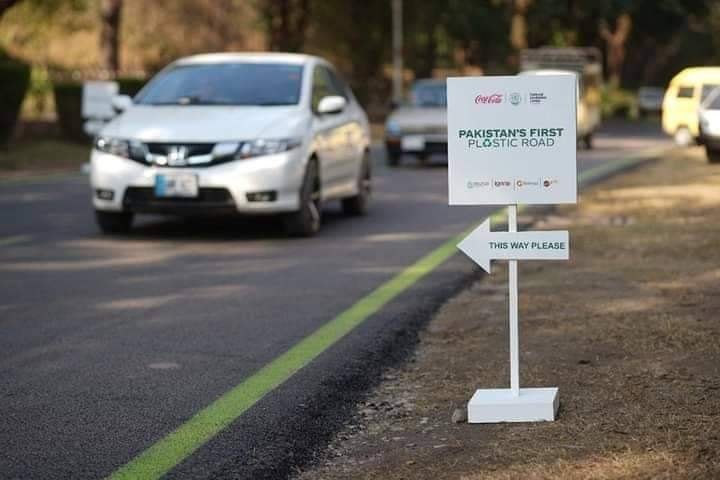
Photo: Coca-Cola Pakistan
How the Plastic Road Was Built
Plastic roads work by shredding waste plastic and blending it with hot asphalt, so the plastic coats the aggregate and becomes part of the road itself. Supporters say the mix can make surfaces more water resistant and durable, while every kilometre consumes tonnes of bottles and wrappers that would otherwise be burned, buried or dumped. Before the Ataturk Avenue stretch, the partners ran a smaller trial inside F-9 Park, and SDPI itself studied the approach in a 2022 policy brief on plastic waste in road construction. The avenue remains the showcase: a sign at the roadside still marks it as Pakistan’s first plastic road.
The mix followed the approach set out in that SDPI policy research: shredded single-use plastic is heated and blended with bitumen so it coats the stone aggregate and binds the surface. Because plastic repels water, advocates of the technique argue the finished road sheds water better than a conventional surface, and water getting into the road bed is the main cause of the potholes that open up every monsoon. The F-9 Park stretch came first, letting the partners test the mix on a park road before the CDA allowed it onto a main avenue carrying thousands of vehicles a day. Five years of Islamabad traffic later, the stretch is still in service, which is the strongest evidence a pilot can offer.
Why This Award Matters Beyond One Road
Pakistan generates plastic waste on a scale its collection systems cannot handle, so any construction use that safely absorbs tonnes of it draws attention. The award also lands in a season of sustainability milestones for Pakistani organisations, from Karandaaz Pakistan’s Green Climate Fund accreditation to manufacturers investing abroad, such as Sazgar’s first overseas plant, and provincial plans like Punjab’s PIVOT plan for exports and jobs.
The honest test of the plastic road idea is replication: one celebrated kilometre in the capital is a proof of concept, not a waste policy. But proofs of concept are how techniques spread, and the SDPI recognition keeps the Ataturk Avenue experiment in front of the city governments and road agencies who would have to order the next hundred kilometres.
From One Kilometre to a Policy
The award’s citation is for a project, but its audience is policy. Pakistan’s cities generate plastic waste on a scale that collection systems visibly cannot handle, and only a fraction of what is collected is recycled. Road building is one of the few industries that can absorb low-grade plastic, the wrappers and bags that recyclers reject, at real scale. Whether municipal agencies beyond Islamabad adopt the technique will depend on honest cost comparisons and on agreed standards for the mix, and the documentation from the Ataturk Avenue build gives engineers a local reference instead of a foreign case study. For now, the road remains what it was designed to be: a working demonstration, on a real avenue, that the waste stream can be turned into infrastructure.
Sources
- TechJuice: Coca-Cola Pakistan Recognized at SDPI’s 29th Sustainable Development Conference for Pioneering Plastic Road Project, 3 November 2026
- NewzTodays: Coca-Cola Pakistan Honored for Plastic Road Innovation, 3 November 2026
- SDPI Policy Brief 81: Plastic Waste Use in Road Construction, 2022
- Featured image: Danish Ambassador Maja Derrous Mortensen presents the Sustainability Award to Coca-Cola Pakistan’s Dr Faisal Hashmi at the SDPI conference in Islamabad. Photo: TechJuice
- In-body image: The sign marking the plastic road on Ataturk Avenue, Islamabad. Photo: Coca-Cola Pakistan

Umar Farooq is the founder and editor of Good News Pakistan. An engineer by profession and a writer by passion, he started the site in December 2022 to share good news from Pakistan, and has since written and edited more than 200 articles about its people, sports, science, business and world records. He believes the story of Pakistan is bigger than its headlines, and that good news, told honestly, is worth telling every day.