


The PRSC-EO1 satellite is Pakistan’s first indigenously designed and built electro-optical Earth observation satellite. Developed by the Space and Upper Atmosphere Research Commission (SUPARCO), it was launched at 12:07 pm Beijing time on 17 January 2025 from China’s Jiuquan Satellite Launch Centre on a Long March 2D rocket, and it opened a three satellite constellation, the PRSC-EO series, that Pakistan completed in April 2026. It is the first time Pakistan has owned a home made imaging constellation rather than single satellites built with foreign partners.
- Satellite: PRSC-EO1 (Pakistan Remote Sensing Satellite, Earth Observation 1)
- Designed and built by: SUPARCO, Pakistan’s national space agency
- Launch: 17 January 2025, 12:07 pm Beijing time, Jiuquan Satellite Launch Centre, China
- Launch vehicle: Long March 2D (Chang Zheng 2D), arranged by China Great Wall Industry Corporation
- Type: electro-optical remote sensing, imaging the Earth in reflected sunlight
- Followed by: PRSC-EO2 on 12 February 2026 and PRSC-EO3 on 25 April 2026, completing the constellation
- Uses announced by SUPARCO: natural resource monitoring, disaster response, urban planning and agricultural development
What the PRSC-EO1 Satellite Does
Electro-optical means the satellite photographs the Earth the way a camera does, using sensors that detect reflected sunlight and emitted radiation from the surface. From its low Earth orbit, the PRSC-EO1 satellite turns that photography into working data: mapping land, classifying crops and assessing their condition, watching rivers and flood extents, tracking how cities grow, and monitoring the environment. SUPARCO’s launch statement listed exactly those priorities, saying the satellite would boost Pakistan’s ability to monitor and manage natural resources, respond to disasters, and improve urban planning and agricultural development. For a country hit by catastrophic floods in 2022 and again threatened most monsoons, timely imagery of inundated districts is not an abstraction; it is the difference between guessing where the water is and knowing.
The launch itself was a shared ride arranged under a multi-launch contract SUPARCO signed with China Great Wall Industry Corporation in 2022 for a remote sensing constellation. The Long March 2D that carried PRSC-EO1 also placed two Chinese satellites, Tianlu-1 and Blue Carbon 1 (also reported as Lantan-1), into orbit on the same flight, the 556th mission of the Long March family. The lift-off was broadcast live to a ceremony at the SUPARCO complex in Karachi, where Prime Minister Shehbaz Sharif said the mission, spearheaded by SUPARCO, demonstrated the nation’s growing capabilities in space science and technology.
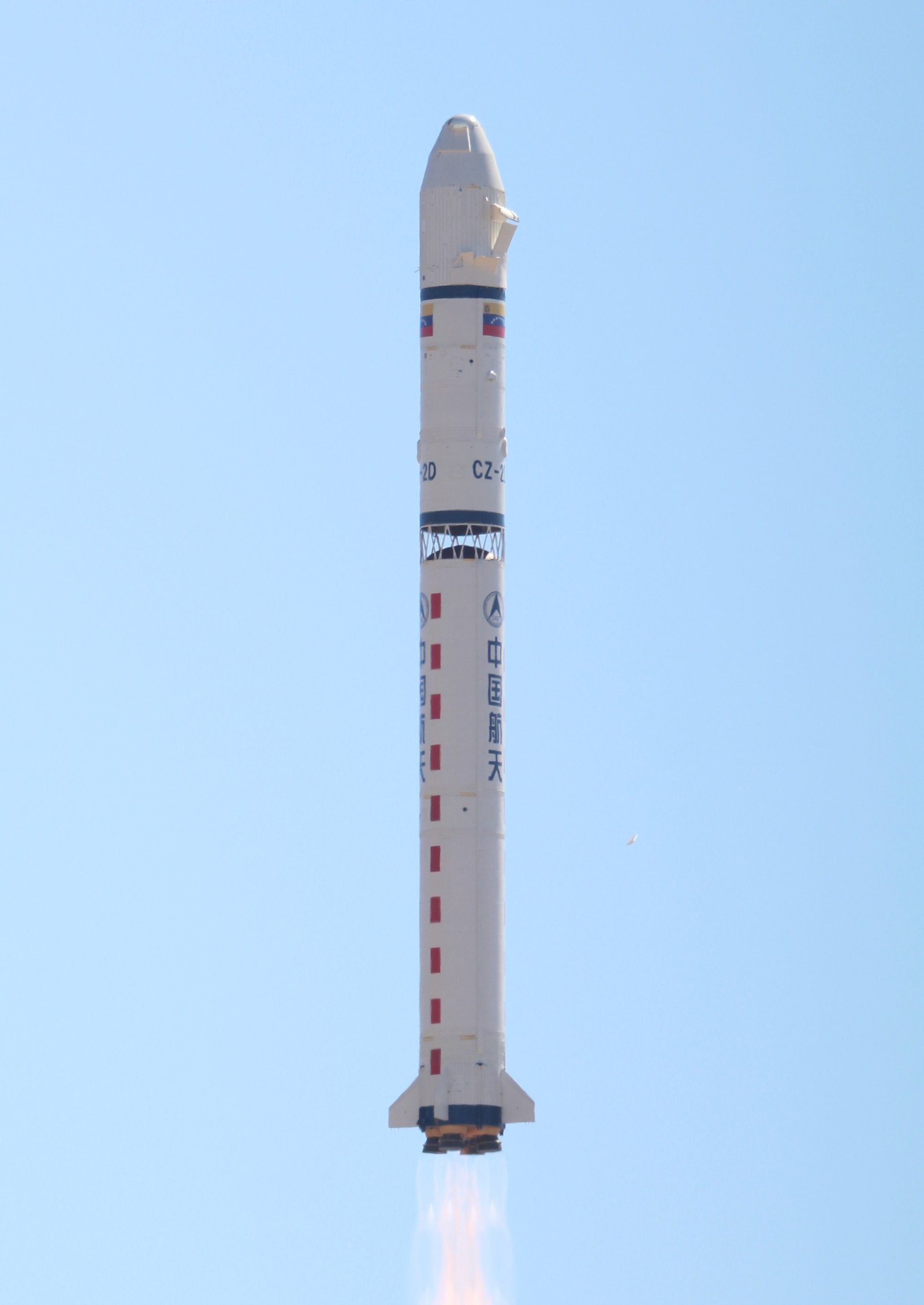
Photo: Cristóbal Alvarado Minic, via Wikimedia Commons
A Constellation Completed in 2026
One satellite photographs a given district only when its orbit passes over; three satellites shorten the wait between passes and let planners compare the same place across days and seasons, which is what turns pictures into monitoring. Pakistan built that cadence in just over a year. PRSC-EO2 followed on 12 February 2026, launched on a Smart Dragon-3 rocket from a sea platform off Yangjiang in Guangdong province; the launch provider’s record describes EO-2 as the second satellite of SUPARCO’s PRSC-EO constellation, designed and developed by SUPARCO, and reports of SUPARCO’s own announcement agree. PRSC-EO3 completed the set on 25 April 2026, launched from the Taiyuan Satellite Launch Centre on a Long March 6. SUPARCO’s satellite page for EO-3 records the date, the launch centre, the LM6 vehicle and the satellite’s indigenous electro-optical design, and the military’s media wing said EO-3 would serve as the edifice of an integrated Earth observation system supporting urban planning, disaster management, food security and environmental protection.
Home Made, and Why That Matters
Pakistan is not new to orbit, which is what makes the EO series a genuine step rather than a debut. SUPARCO, founded in 1961, is one of Asia’s oldest space agencies, and in June 1962 its Rehbar-1 sounding rocket rose from Sonmiani on the Balochistan coast, placing Pakistan among the earliest Asian nations to enter the space age, years before several of today’s bigger programmes. Decades of uneven funding followed, which is what makes the EO series significant beyond its hardware: three satellites in fifteen months is a tempo the programme has never sustained before, and it was achieved with domestic design and manufacture at its centre.
Pakistan is not new to orbit, which is what makes the EO series a genuine step rather than a debut. SUPARCO, founded in 1961, is one of Asia’s oldest space agencies. Pakistan’s first satellite, Badr-1, flew in 1990, and its earlier remote sensing satellite, PRSS-1, launched in 2018, was built in collaboration with China. The difference with PRSC-EO1 is authorship: the satellite was designed and manufactured by SUPARCO’s own engineers, a capability that decides whether a country can repair, replace and improve its fleet on its own schedule. It is the same self-reliance theme running through Pakistan’s recent technology record, from its climb in the Global Innovation Index to the research standing of universities like NUST, ranked third in Southern Asia.
Not to Be Confused With PAUSAT-1
January 2025 was a busy week, and the two launches are often mixed up. Three days before PRSC-EO1, on 14 January 2025, a different and much smaller Pakistani satellite, PAUSAT-1, rode a SpaceX Falcon 9 into orbit. PAUSAT-1 is a separate spacecraft from a separate programme; PRSC-EO1 is the SUPARCO-built Earth observation satellite that began the EO constellation. Keeping them apart matters for the record: the EO series is the one SUPARCO designed, built and then tripled.
Reading the Earth for a Farming Country
Earth observation earns its keep in unglamorous ways. Crop reporting is one: Pakistan’s wheat and cotton estimates feed decisions on imports, support prices and reserves, and satellite vegetation data lets officials check planted area and crop condition district by district instead of relying only on field reports. Disaster mapping is another: in the 2022 floods, responders depended heavily on imagery shared through international disaster mechanisms, valuable help that still had to queue behind other countries’ emergencies. An owned constellation changes that equation: tasking becomes a national decision, revisit times are known, and the same sensors that map a flood in August can check the recovery sowing in November. Add urban growth monitoring, water body tracking and environmental change detection, and the EO fleet becomes quiet infrastructure, less visible than a dam and used by more departments.
What the Constellation Gives Pakistan
With all three satellites operational, Pakistan’s planners, disaster managers and agriculture officials can task a home owned fleet instead of buying imagery abroad or waiting for foreign passes. The announced consumers of the data span the Pakistan Meteorological Department, disaster management authorities mapping risk before floods and assessing damage after them, and food security planners watching the wheat and cotton belts. Like Emma Alam’s world memory titles, the PRSC-EO1 satellite story is at heart about a Pakistani capability reaching an international standard, except this one orbits at several kilometres per second, photographing the country it serves. The first of the three is still the landmark: the day Pakistan stopped borrowing eyes and launched its own.
Sources
- SUPARCO: PRSC-EO3 Satellite, Official Satellite Page
- SpaceNews: China Launches Earth Observation Satellite for Pakistan, 17 January 2025
- Wikipedia: PRSC-EO1 Satellite
- The News: Pakistan Launches Indigenous Electro-Optical Satellite, ISPR, April 2026
- Featured image: A Long March 2D rocket lifts off from Jiuquan carrying the PRSC-EO1 satellite on 17 January 2025. Photo: CASC, via SpaceNews
- In-body image: A Long March 2D climbs away from Jiuquan, the rocket family and launch centre used by the PRSC-EO series. Photo: Cristóbal Alvarado Minic, via Wikimedia Commons

Umar Farooq is the founder and editor of Good News Pakistan. An engineer by profession and a writer by passion, he started the site in December 2022 to share good news from Pakistan, and has since written and edited more than 200 articles about its people, sports, science, business and world records. He believes the story of Pakistan is bigger than its headlines, and that good news, told honestly, is worth telling every day.