

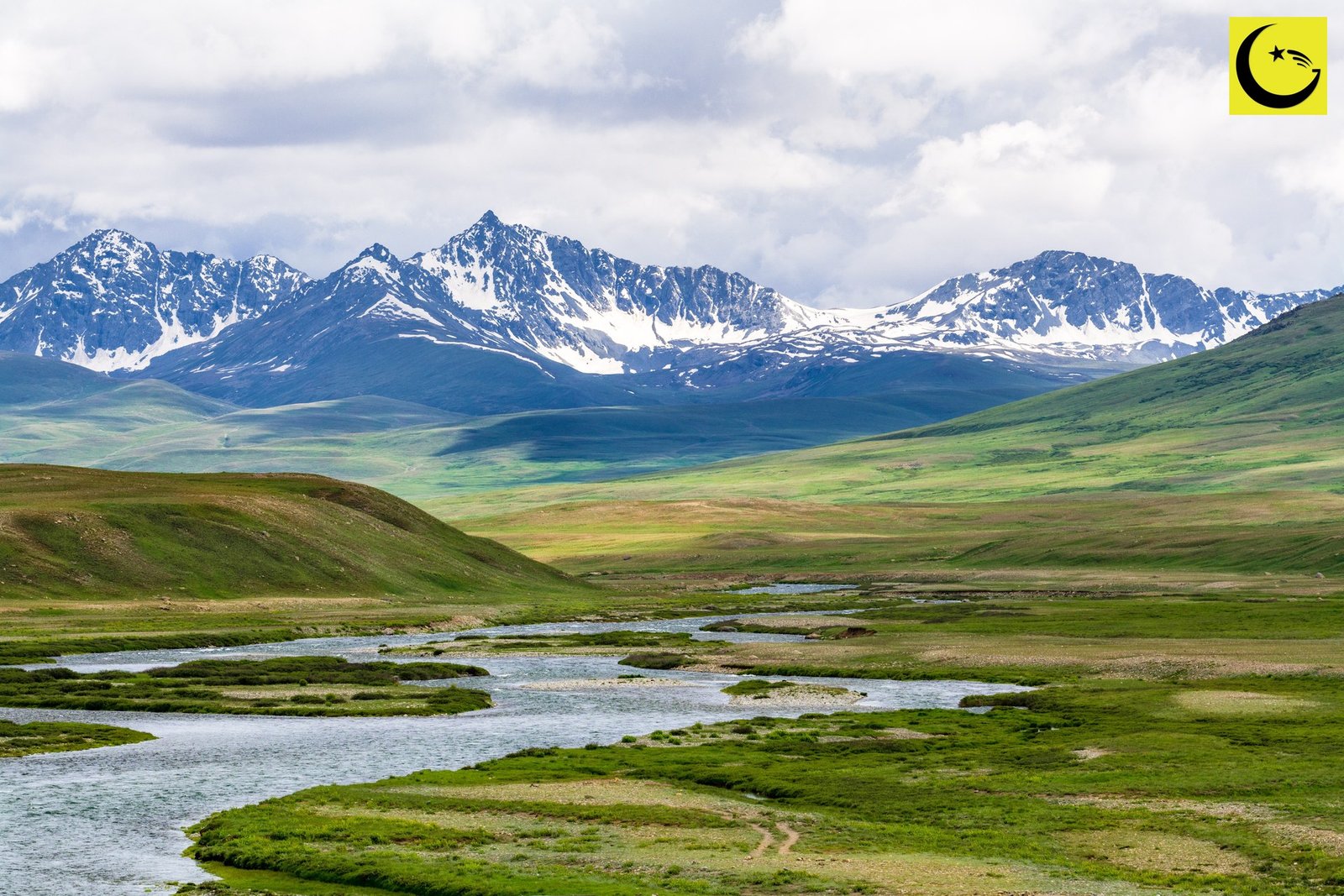
The Deosai second highest plateau in the world lies in Pakistan. Spread between the Skardu and Astore districts of Gilgit-Baltistan at an average elevation of 4,114 metres (13,497 feet), the Deosai Plains are the highest plateau on Earth after one other: the Changtang of the Tibetan Plateau. Since 1993 the heart of the plains has been protected as Deosai National Park, a park created for a single animal, the Himalayan brown bear, and the protection has produced one of Pakistan’s finest conservation stories, a bear population rescued from the edge of disappearance.
A High Plain Between Skardu and Astore
Deosai sits in the western Himalaya, east of Nanga Parbat and close to the central Karakoram range, a rolling ocean of grassland where the hills are soft, the sky feels close, and the rivers run clear over stony beds. The largest of those rivers is the Bara Pani, and in the west of the park lies Sheosar Lake, a sheet of still water that mirrors the surrounding hills. It is the altitude, more than anything, that defines the place: an entire landscape, with its lakes, marshes and flower meadows, spread out at a height where most countries have only bare rock and ice, which is why the Deosai second highest plateau ranking is a statement of fact and not a slogan.
How large is it? Honesty requires a range rather than a single figure, because published sources measure different things and disagree. Guides give about 1,620 square kilometres for the protected national park, about 3,000 square kilometres for the Deosai Plains as a whole, and 3,584 square kilometres in an official park listing carried by Pakistan’s Department of Archaeology and Museums. What no source disputes is the height: 4,114 metres on average, second on Earth only to Changtang.

Sheosar Lake, in the western part of Deosai National Park, mirrors the surrounding hills
Photo: Jehan Sher, CC BY-SA 4.0, via Wikimedia Commons
The Land of the Giant
The name itself carries the landscape’s character. In the Shina language, “deo” means giant and “sai” means shadow, so Deosai is the shadow of the giant, or the land of the giant, a name the travel writer Salman Rashid helped popularise in English in the early 1990s. The Balti people call the plains Ghbiarsa, which means summer place, because that is the only season when they can be reached at all: for most of the year, snow seals the plateau off from the world. Even the ancient world may have heard of this place. The Greek historian Herodotus wrote of gold-digging ants in the far east, and the French ethnologist Michel Peissel argued that the story began here, founded on Deosai’s golden Himalayan marmots and the gold dust found in the earth their burrows throw up, which local people once collected.
R E A D M O R E
Conde Nast Traveller Named Pakistan the Best Holiday Destination for 2020
The Bear That Saved a Plateau
Deosai National Park exists because of a bear. The Himalayan brown bear, a critically endangered subspecies, had long been a prize kill for poachers and trophy hunters, and by the early 1990s it was close to vanishing from the plains. In 1993 the government declared the national park, primarily to protect the bear and its habitat, and the Himalayan Wildlife Foundation, founded the same year after helping secure the designation, ran park check posts and a field research camp here for about a decade. Management passed to the Gilgit-Baltistan forest and wildlife department in 2006.
The recovery since then is recorded in the park’s survey numbers, reported by the Express Tribune and repeated by Dr Zakir Hussain Zakir of the University of Baltistan in an Independent News Pakistan report: 19 bears in 1993, 40 in 2005, and 78 in 2022. Four times the founding population, in a species that breeds slowly and ranges widely. Deosai is now described as holding one of the last stable, breeding populations of Himalayan brown bears anywhere, and while the pressures of the 1990s have faded, the threats have changed rather than vanished: climate change and the nutrition it disrupts are the concerns named by the park’s researchers today.
Wildlife and Wildflowers Above the Clouds
The bear shares the plateau with a cast of high-altitude wildlife: Siberian ibex picking across the slopes, the snow leopard that few visitors ever see, Kashmir musk deer, Himalayan wolf, and colonies of Himalayan marmots whose whistles carry across the grass. More than 124 species of resident and migratory birds have been recorded, among them the golden eagle, the lammergeier or bearded vulture, the Himalayan vulture, the laggar falcon, the peregrine falcon and the Himalayan snowcock. Each spring the plateau performs its other transformation, when sweeps of wildflowers and clouds of butterflies cover the alpine steppe of the Karakoram and West Tibetan plateau eco-region, and the plains that were white and silent all winter turn, for a few short months, into one of the highest flower gardens on Earth.
R E A D M O R E
Pakistan Has the World’s Largest Irrigation System
A Wilderness in the Fullest Sense
Deosai’s protection is of the strictest kind. The park is classed by the IUCN, the global authority on protected areas, in category Ib, a wilderness area, the designation reserved for large, unmodified landscapes where nature is left to run itself with the lightest possible human footprint. That philosophy fits the plateau: there are no towns inside it, no permanent population, and for most of the year no people at all beyond the wardens, only the herders and visitors of the short summer. It is also why Pakistan has placed Deosai on its tentative list for UNESCO World Heritage status, a first step toward the full inscription that would put the plateau on the same register as the world’s most treasured natural places.
Visiting the Deosai Second Highest Plateau
Deosai lies about 30 kilometres from Skardu city, the shortest and most used route in, and it can also be reached from the Astore valley through Chilim and by the Burji La route from Skardu. The visiting season is the summer alone: the same snow that gives the Balti name its meaning closes the roads for most of the year, and even in season the Gujjar-Bakarwal herders who cross the park with their flocks are a reminder that this is a working landscape as well as a protected one. The park stands on Pakistan’s tentative list for UNESCO World Heritage status. It sits, too, in distinguished company: the same corner of Gilgit-Baltistan holds K2, the world’s second highest mountain, and the ranges where Shehroze Kashif became the youngest Pakistani to climb all 14 eight-thousanders, while the streams that rise on the plateau drain toward the river system behind the Indus Basin’s mega irrigation network.
Second highest plateau, land of the giant, summer place: Deosai answers to all three names, and earns each of them. In a country better known to the world for very tall mountains, it is the flat land at the top of the world that may be its most quietly astonishing landscape.
Sources
- Deosai National Park, Wikipedia, and the official and published sources it cites
- Independent News Pakistan, University of Baltistan expert on Deosai’s bears and glaciers
- Skardu.pk, Deosai National Park facts and wildlife
- Featured image: A river winds across the Deosai Plains below the snow peaks of Gilgit-Baltistan (Qammer Wazir, CC BY-SA 4.0, via Wikimedia Commons)
- In-body image: Sheosar Lake, in the western part of Deosai National Park (Jehan Sher, CC BY-SA 4.0, via Wikimedia Commons)

Umar Farooq is the founder and editor of Good News Pakistan. An engineer by profession and a writer by passion, he started the site in December 2022 to share good news from Pakistan, and has since written and edited more than 200 articles about its people, sports, science, business and world records. He believes the story of Pakistan is bigger than its headlines, and that good news, told honestly, is worth telling every day.