

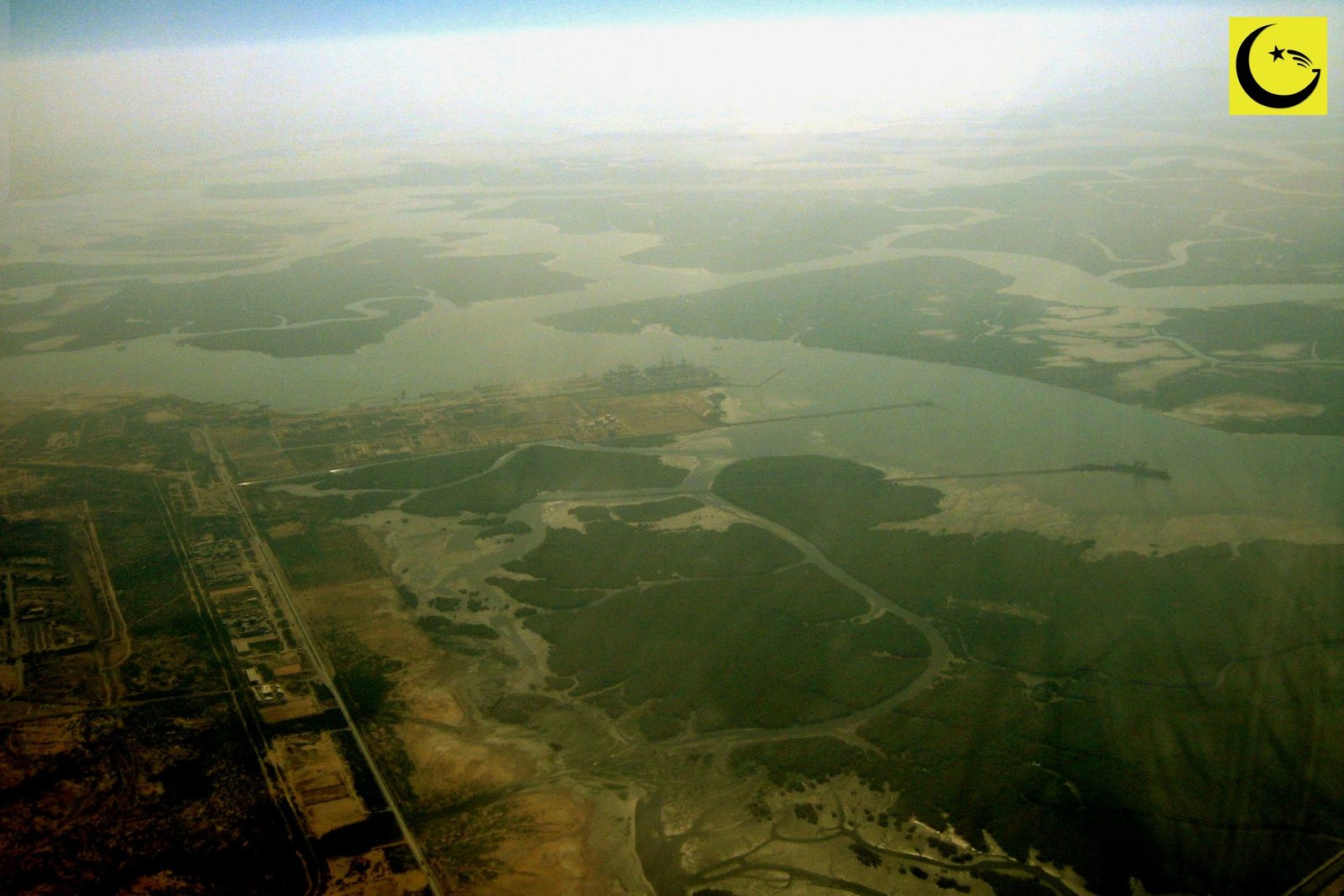
Where the Indus River ends its long journey to the Arabian Sea, it fans out into a maze of creeks, mudflats and green forest. The Indus Delta mangroves that clothe this coast are described by the Sindh Forest Department as the largest arid climate mangroves in the world: a vast mangrove forest thriving where rain is scarce and the desert is never far away. The delta they grow in is the fifth largest on Earth, cut by 17 major creeks, and its wetlands have been protected as a Ramsar site since 5 November 2002.
A Forest That Grows Where Rain Barely Falls
Most of the world’s great mangrove forests grow in wet tropics, in steaming deltas drenched by monsoon rain. The Indus Delta is different. Its climate is arid, with only about 25 to 50 centimetres of rain in a normal year, and its trees survive on a twice daily gift from the sea: the tide. Salt water floods the creeks, retreats, and floods again, and the mangroves have built their whole lives around that rhythm.
The river that feeds them travels some 3,000 kilometres from a Tibetan spring to reach this coast, a journey we traced in The Indus: Pakistan’s Great River, From a Tibetan Spring to the Arabian Sea. Where its fresh water meets the tide, the delta spreads from Korangi Creek near Karachi in the north to Sir Creek at the Indian border in the south. The Ramsar Sites Information Service notes that the delta was formed under largely arid conditions and carries some of the highest wave energy of any river delta in the world, yet the forest endures, rooted in mud that is underwater half of every day.
The Indus Delta Mangroves in Numbers
The figures behind the forest explain why it holds a world title:
- Largest arid climate mangroves in the world, in the Sindh Forest Department’s own description of the forests it manages
- Fifth largest river delta in the world, formed where the Indus meets the Arabian Sea
- 17 major creeks and countless minor channels thread the delta
- 97 percent of all mangroves in Pakistan grow in this one delta
- Ramsar site number 1284, designated on 5 November 2002, covering a listed wetland area of 472,800 hectares
- One species does most of the work: about 95 percent of the forest is Avicennia marina, the grey mangrove, among the most salt tolerant trees on Earth
That dominance was not always so narrow. The delta once held eight mangrove species; four remain common today, and replanting programmes have been bringing back species such as Rhizophora mucronata, whose stilt roots now stand in neat young rows along the creeks. In December 2010 the Government of Sindh declared all the mangrove forests of the delta protected forests, giving the whole ecosystem legal cover.

The Indus Delta from space, photographed by NASA’s MODIS satellite on 28 May 2024: the dark green fan at the coast is the mangrove forest
Photo: MODIS Land Rapid Response Team, NASA GSFC (public domain)
Three Guinness World Records, Planted in a Day
The delta’s fame is not only about what nature planted. Three times, teams of 300 volunteers from local coastal communities have set Guinness World Records here for the most trees planted in 24 hours by a team. On 15 July 2009 they put 541,176 mangrove seedlings into the mud at Keti Bandar, taking the world record. On 22 June 2013, at Kharo Chan in the same Keti Bandar coast, they broke their own record with 847,275 saplings in a single day. Then, on 19 April 2018, they did it again, planting 1,129,294 saplings in 24 hours.
Planting at that speed is only possible because the Indus Delta mangroves grow in soft tidal mud that takes a seedling with a single push, and because whole villages turn out for the planting days. The records belong to the Sindh Forest Department and the communities of the delta coast, and no team anywhere else in the world has yet beaten the 2018 mark in this category as reported by Dawn and the IUCN.
R E A D M O R E
Mohenjo-daro: The Planned City Pakistan Built 4,500 Years Ago
The World’s Largest Blue Carbon Project
The delta’s second world title arrived through the carbon market. Delta Blue Carbon 1, launched in 2015 as a partnership between the Government of Sindh and Indus Delta Capital, protects and restores mangroves across 350,000 hectares of the delta. The registry body Verra describes it as the world’s largest blue carbon project: over its 60 year lifetime it is expected to remove 142 million tonnes of carbon dioxide from the atmosphere, roughly the yearly emissions of 33 million petrol cars taken off the road. More than 11,000 villagers work directly as stewards of the project, planting, guarding and monitoring the forest their grandparents watched shrink.
That last part matters. For decades the delta was losing its trees to fuelwood cutting, grazing and, above all, a weakening river: as more Indus water was used upstream, less fresh water reached the coast to hold back the sea. The same river system that feeds the world’s largest irrigation system, whose scale we compared with the world’s mega systems in How the Indus Basin Irrigation System Stacks Up Against the World’s Mega Irrigation Systems, now delivers a fraction of its old flow to the delta. Restoration since the 1990s, powered first by public projects and now by carbon finance, has turned the direction around: Sindh’s is the only mangrove cover in the region that is expanding.
How Big Is the Forest, Honestly?
Ask how many hectares of mangrove the delta holds and you will get more than one honest answer, because the numbers measure different things. The Sindh Forest Department speaks of around 600,000 hectares of mangrove lands across the delta, the full landscape of forest, creeks and mudflats under its care. Recent scientific estimates of the actual tree cover are lower, above 230,000 hectares, and the Ramsar information sheet recorded 129,000 hectares of mangrove when the site was listed in 2002. The trend across those counts is the real story: the forest shrank hard in the late 20th century, and the counts since then have climbed as replanting took hold. What no estimate disputes is the ranking: measured either way, this remains the largest arid climate mangrove system on the planet.
R E A D M O R E
K2: The Second Highest Mountain in the World Stands in Pakistan
Why the Delta Matters Far Beyond Sindh
A mangrove forest is a working coast defence. Its roots break storm waves before they reach the villages behind it, and the 1999 cyclone that struck this coast showed what happens where the green wall is thin. Its creeks are nurseries for the fish and shrimp that support the delta’s fishing economy: the Ramsar listing counts some 40 settlements and about a million people in the delta area whose livelihoods rest largely on fishing. Its waters shelter the threatened Dalmatian pelican, plumbeous dolphins, finless porpoises and bottlenose dolphins.
Pakistan’s coastline is short, and almost everything green on it grows in this one delta. The Indus Delta mangroves hold a world record title, three planting records and the planet’s biggest blue carbon project all at once, and they earned each of them in one of the harshest climates any mangrove forest endures. Largest, in this case, is not a boast. It is a measurement.
Sources
- Ramsar Sites Information Service, Indus Delta, site number 1284
- Verra, Restoring Pakistan’s Mangroves to Protect Climate, Communities and Coastlines
- IUCN, Twenty Years of Indus Delta Mangroves: Development and Rehabilitation by Sindh Forests Department
- Dawn, Environment Day at Keti Bandar
- Wikipedia, Indus River Delta
- Featured photo: Ismail.sultan, CC0, via Wikimedia Commons
- Photo: MODIS Land Rapid Response Team, NASA GSFC (public domain)

Umar Farooq is the founder and editor of Good News Pakistan. An engineer by profession and a writer by passion, he started the site in December 2022 to share good news from Pakistan, and has since written and edited more than 200 articles about its people, sports, science, business and world records. He believes the story of Pakistan is bigger than its headlines, and that good news, told honestly, is worth telling every day.