

Pakistan game studios earn an estimated $400 million to $480 million a year, according to a report in Dawn’s Business and Finance Weekly on 9 November 2026, yet a large part of that money never reaches a Pakistani bank account. Independent estimates put the industry’s true size higher still, at up to $600 million a year, which would make game development one of the country’s biggest creative export earners.
How Big Pakistan Game Studios Have Become
The scale has built up quietly. The Pakistan Software Export Board counts more than 300 game studios and over 12,000 developers in the country, most of them earning from international markets, and the Express Tribune reported last December that Pakistan ranks as the second-largest mobile game developer in its region, behind Vietnam, with around 18,000 people employed across the wider industry. The money is part of a much larger technology story: animation, graphics and games together account for 10.5 percent of the $4.6 billion in IT exports Pakistan recorded in fiscal year 2026, the landmark year covered in Pakistan IT Exports Record: $4.6 Billion in FY2025-26 as June Hits $416 Million.
- Estimated annual earnings of game development: $400 million to $480 million (Dawn)
- Independent estimates: up to $500 million to $600 million
- Studios counted by the Pakistan Software Export Board: more than 300
- Developers: more than 12,000, with wider industry employment put at about 18,000
- Animation, graphics and games share of FY26 IT exports: 10.5 percent of $4.6 billion

Competitive gaming on stage in Essen, Germany. Pakistan’s studios sell into this same global games market, mostly through mobile titles bought by players abroad.
Photo: Matti Blume, CC BY-SA 4.0, via Wikimedia Commons
Mobile Games Lead, PC Studios Are Growing
Mobile is firmly in the lead. A Pakistan Software Export Board report cited by Dawn splits the market across mobile, console and PC games, with mobile holding around half of the total. Syed Bilal Qasim, project director at the Centre of Excellence in Gaming and Animation (CEGA), a Ministry of Information Technology and Telecommunication project backed by Ignite, told Dawn that game development is the dominant industry in Pakistan’s creative technology sector. He put its published value at more than $200 million, while noting that quoted figures for the country range from $200 million to around $450 million and the actual size is much bigger. A smaller number of studios work on PC games, where a shortage of Unreal Engine developers and experienced animators is a real constraint, and the playing audience is proven too: the competitive scene made its own history when Pakistan Clinches First-Ever Asian Games Esports Podium with PUBG Mobile Bronze was reported earlier this year.
R E A D M O R E
Pakistan’s IT Exports Hit $435 Million in September 2026, Second-Highest Monthly Figure Ever
The Squeeze: Half the Earnings Converted, Ad Top-Ups Taxed
The honest part of the Dawn report is the squeeze underneath the headline number. State Bank rules for IT exporters let a company keep the higher of $5,000 a month or half of its export proceeds in foreign currency, which means the other half must be converted into rupees. Studios also face caps on incoming transactions and slow remittance screening, and they pay a 27 percent tax on the top-ups they use to buy advertising on platforms such as Google and Unity. Industry insiders told Dawn that a typical game clears a profit margin of only 20 to 25 percent, while most of its costs, advertising, software licences and cloud services, are billed in dollars abroad. On those margins, surrendering half of every dollar earned makes little business sense, so, as Dawn put it, virtually every studio has also registered a company outside Pakistan and runs much of its money from there. The result is an industry whose real footprint is larger than the official figures suggest, because so much of its income never lands in a Pakistani bank.
What Pakistan Game Studios Need Next
Founders quoted in the report are not asking for subsidies. The asks are practical: let exporters hold more of the dollars they earn, speed up screening of incoming payments, and rethink a 27 percent tax on the advertising top-ups that are a basic cost of selling games worldwide. Technology exports to a single market have grown fast, as Pakistan’s IT Exports to UAE Jump 42% to $536 Million showed, and games are one of the few export products Pakistan makes that sells directly to consumers in almost every country. Artificial intelligence is the next test: development cycles are getting shorter, complete games can be built with AI tools by non-developers, and platforms are adding checks on AI-generated games. Small, agile teams can adapt quickly, and Pakistan game studios, more than 300 of them, have already shown they can compete on talent. Fixing the money rules would let more of their earnings come home.
Sources
- Dawn, Business and Finance Weekly, 9 November 2026: Turning gaming talent into export earnings
- Paktechstan: Pakistan’s Game Studios Earn Up to $480 Million a Year, But Most of the Money Never Comes Home
- GoGenerational: Pakistan’s gaming talent faces an export-business test
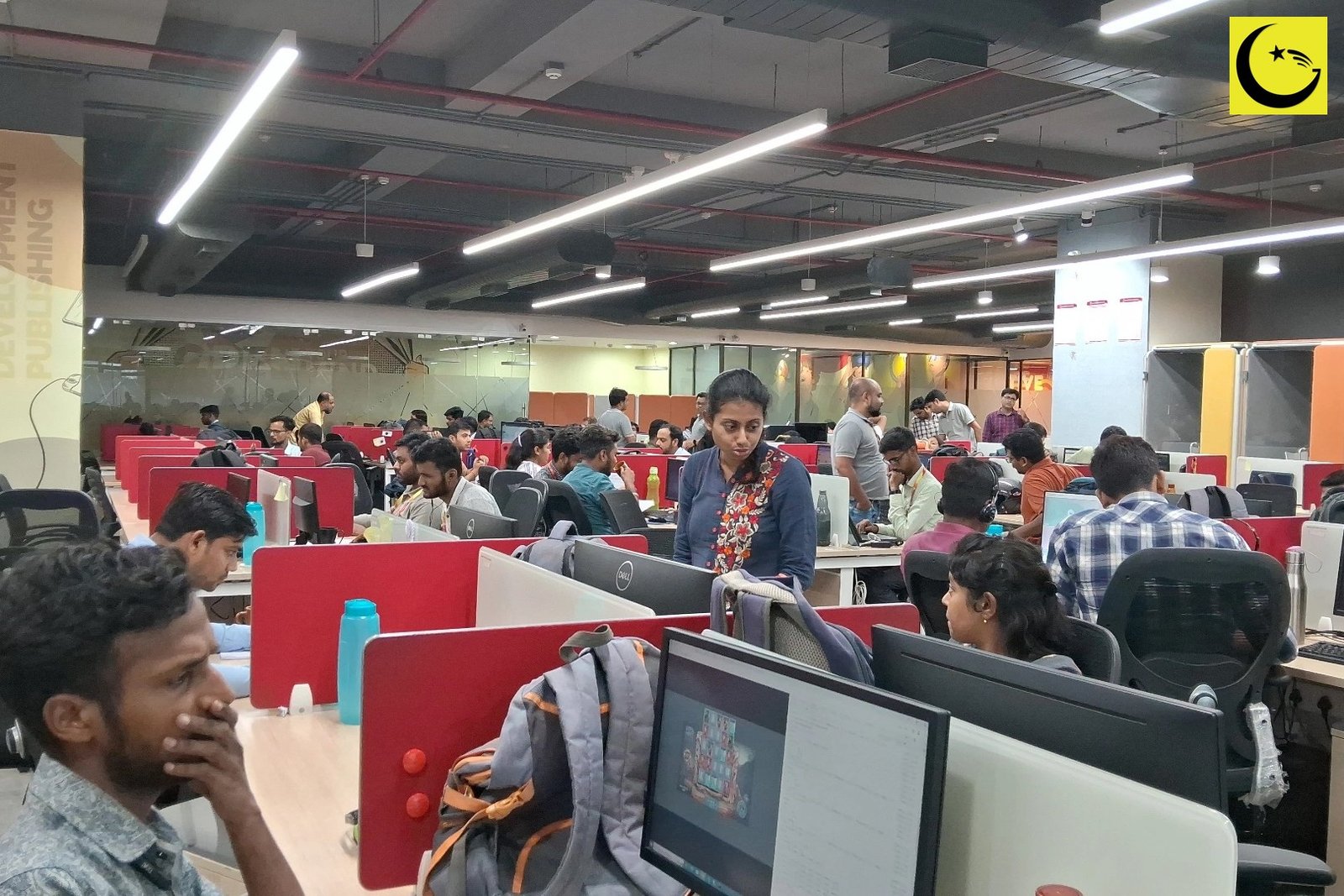
- Featured image: A game development company office floor (Red Apple Learning, CC BY-SA 4.0, via Wikimedia Commons)
- In-body image: DTM esports event, Essen, 2024 (Matti Blume, CC BY-SA 4.0, via Wikimedia Commons)

Umar Farooq is the founder and editor of Good News Pakistan. An engineer by profession and a writer by passion, he started the site in December 2022 to share good news from Pakistan, and has since written and edited more than 200 articles about its people, sports, science, business and world records. He believes the story of Pakistan is bigger than its headlines, and that good news, told honestly, is worth telling every day.