

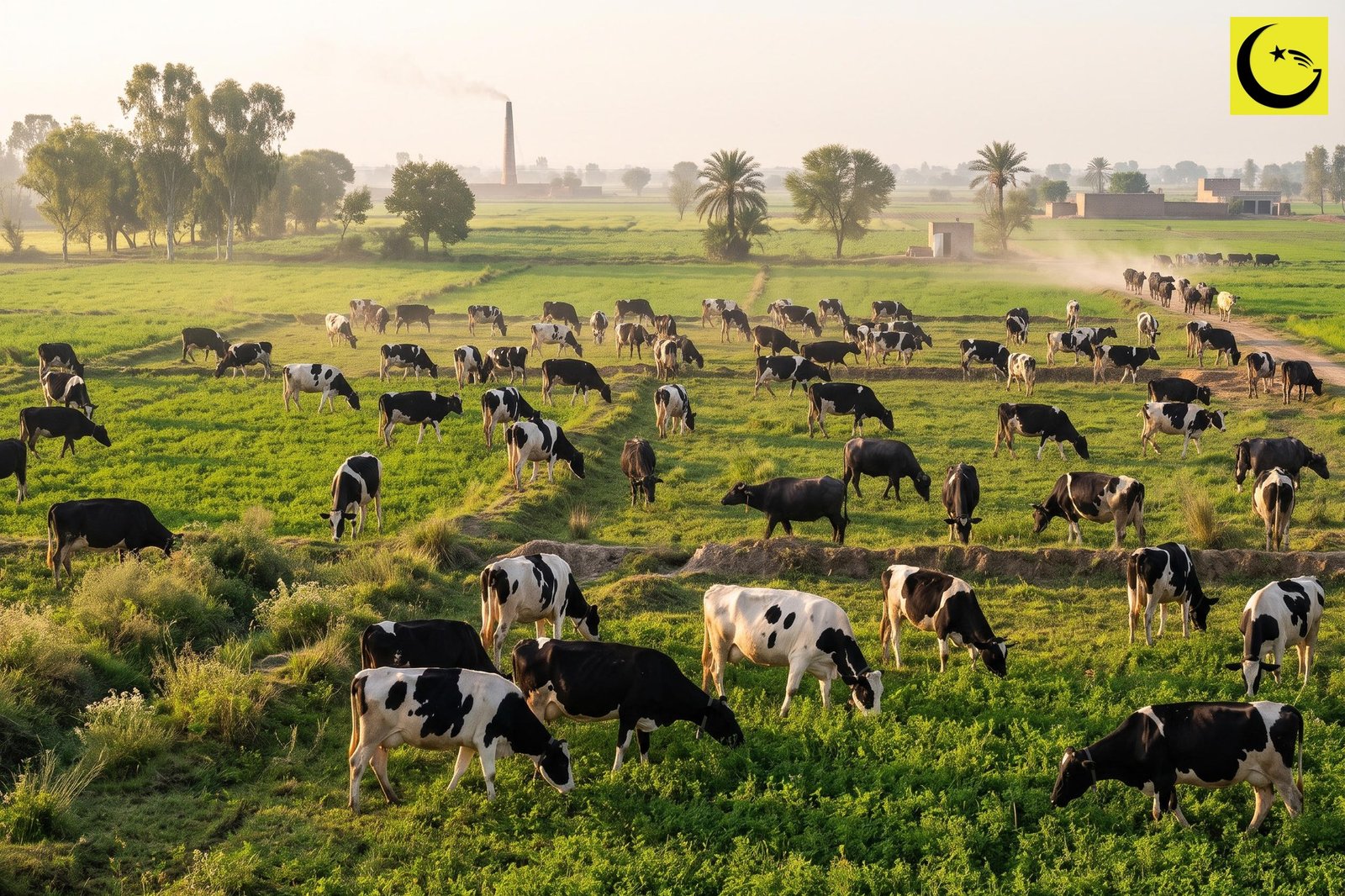
Pakistan milk production reached 66.3 million tonnes in 2024, according to the FAO Dairy Market Review 2025, a rise of about 3 percent from 64.4 million tonnes in 2023. The figure places Pakistan third among the world’s individual milk producing countries, behind only India and the United States, and fourth in the full table when the European Union is counted as one producing bloc. It is a ranking built not on giant dairy corporations, but on millions of small family farms.
What the FAO Numbers Actually Say
The Food and Agriculture Organization of the United Nations tracks milk in its annual Dairy Market Review, and its 2025 edition, covering market developments in 2024, records world milk production growing by about 1.1 percent to roughly 950 million tonnes. Within that global picture, the FAO and its joint outlook with the OECD single out the same two Asian producers: production in India and Pakistan each rose by about 3 percent in 2024, and the outlook expects more than half of the growth in world milk production over the coming decade to come from those two countries alone.
The ranking needs one honest explanation. Counted country by country, Pakistan stands third, behind India, the world’s largest producer by a wide margin, and the United States. The European Union, taken together, produces more milk than any single country except India, so when tables list the EU as one bloc, Pakistan sits fourth. Both statements are true, and which one a headline uses depends on whether the EU is in the table. What does not change is the company Pakistan keeps: by volume, its dairy herd produces at a scale matched by only a handful of nations on earth.
R E A D M O R E
Pakistan Has the World’s Largest Irrigation System
Pakistan milk production Is Built on Small Farms
Unlike the industrial dairy model of North America or Europe, where a single farm may milk thousands of cows, Pakistan milk production comes overwhelmingly from smallholders: rural families keeping a handful of animals alongside their crops, selling the morning surplus to a collector, and keeping the rest for the household. The backbone of the herd is the water buffalo, the main dairy animal of the country, with the great majority of buffaloes kept in Punjab and most of the rest in Sindh. The breeds are local and famous among farmers: the Nili-Ravi of the Punjab river plains, the Kundi of Sindh, and the Azi Kheli of the Swat valley, alongside Sahiwal and other local cow breeds.
Buffalo milk is richer than cow milk, with a higher fat content, which is why it is prized for the desi ghee, butter and thick dahi that anchor Pakistani cooking. The same farm economy shows up across the country’s other world rankings: the canal network that waters these farms is the subject of Pakistan Ranks Fifth in World Seed Cotton Production in FAO Figures for the 2021 Crop, and the wheat fields of the same province produced the record harvests in Punjab Farmers Sweep Wheat Yield Competition at Nearly Double the National Average. Milk, cotton and wheat are three faces of one Punjab and Sindh farm economy.
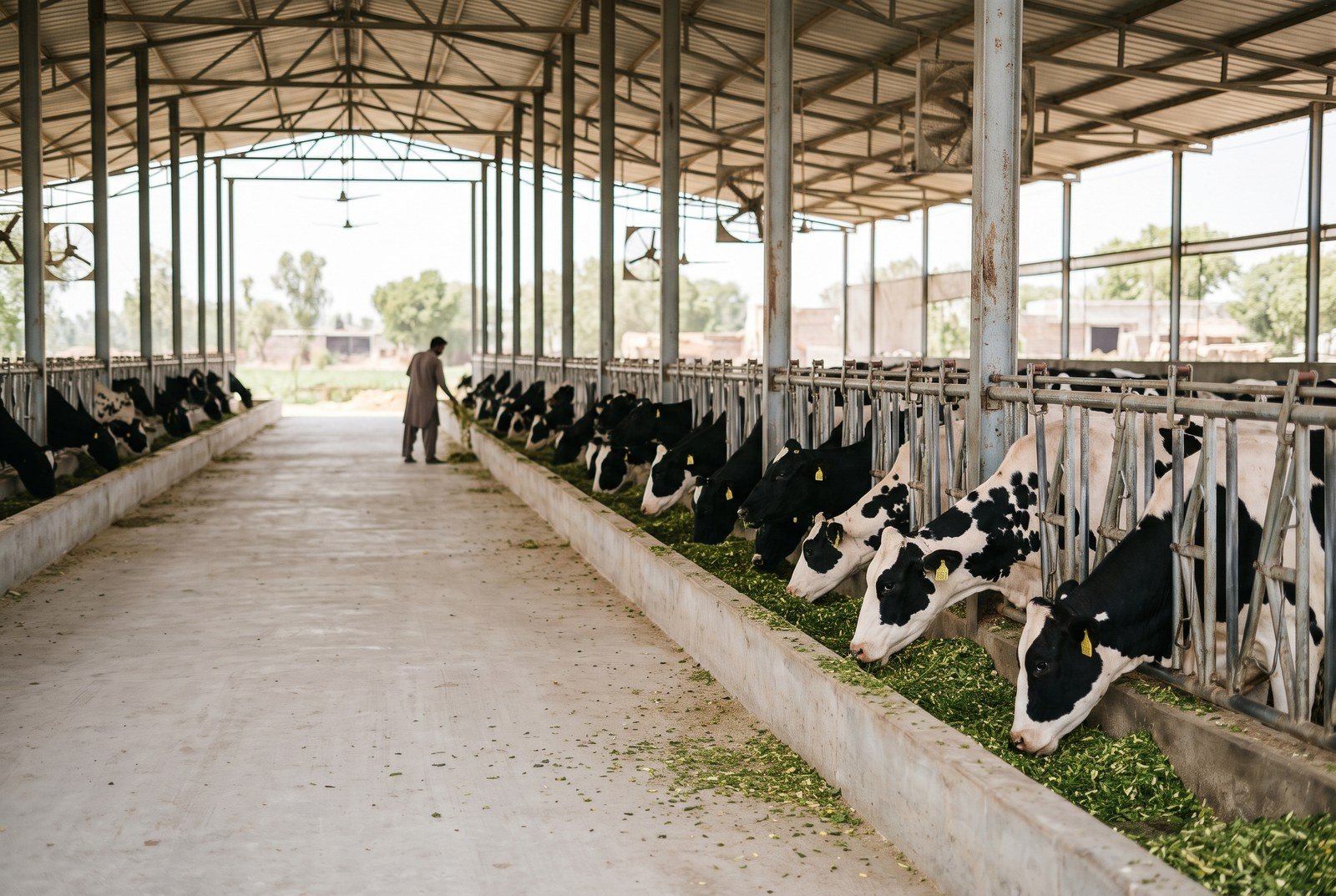
Rows of black and white Friesian cows feed at stalls in a modern Pakistani dairy shed, the kind of organised farm behind the country’s rising milk output.
AI-generated image, used for illustration
Loose Milk, the Doodh Wala and a Domestic Market
Almost all of this milk is drunk at home. The FAO outlook notes that Pakistan, like India, exports only marginal quantities of milk and dairy products, so the 66.3 million tonnes flow almost entirely into domestic glasses, tea, lassi, yoghurt and sweets. Most of it still travels the old way, as loose milk carried from village collection points to city neighbourhoods, where the doodh wala remains a fixture of the morning. Only a minority passes through pasteurising plants and branded cartons, a share that is growing in the big cities but still small beside the informal trade.
That structure cuts both ways. It means the ranking rests on real household nutrition and rural income rather than export statistics, and that millions of farm families, very many of them women who tend the animals, share directly in the value of the world’s fourth largest milk supply. It also means the sector’s weaknesses, from summer fodder shortages to the long unrefrigerated journey to the city, are felt at the breakfast table.
R E A D M O R E
Pakistan Rice Exports Beat Vietnam in September 2026 With 420,277 Tonnes Shipped
The Gap Between Volume and Value
The honest caveat to the celebration is productivity. Pakistan reaches its total by keeping very large numbers of animals, and yields per animal remain low by the standards of industrial dairy countries, where a single cow can give several times the milk of a village buffalo. The FAO and OECD outlook expects world growth to be fuelled mainly by rising yields, which is exactly the lever Pakistan has pulled least. Better feed, animal health cover, breeding and a working cold chain would let the same national herd produce more, and let more of it reach cities in good condition.
Even with that caveat, the direction of travel is consistent. Output rose about 3 percent in a single year, the herd economy keeps expanding with the population it feeds, and the same FAO family of reports that records the current ranking projects Pakistan, with India, to supply more than half of the world’s milk growth in the decade ahead. The country’s farm sector already holds a parallel place in world trade, as Pakistan Among the World’s Top Rice Exporters, Fourth in 2025 records. Third among individual countries, fourth counting the European Union as one: by either count, Pakistan milk production is one of the quiet giants of the world food economy, and it is carried on the backs of its smallest farmers.
Sources
- FAO: Dairy Market Review, Overview of Global Market Developments in 2024 (Rome, 2025)
- OECD-FAO Agricultural Outlook 2025-2034: Dairy and Dairy Products chapter
- Featured photo: AI-generated image, used for illustration
- In-body image: AI-generated image, used for illustration

Umar Farooq is the founder and editor of Good News Pakistan. An engineer by profession and a writer by passion, he started the site in December 2022 to share good news from Pakistan, and has since written and edited more than 200 articles about its people, sports, science, business and world records. He believes the story of Pakistan is bigger than its headlines, and that good news, told honestly, is worth telling every day.