

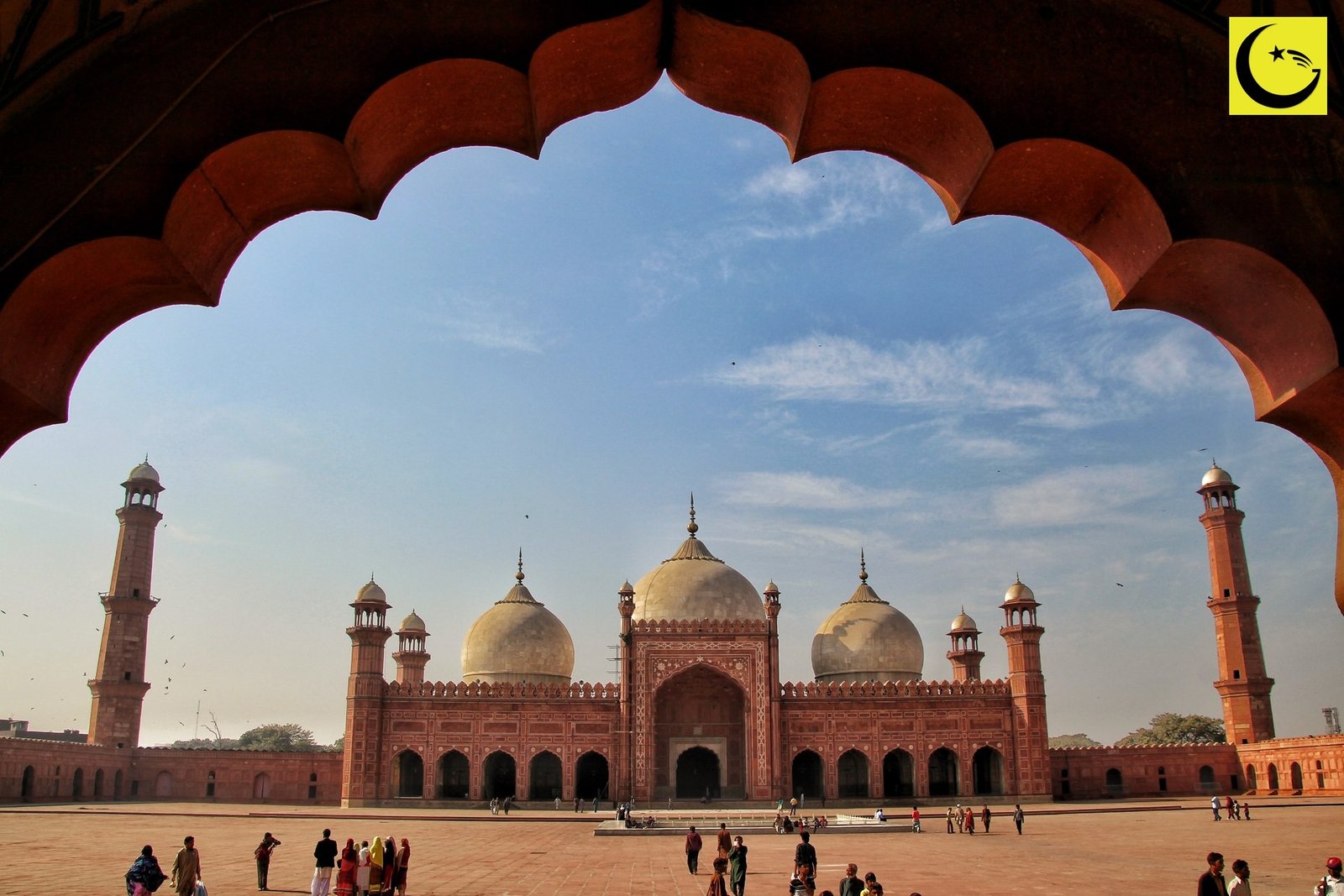
Some records last a season. This one lasted more than three centuries. When it was completed in 1673, the Badshahi Mosque in Lahore became the largest mosque in the world, and it kept that title for 313 years, until 1986. Built for the Mughal emperor Aurangzeb in red sandstone and white marble, it remains the largest mosque of the Mughal era, and its long reign at the top is one of the great building stories of Pakistan.
An Emperor’s Mosque, Finished in Two Years
Aurangzeb, the sixth Mughal emperor, ordered the mosque in 1671, choosing Lahore, one of the empire’s great cities, as its home. The work was overseen by his foster brother Muzaffar Hussein, better known as Fidai Khan Koka, who was governor of Lahore, and it rose at remarkable speed: the gateway inscription dates the building to AH 1084, the Hijri year covering 1673 to 1674, just two years after work began. Aurangzeb modelled his mosque on the Jama Masjid his father Shah Jahan had built in Delhi, but on a far grander scale.
The setting was chosen to make a statement. The mosque stands on a raised platform west of the Lahore Fort, across the garden square of the Hazuri Bagh, and its great gateway faces the fort’s Alamgiri Gate, which Aurangzeb built at the same time. Visitors climb a flight of 22 steps, as UNESCO’s description of the mosque notes, before passing through the two-storey entrance into the courtyard beyond.
The Badshahi Mosque in Numbers
Everything about the building is outsized. The prayer hall is built of red sandstone decorated with carved white marble inlay, and it is crowned by three white marble domes, the largest in the centre. At the four corners of the courtyard stand octagonal red sandstone minarets, each about 60 metres (196 feet) tall and topped with a marble canopy, with four smaller minarets on the prayer hall itself. The courtyard alone spreads over some 25,600 square metres of sandstone paving.
The prayer hall holds about 10,000 worshippers, and the courtyard is often cited as holding around 100,000 more when it is used as an Idgah, an open-air prayer ground: figures that made it, by the measures of its age, the biggest mosque on earth.
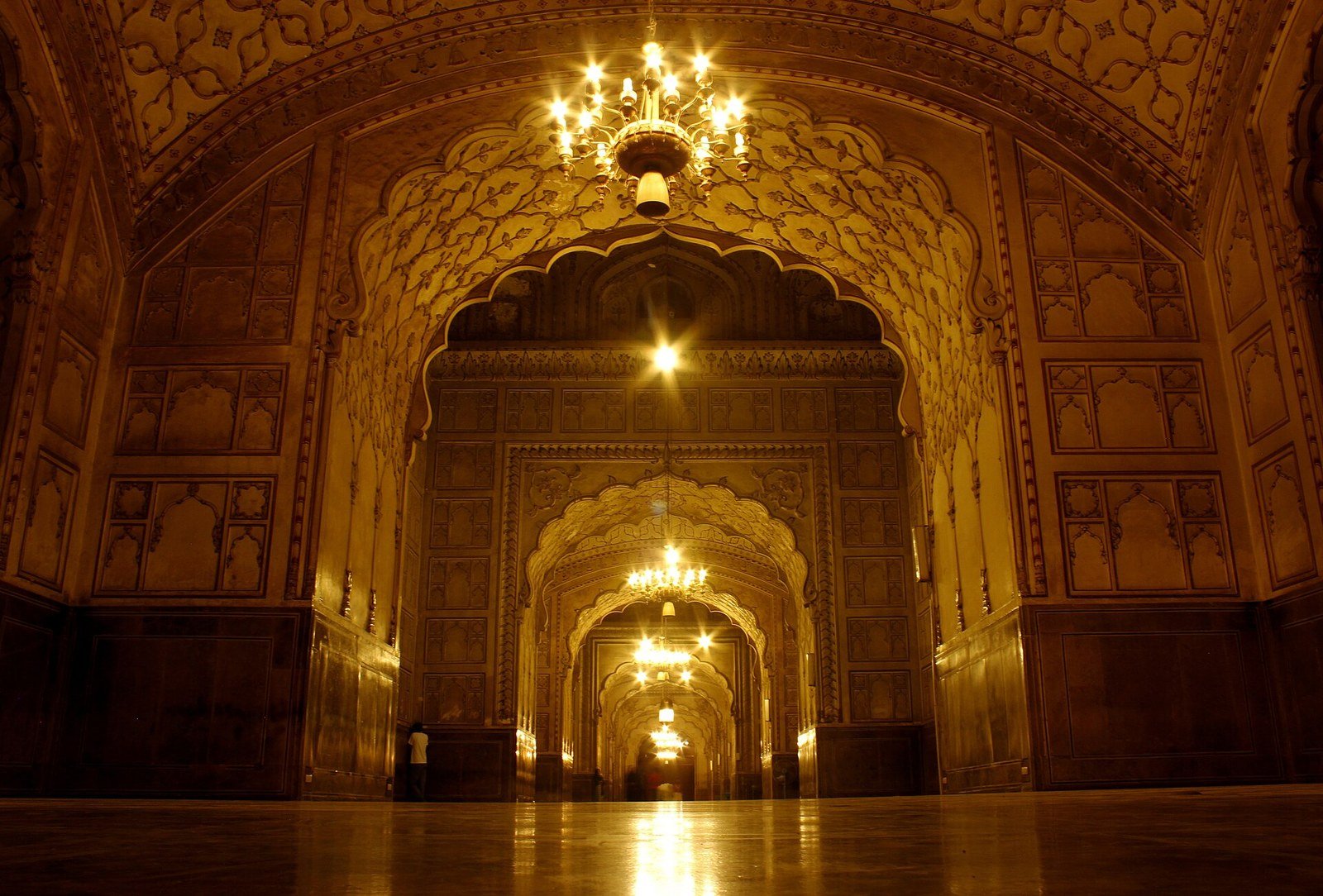
Inside the prayer hall of the Badshahi Mosque in Lahore at night, its rows of arches and chandeliers reflected in the marble floor.
Photo: Ahmad Tahir, CC BY-SA 3.0, via Wikimedia Commons
READ MORE
313 Years at the Top, Then the Title Moved On
From 1673 until 1986, through the fall of the Mughal Empire and the rise and fall of several others, no mosque anywhere surpassed it. When the title finally moved on in 1986, it stayed in Pakistan: the Faisal Mosque in Islamabad, completed that year, became the largest mosque in the world, and it held the honour until 1993. (The Faisal Mosque’s own seven years at the top are Day 20 of this series.) Since then, ever larger mosques have been built, and today the largest mosque in the world is Masjid al-Haram in Makkah. The Badshahi Mosque, meanwhile, remains what it has been since 1673: the largest mosque of the Mughal era.
Stables, Soldiers and a Long Road Back
The building’s middle years were hard. After Mughal power faded, Sikh rulers used the vast courtyard as a stable for army horses and its surrounding rooms as soldiers’ quarters and stores, and under British rule the mosque and fort served as a military garrison. It was handed back to the Muslim community in 1856, and a long restoration, begun in 1939, was completed in 1960. In February 1974 the restored mosque hosted Friday prayers for the heads of Muslim states gathered in Lahore for the second Islamic Summit, a moment that announced its return to the centre of the city’s life.
The mosque also keeps a small museum, best known for a complete Quran hand-stitched on cloth panels in gold and silver thread. And its heritage status is often misstated, so here it is exactly: Pakistan placed the Badshahi Mosque on UNESCO’s Tentative List in 1993, the first step towards any World Heritage nomination, but the mosque is not itself a World Heritage Site. That honour in Lahore belongs to the Fort and Shalamar Gardens, inscribed in 1981, in the same historic landscape across the Hazuri Bagh.
Why This Fact Sits in the Record Books
This series keeps two kinds of facts apart. Some are still true today; others, like this one, are labelled From the Record Books, and they are published with the full story: when the record was set, how long it was held, and who holds it now. By that honest measure the Badshahi Mosque needs no exaggeration. For 313 years, longer than most nations have existed, the largest mosque in the world stood in Lahore, and it still rises over the Walled City each morning, red sandstone glowing, exactly where Aurangzeb’s builders left it.
Sources
- Encyclopaedia Britannica: Bādshāhī Mosque
- UNESCO World Heritage Centre: Badshahi Mosque, Lahore (Tentative List)
- Wikipedia: Badshahi Mosque
- Featured photo: The prayer hall of the Badshahi Mosque seen through a courtyard arch (Photo: Fassifarooq, CC BY-SA 4.0, via Wikimedia Commons)
- Prayer hall photo: Inside the prayer hall of the Badshahi Mosque at night (Photo: Ahmad Tahir, CC BY-SA 3.0, via Wikimedia Commons)

Umar Farooq is the founder and editor of Good News Pakistan. An engineer by profession and a writer by passion, he started the site in December 2022 to share good news from Pakistan, and has since written and edited more than 200 articles about its people, sports, science, business and world records. He believes the story of Pakistan is bigger than its headlines, and that good news, told honestly, is worth telling every day.