

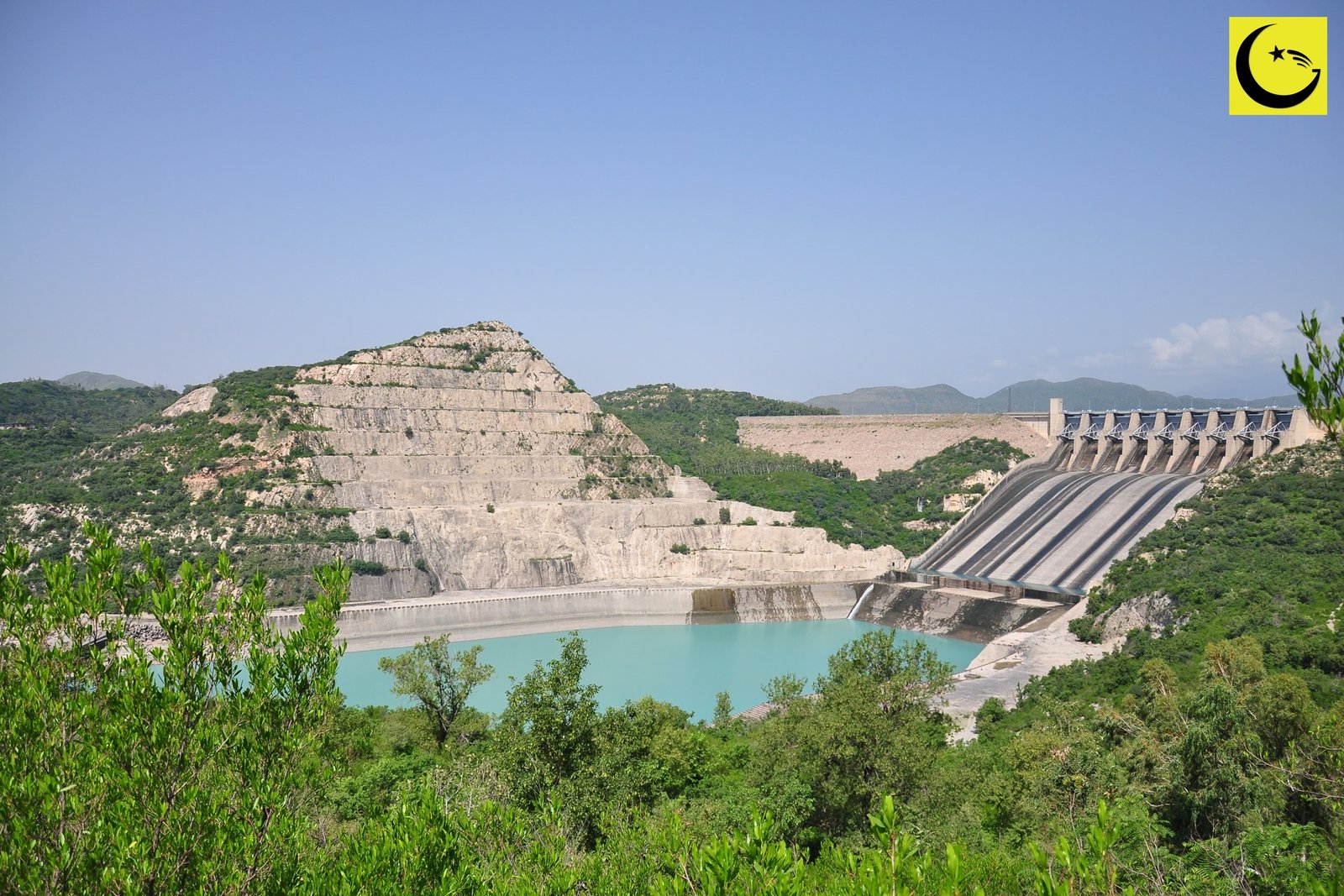
Tarbela Dam, the great earth and rock fill embankment across the Indus River in Khyber Pakhtunkhwa, is the largest earth-filled dam in the world by volume. Built between 1968 and 1976, it holds about 106 million cubic metres of fill in a wall 143 metres high and 2,743 metres long at the crest, and its power stations carry an installed capacity of 4,888 MW, the largest of any generating facility in Pakistan.
What earth-filled means, and how the Tarbela Dam record is measured
An earth-filled dam is not a single wall of concrete. It is a vast engineered hill: layer upon layer of compacted earth and rock, placed and rolled until the mass of the fill itself holds back the river. Tarbela was built this way because the Indus at this point, where the river leaves the Himalayan foothills and enters the Pothohar Plateau, demanded a structure of enormous bulk rather than height.
The world ranking is measured on that bulk. Encyclopaedia Britannica gives the dam a volume of 138.6 million cubic yards, which is 106 million cubic metres of earth and rock fill, and describes it as the largest earth and rock fill dam in the world by volume. That qualifier matters, and this series always prints it: Tarbela is the largest earth-filled dam in the world by volume, not the largest dam of every kind on every measure. Even set against dams of all types, its fill volume places it among the very largest dam structures ever built.
The main embankment is flanked by two auxiliary dams on the left bank, and the reservoir it creates, Tarbela Lake, runs about 80.5 kilometres long with a surface area of roughly 250 square kilometres. Two spillways cut through the left bank carry flood water safely past the dam: the service spillway can discharge 650,000 cusecs and the auxiliary spillway 850,000 cusecs. Five tunnels were driven through the rock, the first three for power, the fourth and fifth built for irrigation and later turned to power as well.
Built on the Indus, 1968 to 1976
Tarbela was one of the major structures of the Indus Basin Project, the vast programme of dams and link canals that followed the Indus Waters Treaty of 19 September 1960. The Water and Power Development Authority, WAPDA, which Pakistan had set up in 1958, executed the project for the government, and the civil works were carried out by the Tarbela Dam Joint Venture, a consortium led by the Italian firm Impregilo, under what was then the largest single civil works contract of its kind.
Construction began in 1968 and the dam was completed in 1976. The first power units followed from 1977, and the reservoir began the double job it has done ever since: storing the Indus in the high flow season and releasing it in the low flow winter, for farms, for flood control and for electricity. Fifty years on, the embankment those engineers raised still holds the record it set on completion.
READ MORE
Pakistan Has the World’s Largest Irrigation System
Power on a national scale: 4,888 MW
The power complex at Tarbela Dam grew in stages, tunnel by tunnel. Ten units of 175 MW on the first two tunnels and four units of 432 MW on the third took the station to 3,478 MW. The fourth extension, built on Tunnel 4 and in service from 2018, added three units of 470 MW each, another 1,410 MW, and lifted the total to the present 4,888 MW from 17 generating units.
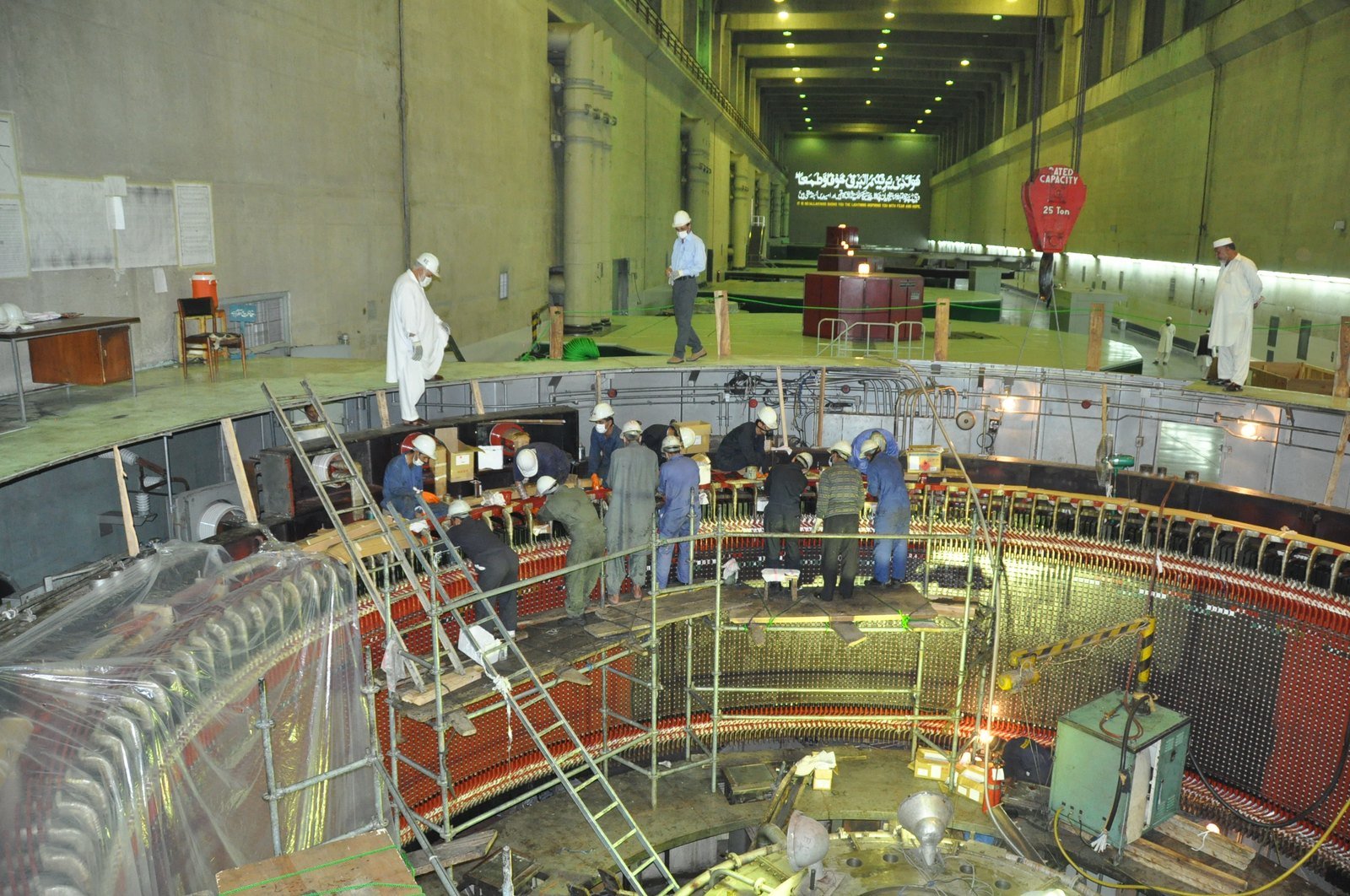
Inside the Tarbela powerhouse, engineers work on a generator during maintenance in the turbine hall that houses the dam’s generating units.
Photo: USAID Pakistan, public domain, via Wikimedia Commons
That total makes Tarbela the biggest electricity generation facility in Pakistan. WAPDA briefings put its 4,888 MW at 51.6 percent of the authority’s total hydel capacity, and the station’s contribution over its life is measured in hundreds of billions of units: a World Bank delegation visiting in February 2025 was told the dam had contributed about 597 billion units of low cost, environment friendly hydel electricity to the national grid since completion, alongside about 411 million acre feet of stored water released for agriculture.
The silt problem, stated honestly
The Indus is a young mountain river, fed by glacial meltwater, and it carries an enormous load of sediment down from the Himalayas. Year by year that silt settles in the still water of the reservoir, and it has taken a real share of the storage held behind Tarbela Dam. The reservoir was designed with a live storage of 9.68 million acre feet. Later surveys put the remaining live storage at about 6.8 million acre feet, and Dawn reported in October 2025 that it had fallen further, to 5.73 million acre feet, a loss of roughly 40 percent against the design figure.
Those older design figures are still widely quoted as if they were current, and they are not: 9.68 million acre feet is the 1974 design value, not today’s storage. The honest picture is still a strong one. Sedimentation has run slower than the first engineers feared, and the useful life of the dam and reservoir, once put at about 50 years, is now estimated at about 85 years, running to around 2060. Upstream storage on the Indus, above all the Diamer Bhasha Dam now under construction, is expected to cut the sediment load reaching Tarbela sharply and extend that life further.
READ MORE
The World’s Highest ATM: Ten Years of Cash in the Clouds at Khunjerab Pass
The fifth extension: a bigger Tarbela, paused
The next stage of growth is the fifth extension, T5, which puts a powerhouse on Tunnel 5, the last of the original tunnels. Its three units of 510 MW each would add 1,530 MW and take the station from 4,888 MW to 6,418 MW, with finance from the World Bank and the Asian Infrastructure Investment Bank. That figure is a plan, not a present fact, and after the events of this month it cannot be presented as on track.
On 9 November 2026, during excavation of the connecting tunnel at the T5 site, a weak rock mass collapsed and a protective bund was breached, sending water from the intake pit into Tunnel 5 and the unfinished powerhouse area. Construction was suspended indefinitely, and WAPDA declared an emergency at the site while workers were moved to safety. WAPDA has said the main tunnel, the powerhouse, the tailrace and the switchyard were not damaged, that the intake pit was drained and pumping begun at the powerhouse, and a high level inquiry is examining how the bund failed. It was the second flooding at the T5 site in about fifteen months, after rising reservoir water entered the site in August 2025, and completion had already slipped to September 2027 before this latest halt.
None of that touches the record this article is about. The dam itself was declared safe by WAPDA within a day of the incident, the existing 4,888 MW station is untouched, and the embankment across the Indus remains what it has been since 1976: the largest earth-filled dam in the world by volume, still storing the river for Pakistan’s farms and still the single biggest source of power in the country. More of the country’s records and world standings are collected on our Pakistan World Rankings and Records page.
Sources
- Encyclopaedia Britannica: Tarbela Dam: dimensions, history and power generation
- Wikipedia: Tarbela Dam: project description, extensions and reservoir data
- World Bank: Tarbela Fourth Hydropower Extension Project factsheet
- The News International: World Bank executive directors visit Tarbela Dam, February 2025
- SANDRP: November 2026: another setback for Pakistan’s Tarbela T-5 project
- Skardu Times: Rock fall floods Tarbela tunnel 5, workers evacuated unhurt
- Skardu Times: WAPDA says Tarbela Dam safe after rock collapse at extension site
- Featured image: Photo: Waleed Pervaiz, CC BY-SA 3.0, via Wikimedia Commons
- In-body image: Photo: USAID Pakistan, public domain, via Wikimedia Commons

Umar Farooq is the founder and editor of Good News Pakistan. An engineer by profession and a writer by passion, he started the site in December 2022 to share good news from Pakistan, and has since written and edited more than 200 articles about its people, sports, science, business and world records. He believes the story of Pakistan is bigger than its headlines, and that good news, told honestly, is worth telling every day.