


Pakistan successfully carried out the Fatah-3 missile test on Wednesday, 18 November 2026, launching the indigenously developed supersonic cruise missile in what the military called another significant milestone for the country’s national defence. The launch was announced by the Inter-Services Public Relations (ISPR), the media wing of the armed forces, and it places a fast, long range precision weapon at the centre of the Pakistan Army’s growing rocket and missile capability.
What the Fatah-3 Missile Test Announced
According to the ISPR statement carried by national news outlets, the Pakistan Army conducted the successful launch of the Fatah-3 supersonic cruise missile on Wednesday. “The Pakistan Army successfully conducted the launch of the Fatah-3 supersonic cruise missile, marking another significant milestone in strengthening Pakistan’s national defence capabilities,” the statement said. It added: “The weapon system is equipped with advanced navigation and propulsion systems and is capable of engaging targets at long range with high precision and lethality at supersonic speed.”
The ISPR did not disclose the missile’s range, its exact speed or the location of the test, and no date was announced for when the system will formally enter service. What the statement did confirm is who was present. The launch was witnessed by the Commander of the Army Rocket Force Command, senior officers of the Pakistan Armed Forces, and the scientists and engineers involved in developing the missile system, a detail that underlines how closely the test was tied to the teams who built it.
Why the Launch Matters for the Army Rocket Force Command
The Fatah-3 belongs to the Army Rocket Force Command (ARFC), the dedicated command that Pakistan raised in August 2025 to bring its conventional guided rockets and missiles under one specialised headquarters. Prime Minister Shehbaz Sharif announced the formation of the command on 13 August 2025, and it has since overseen a steady programme of training and test launches. The ISPR said the new weapon system will “significantly enhance the operational flexibility and strike reach” of the command, further strengthening the country’s conventional deterrence and overall defence posture.
READ MORE
Pakistan’s First Astronaut Confirmed for Shenzhou-24 Flight to China’s Tiangong Station
Wednesday’s launch also continues a busy season for Pakistani missile development. In October, the Army Rocket Force Command test launched the extended version of the Fatah-IV ground launched cruise missile on 6 October and the Fatah-2 extended range missile on 13 October. Earlier in November, the Pakistan Air Force carried out a successful flight test of the Fa’az, the country’s first indigenously developed air to air missile. Together, the launches point to a deliberate, step by step effort to design, build and prove advanced weapons at home rather than relying on imported systems.
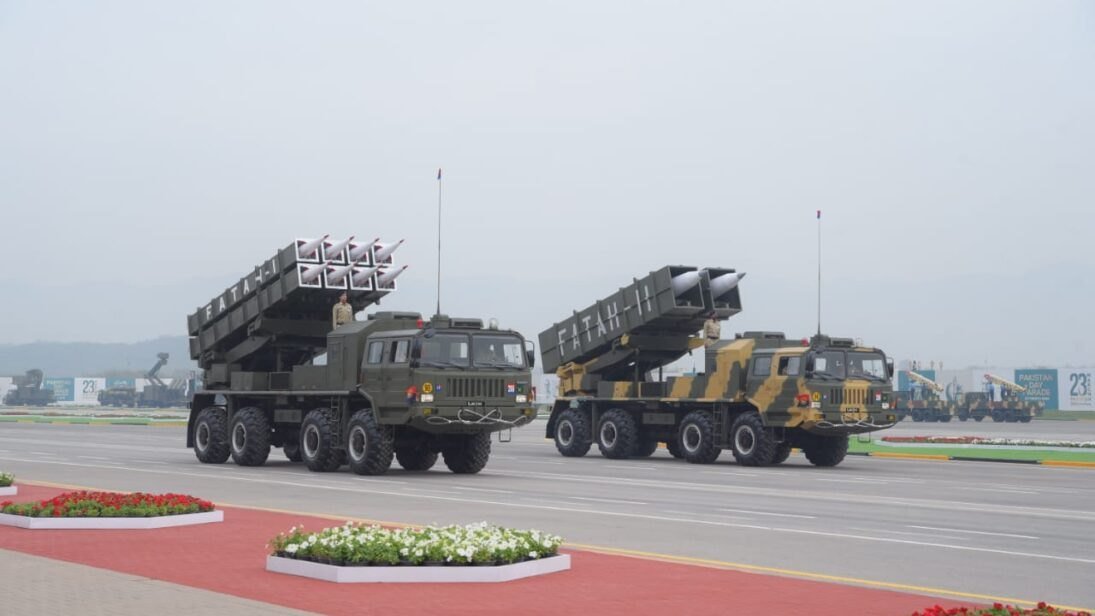
Fatah-1 and Fatah-2 launchers of the Pakistan Army on parade, earlier members of the indigenous Fatah family of guided rockets and missiles.
Photo: Wikimedia Commons
A Family Built at Home: The Fatah Series
The Fatah name, which means victory, covers a family of guided rockets and missiles developed in Pakistan by the National Engineering and Scientific Commission (NESCOM) and marketed by Global Industrial and Defence Solutions (GIDS). The series began with the Fatah-1, unveiled in January 2021 as the country’s first indigenously developed guided multiple launch rocket system, with a range of up to 140 kilometres. The larger Fatah-2 followed, first tested in December 2023 with a range of around 400 kilometres, while the Fatah-IV added a ground launched cruise missile able to cover a reported 750 kilometres.
The Fatah-3 was first revealed to the public in May 2026, when the ISPR presented it as a supersonic cruise missile during a briefing marking the first anniversary of Operation Bunyan al Marsoos. Wednesday’s Fatah-3 missile test was therefore the moment a system shown earlier this year moved from unveiling to a full, successful launch, confirmed by the military itself.
What a Successful Test Proves
A test launch of this kind is, in general terms, a proving exercise for the whole weapon system at once. Engineers use it to validate the guidance and navigation package that keeps the missile on its planned path, the propulsion system that carries it to supersonic speed and sustains that speed in flight, and the accuracy with which it can engage a distant target. A successful firing also confirms that the launcher, the ground crews and the command procedures around the missile work together as one system under real conditions. For the teams behind the Fatah-3 missile test, the value of the day lies in that complete chain working end to end.
Praise for the Scientists and Engineers
The country’s civil and military leadership was quick to credit the people behind the programme. President Asif Ali Zardari, Prime Minister Shehbaz Sharif, Chief of Defence Forces and Chief of the Army Staff Field Marshal Syed Asim Munir, and the services chiefs congratulated the armed forces and the teams involved on the successful launch. According to the ISPR, they praised the dedication and commitment of the scientists, engineers and personnel who helped achieve this milestone in developing Pakistan’s national defence capabilities. Interior Minister Mohsin Naqvi also congratulated the nation on the successful launch.
For a country that has steadily invested in its own defence industry, the Fatah-3 launch is best read as a story of home grown engineering: a missile conceived, developed and tested by Pakistani scientists and engineers, flown by a Pakistani command created to operate exactly this class of weapon, and announced to the public as a milestone in national self reliance.
Sources
- Dawn: Pakistan conducts successful launch of Fatah-3 supersonic cruise missile: ISPR
- The Express Tribune: Military successfully tests launch of Fatah-3 supersonic cruise missile
- Geo News: Pakistan conducts successful launch of Fatah-3 supersonic cruise missile
- Arab News Pakistan: Pakistan says successfully test-fired Fatah-3 supersonic cruise missile
- Quwa: GIDS Fatah Guided Surface-to-Surface Missiles (family background)
- Featured photo: The Fatah-3 supersonic cruise missile lifts off from its road mobile launcher in imagery released by the ISPR. (Photo: ISPR)
- Body photo: Fatah-1 and Fatah-2 launchers of the Pakistan Army on parade. (Photo: Wikimedia Commons)

Umar Farooq is the founder and editor of Good News Pakistan. An engineer by profession and a writer by passion, he started the site in December 2022 to share good news from Pakistan, and has since written and edited more than 200 articles about its people, sports, science, business and world records. He believes the story of Pakistan is bigger than its headlines, and that good news, told honestly, is worth telling every day.