

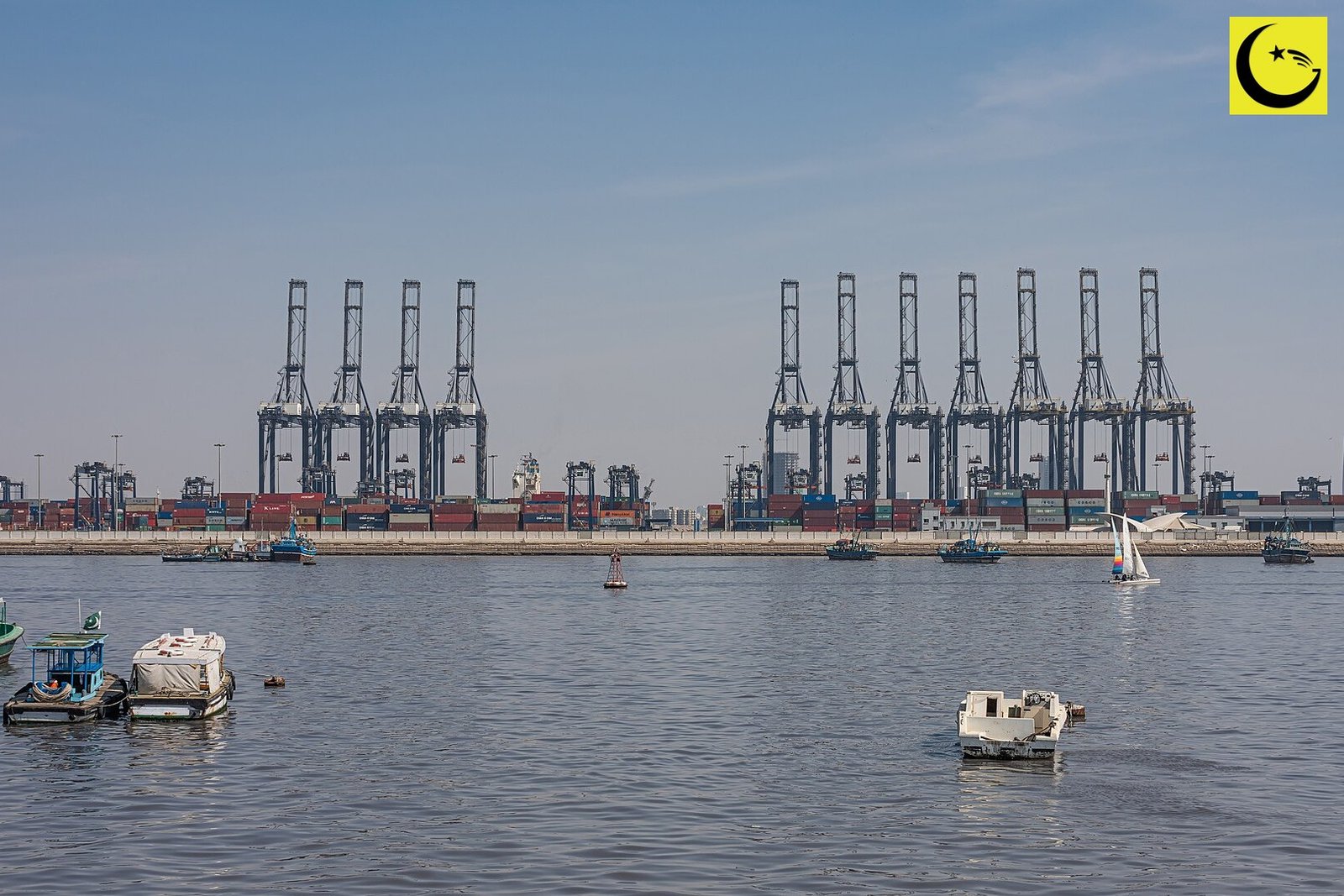
Construction is advancing on the Karachi Port Pipri freight corridor, a 50 kilometre dedicated freight railway that will move containers by train between Karachi Port and the Pipri Marshalling Yard instead of by truck, with 2.5 kilometres of track laid by October 2026 and work under way on a multi-modal logistics park at Pipri, according to Ministry of Railways documents reported by Wealth Pakistan this week. The project, developed by DP World, the National Logistics Corporation (NLC) and Pakistan Railways, tackles a problem every Karachi driver knows well: nearly all of the port’s cargo currently leaves by road, on thousands of trucks a day.
What the Karachi Port Pipri freight corridor will carry
The corridor runs from the berths of Karachi Port, Pakistan’s largest and busiest harbour, eastwards to the Marshalling Yard at Pipri, a major rail hub on the city’s outskirts. Once it is working, import containers unloaded from ships will be loaded straight onto freight trains, carried to Pipri, and then dispatched onward by rail and road to destinations across Pakistan. Export containers will make the same journey in reverse, arriving at the port by train rather than threading through city traffic.
At the launch of construction in January 2026, officials said the link would also feed onward routes towards China and Central Asia, aligned with Pakistan Railways’ Main Line 1 (ML-1) upgrade under the China-Pakistan Economic Corridor framework. The logic is simple: containers moving between a quay and one fixed rail yard are exactly the traffic that belongs on rails.
Progress on the ground: 2.5 kilometres laid and a logistics park rising
The latest progress report shows the scheme has moved well beyond the announcement stage. Construction was under way by September 2026, with the DP World NLC (Pvt) Ltd team mobilised on site, and by October 2.5 kilometres of track laying had been completed. The November 2026 update shows work continuing at the logistics park on offices, establishment facilities and loading and unloading platforms.
The project is being built in two phases. The first phase upgrades the existing railway track (launch coverage put the phase one rehabilitation at 52 kilometres of line) and is planned to accommodate two freight trains a day. The second phase envisages a new double track that would lift capacity initially to 17 trains a day. The logistics park grows with it, from about 25 acres in the first phase to a planned 500 acres in the second.
READ MORE
Sialkot Exports: How One City Built Its Own Airport, Airline and Dry Port
Who is building it, and what Phase 1 costs
Phase 1 carries a $20 million investment, split between $17 million from the NLC as concessionaire (85 percent) and $3 million from Pakistan Railways as grantor (15 percent), according to the ministry documents. The NLC share includes $9 million for building the Multi-Modal Logistics Park, $3.5 million for locomotives, $2.5 million for rolling stock and $2 million for material handling equipment. Pakistan Railways’ $3 million covers track safety works between Karachi Port Trust and Pipri, including $2.175 million of permanent way works, $718,000 of signalling and $107,000 of electrical works.
That $20 million is the opening tranche of a much larger programme. When the partnership was announced in 2025, the NLC said construction would commence with immediate foreign direct investment of $20 million, subsequently reaching $400 million under the joint venture between DP World, the NLC and Pakistan Railways, a figure also carried by Business Recorder and Arab News. The ministry documents put the second phase alone at about $410 million. The road to construction ran through a framework agreement with the Government of Dubai on 17 January 2024, a term sheet in January 2025, the Phase 1 commercial agreement on 8 September 2025, and a groundbreaking on 9 January 2026 attended by Railways Minister Hanif Abbasi and DP World Chairman and CEO Sultan Ahmed bin Sulayem.
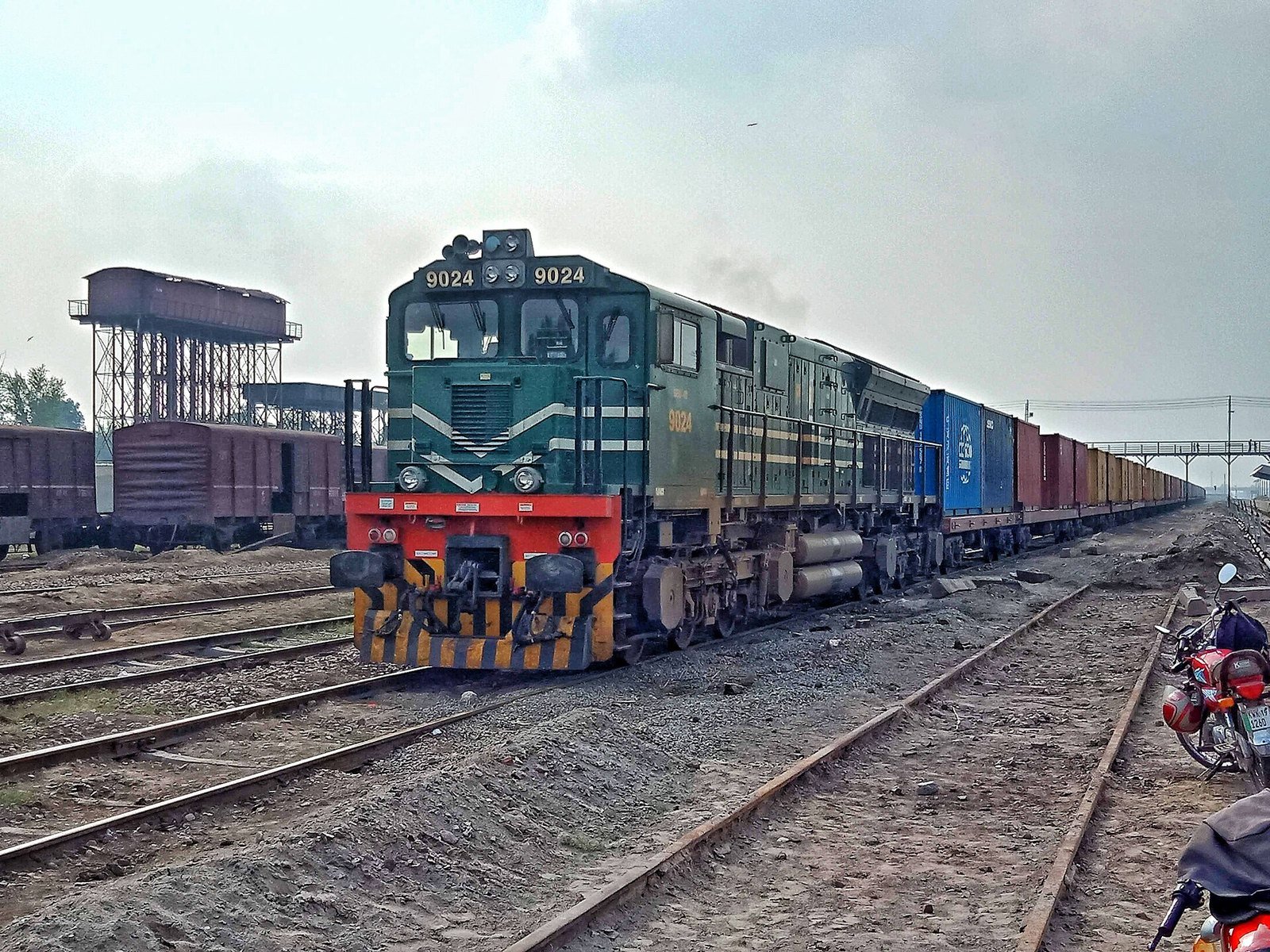
A Pakistan Railways GEU-40 locomotive hauls a long container train, the kind of traffic the new corridor is being built to grow.
Photo: Mazahirshah, CC BY-SA 4.0, via Wikimedia Commons
Why it matters for Karachi’s roads and Pakistan’s exporters
The case for the corridor starts with a single striking number. According to the ministry’s project assessment, about 17,000 trucks travelled to and from Karachi Port every day during 2023-24, nearly all port cargo moved by road, the railway was underused, and truck operations were restricted to the hours between 11pm and 6am. That pattern means port traffic competes with city traffic all night, wears out urban roads, and leaves cargo at the mercy of congestion and delays.
Moving even part of that flow onto trains changes the arithmetic for everyone. Containers cleared faster mean ships and terminals turn around more quickly, and exporters up country get a more predictable, cheaper route to the quay. At the project’s launch, officials estimated the wider programme could save up to Rs100 billion a year in logistics costs and transit times, alongside lower emissions and a longer life for Karachi’s roads. For the Karachi Port Pipri freight corridor, success will be measured in a very visible way: fewer container trucks on the roads between the port and Pipri, and more of them on rails.
READ MORE
Pakistan Goods Exports Hit a Record $11.34 Billion in First Four Months of FY27
A bigger bet on rail freight
The corridor is also a statement about Pakistan’s freight future. For decades the railway’s share of cargo has shrunk while trucking has grown, even on fixed routes where rail is cheaper per tonne. A dedicated port freight line, built with a global operator and foreign investment and tied into the ML-1 upgrade, is meant to prove rail freight can win traffic back.
There is still a long way to go: 2.5 kilometres laid is a start on a 50 kilometre corridor, and the jump from two trains a day to 17 will test both track and logistics park. But the direction is set and the phase one money is committed. If the Karachi Port Pipri freight corridor delivers its first phase on schedule, Karachi gets quieter roads, the port gets faster evacuation, and Pakistan Railways gets a freight business worth growing.
Sources
- Wealth Pakistan (INP): Karachi Port-Pipri freight corridor advances as 2.5km track laid, reporting Ministry of Railways documents, 18 November 2026
- Arab News: Dubai’s DP World to invest $400 million in Pakistan rail freight corridor, reporting the NLC statement, August 2025
- The Nation: NLC starts work on Dedicated Freight Corridor and Multimodal Logistics Park, Pipri, 12 January 2026
- Radio Pakistan: Significant progress made in $400m NLC, Pakistan Railways and DP World logistics project, 10 January 2026
- Featured photo: Container cranes and stacked containers at the container port in Karachi, Pakistan. (Photo: A.Savin, Free Art License, via Wikimedia Commons)
- Body photo: A Pakistan Railways GEU-40 locomotive, number 9024, hauling a container freight train. (Photo: Mazahirshah, CC BY-SA 4.0, via Wikimedia Commons)

Umar Farooq is the founder and editor of Good News Pakistan. An engineer by profession and a writer by passion, he started the site in December 2022 to share good news from Pakistan, and has since written and edited more than 200 articles about its people, sports, science, business and world records. He believes the story of Pakistan is bigger than its headlines, and that good news, told honestly, is worth telling every day.