

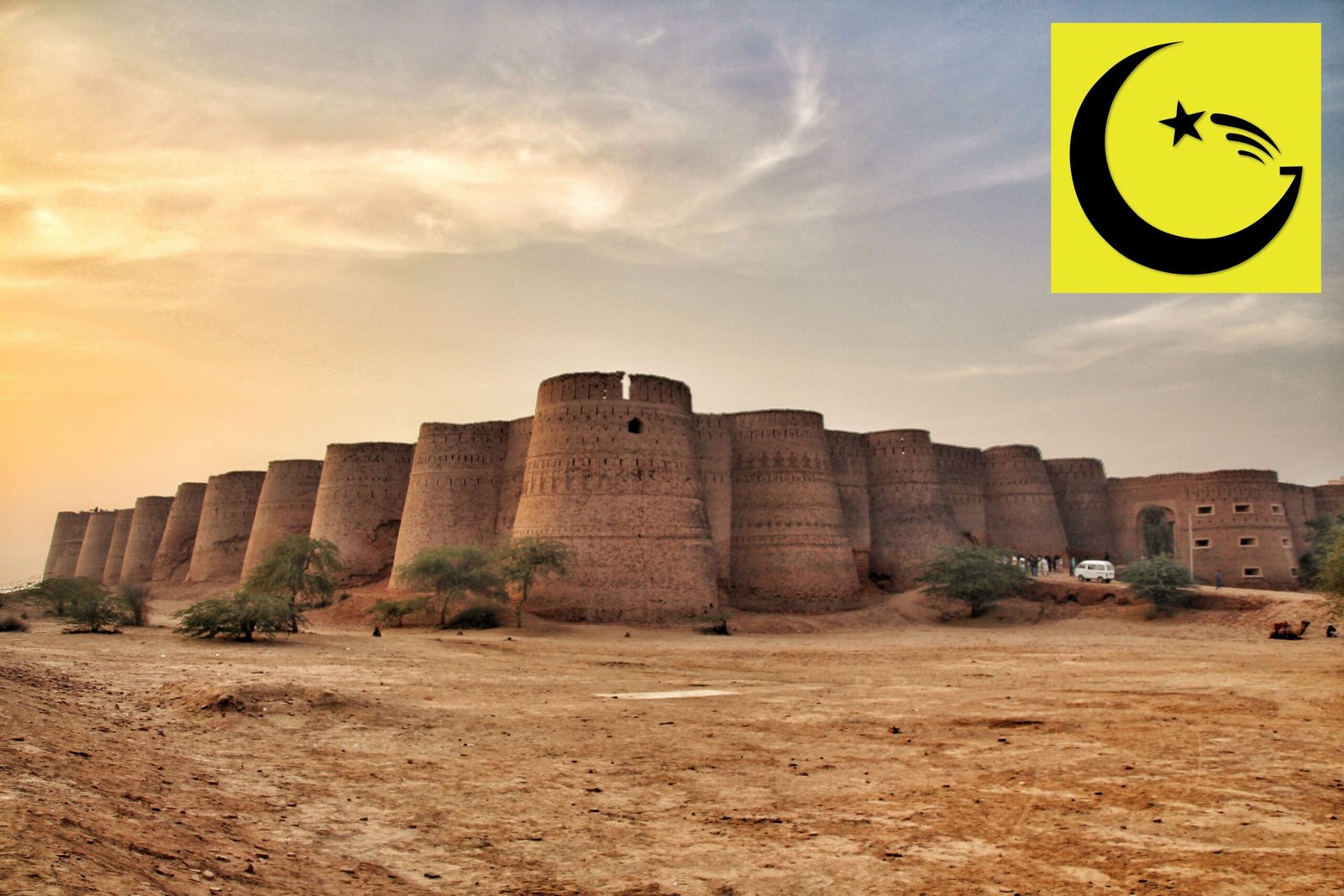
Derawar Fort stands alone in the Cholistan Desert of Bahawalpur District, a square fortress of baked clay brick whose forty circular bastions rise up to 30 metres above the sand. Its walls run about 1,500 metres around the square, ten bastions to a side, and travellers crossing the flat desert can pick out its silhouette from miles away. It is the finest and best preserved of the desert forts of Cholistan, and the wonder at the heart of this district.
Why build such a giant in an empty desert? The answer is water. Derawar Fort was placed at a point where deep water deposits, the last remains of the ancient Hakra River, could be reached beneath the sand. Whoever held the fort held the wells, and whoever held the wells controlled the caravan routes that crossed Cholistan carrying goods, pilgrims and news between the Indus valley and the lands beyond. UNESCO, which placed Derawar and the desert forts of Cholistan on its Tentative List in 2016, describes the forts as a network built around exactly this logic of water, protection and trade.
Derawar Fort Through the Centuries
Tradition dates the first fort on this ground to the ninth century, raised by Rai Jajja Bhati, a Rajput ruler of the Bhatti clan, and the year 858 CE is the date local history attaches to it. The fort that stands today owes its form to the Abbasi Nawabs of Bahawalpur. Nawab Sadeq Muhammad Khan I took Derawar in 1733 and rebuilt it in broadly the shape visitors see now, a perfect square of massive round towers linked by high curtain walls. The Nawabs kept the fort as a residence into the 1970s, and that constant occupation is one reason its brickwork survived while sister forts crumbled back into the sand.
Beside the walls stand the fort’s two companions: the royal graveyard of the Abbasi family, where generations of Nawabs lie in carved and tiled tombs, and the Abbasi mosque, a gleaming white marble building raised in 1849 by Nawab Bahawal Khan III. Together, fort, graveyard and mosque form a complete desert court, preserved in brick and marble at the edge of the dunes.
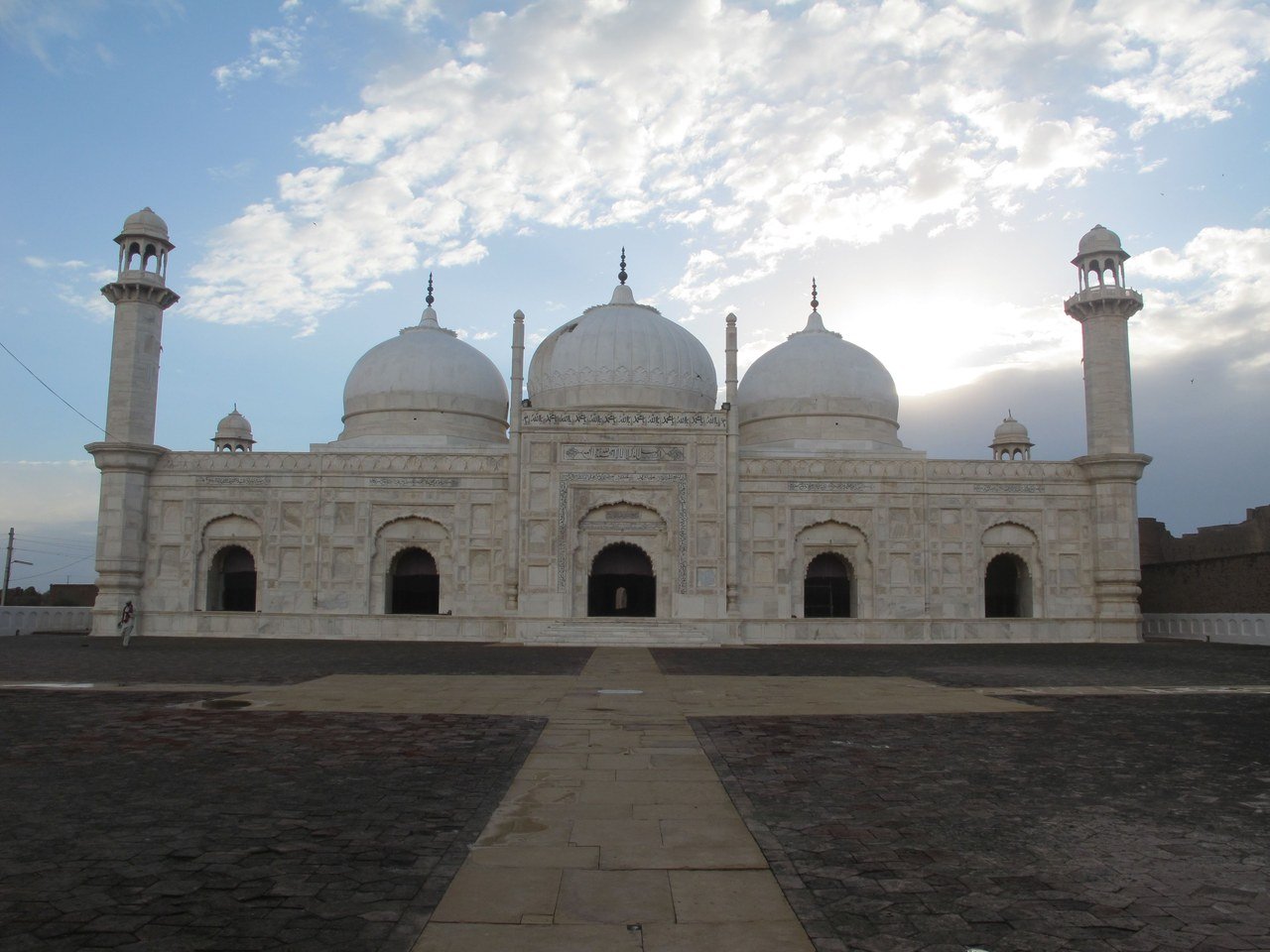
The Abbasi Mosque, the gleaming white marble building raised in 1849, stands beside the fort’s walls with a clay bastion rising behind it.
Photo: Muhammadmadni9, CC BY-SA 4.0, via Wikimedia Commons
READ MORE
The Badshahi Mosque Was the Largest Mosque in the World for 313 Years
The Chain of Desert Forts
Derawar was never alone. Up to a dozen forts once guarded the wells and tracks of Cholistan: Meergarh, Jaangarh, Marotgarh, Maujgarh, Dingarh, Khangarh, Khairgarh, Bijnotgarh and Islamgarh among them. Some still stand in part; others have melted back into the desert they were built from. Derawar Fort is the best surviving and the largest of the chain, the one fort where a visitor can still read the whole system at a glance: the wells inside the walls, the stores and garrison quarters, and the lookout towers that watched the horizon for caravans and raiders alike.
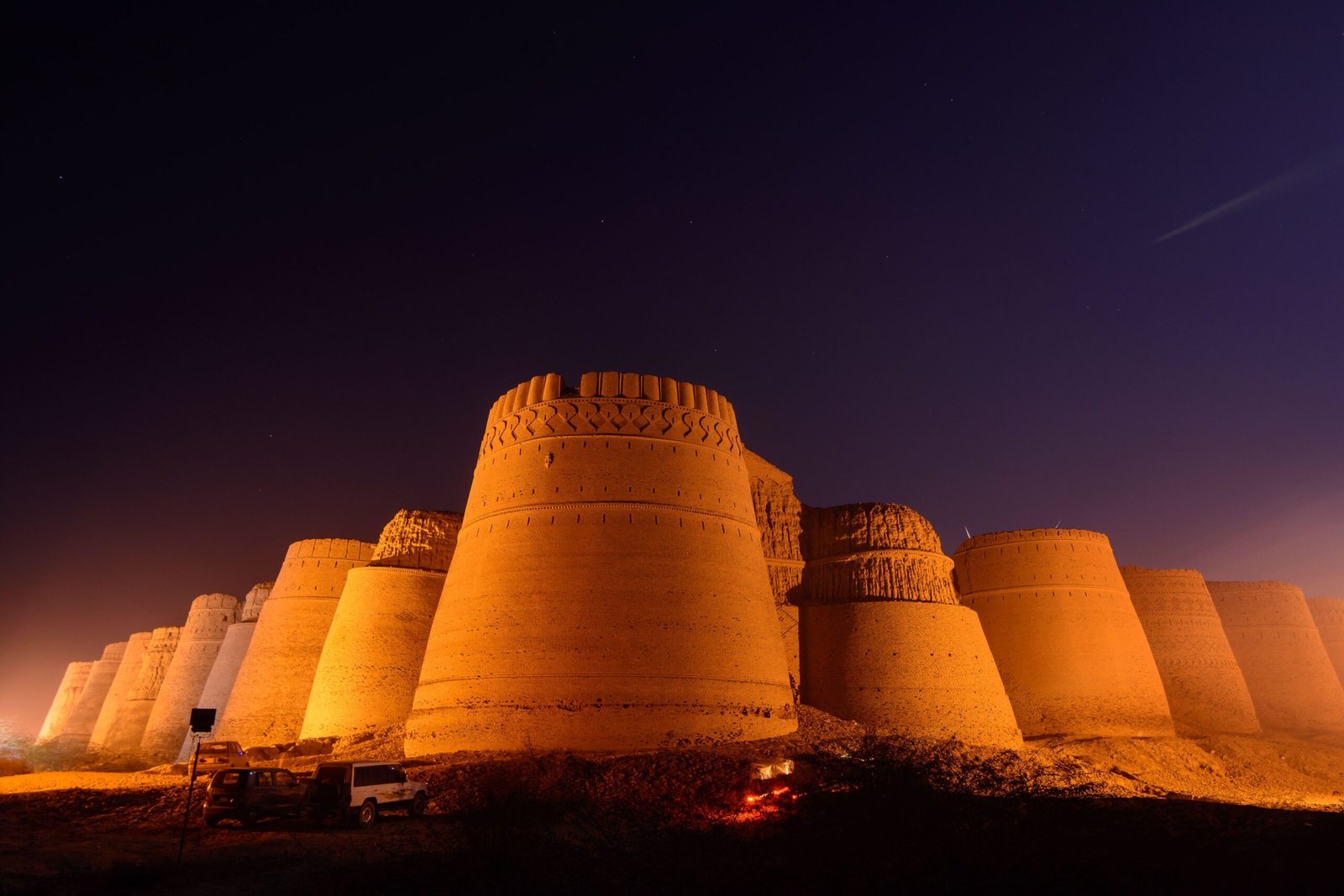
After dark, floodlights turn the clay brick bastions gold against the desert night.
Photo: Mhtoori, CC BY-SA 4.0, via Wikimedia Commons
The Fort Today
Stand at the foot of the walls at sunrise and the fort explains itself. The bastions are so large that each one feels like a tower in its own right, ringed with patterned brickwork and made to be seen from far across the plain, and the curtain walls run straight as a ruler’s edge from one to the next. Through the great gateway lies a walled town in miniature, with room for a garrison, its animals, its stores and the deep wells that made the whole position possible. Photographers come for the first and last light of the day, when the clay brick glows red and the fort’s long shadow stretches out across the sand.
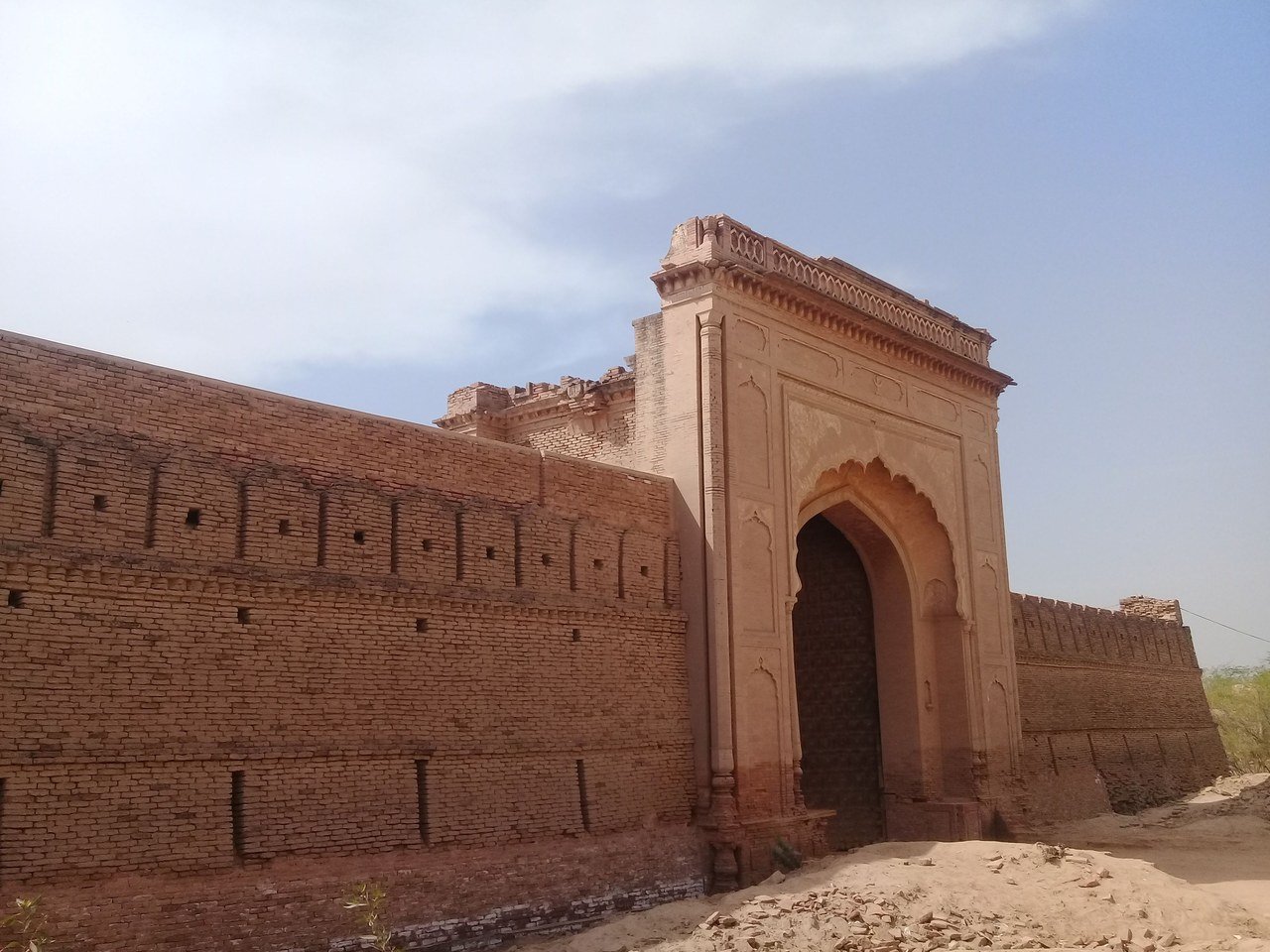
The great gateway of Derawar Fort, the arched entrance that leads through the walls to the garrison town inside.
Photo: Umairsid, CC BY-SA 4.0, via Wikimedia Commons
The fort sits about 20 kilometres south of Ahmedpur East in Yazman Tehsil, reached by a road that runs straight out into the sand. Each year the Cholistan Desert Jeep Rally brings thousands of visitors to the fort’s shadow, and for a few days the quiet desert fills with engines, camps and flags. For the rest of the year Derawar keeps its silence, visited by travellers who come for the sheer scale of the walls and the strange beauty of a palace fortress rising from an empty plain.
UNESCO’s Tentative List entry, submitted by the Government of Pakistan in 2016 under criteria (iii) and (v), is a first step on the road to World Heritage inscription, not the inscription itself, and the fort’s caretakers are the first to say so. Derawar Fort remains linked to the Abbasi family, and entry inside is by permission rather than by ticket, so most visitors walk the outside walls and take in the bastions from the desert floor, which is where the fort shows its full power anyway. For Bahawalpur District, this fortress is more than an old building. It is proof that this desert was once a crossroads of the world, and it still stands tall enough to remind everyone who sees it.
Sources
- UNESCO World Heritage Centre, Derawar and the Desert Forts of Cholistan, Tentative List entry (2016)
- Government of Punjab, Bahawalpur District portal
- Featured photo: Fassifarooq, CC BY-SA 4.0, via Wikimedia Commons
- Body photo: Mhtoori, CC BY-SA 4.0, via Wikimedia Commons
- Extra body photo: Photo: Muhammadmadni9, CC BY-SA 4.0, via Wikimedia Commons
- Extra body photo: Photo: Umairsid, CC BY-SA 4.0, via Wikimedia Commons

Umar Farooq is the founder and editor of Good News Pakistan. An engineer by profession and a writer by passion, he started the site in December 2022 to share good news from Pakistan, and has since written and edited more than 200 articles about its people, sports, science, business and world records. He believes the story of Pakistan is bigger than its headlines, and that good news, told honestly, is worth telling every day.