

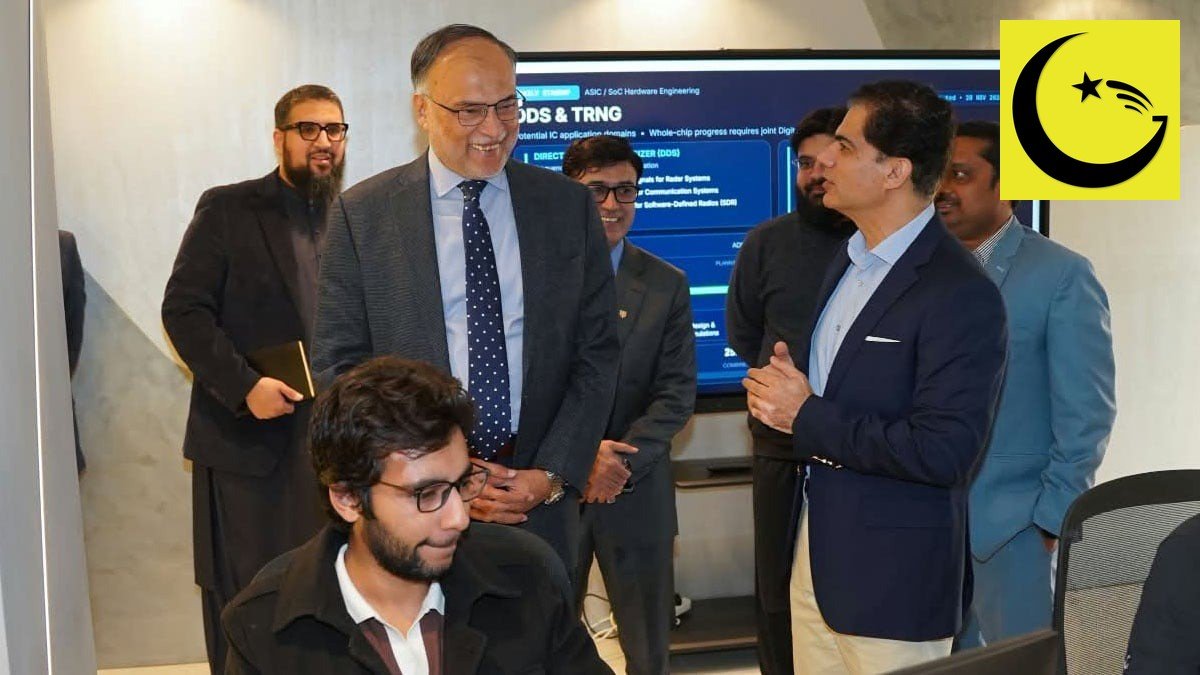
Pakistan will set up 10 National Catapults, a network of shared centres where universities, start-ups and manufacturers can test new technologies, refine prototypes and prepare them for commercial production, Planning Minister Ahsan Iqbal announced on Friday 20 November 2026. The network will be built under the Science, Technology and Engineering for Development programme, known as STED, a flagship initiative of URAAN Pakistan, and its purpose is to close the long-standing gap between research carried out in Pakistani laboratories and products manufactured in Pakistani factories.
The minister made the announcement after visiting IRADA in Islamabad, and he set out the measures by which the network will be judged: how many technologies reach commercial production, how many Pakistani firms gain access to new markets, and how many skilled jobs are created for young engineers, scientists and technicians.
What the National Catapults will do
A catapult centre is, in plain words, a shared workshop for technology at the awkward middle stage of its life. A university team will be able to refine a prototype side by side with engineers from industry. A small manufacturer will be able to test a new process on a pilot production line before committing capital to a full factory line. Investors will be able to assess a technology by watching it perform under real operating conditions, rather than by reading a research paper.
The centres will concentrate on Technology Readiness Levels 4 to 7. That scale runs from level 1, a basic idea, to level 9, a product proven in everyday use. Levels 4 to 7 cover the stretch where an idea has been shown to work in a laboratory, is built into a working prototype, and is then demonstrated in realistic conditions. It is the most expensive and risky part of the journey, and the point where promising research most often stalls, because few universities or small firms can afford the testing facilities on their own.
“For decades, Pakistan has recognised the need for closer collaboration between universities and industry,” the minister said. “A promising idea may work in a university laboratory, but a manufacturer needs to know whether it can perform reliably on a factory floor, meet the required standards and be produced at a competitive cost. That is where many promising technologies stall.”
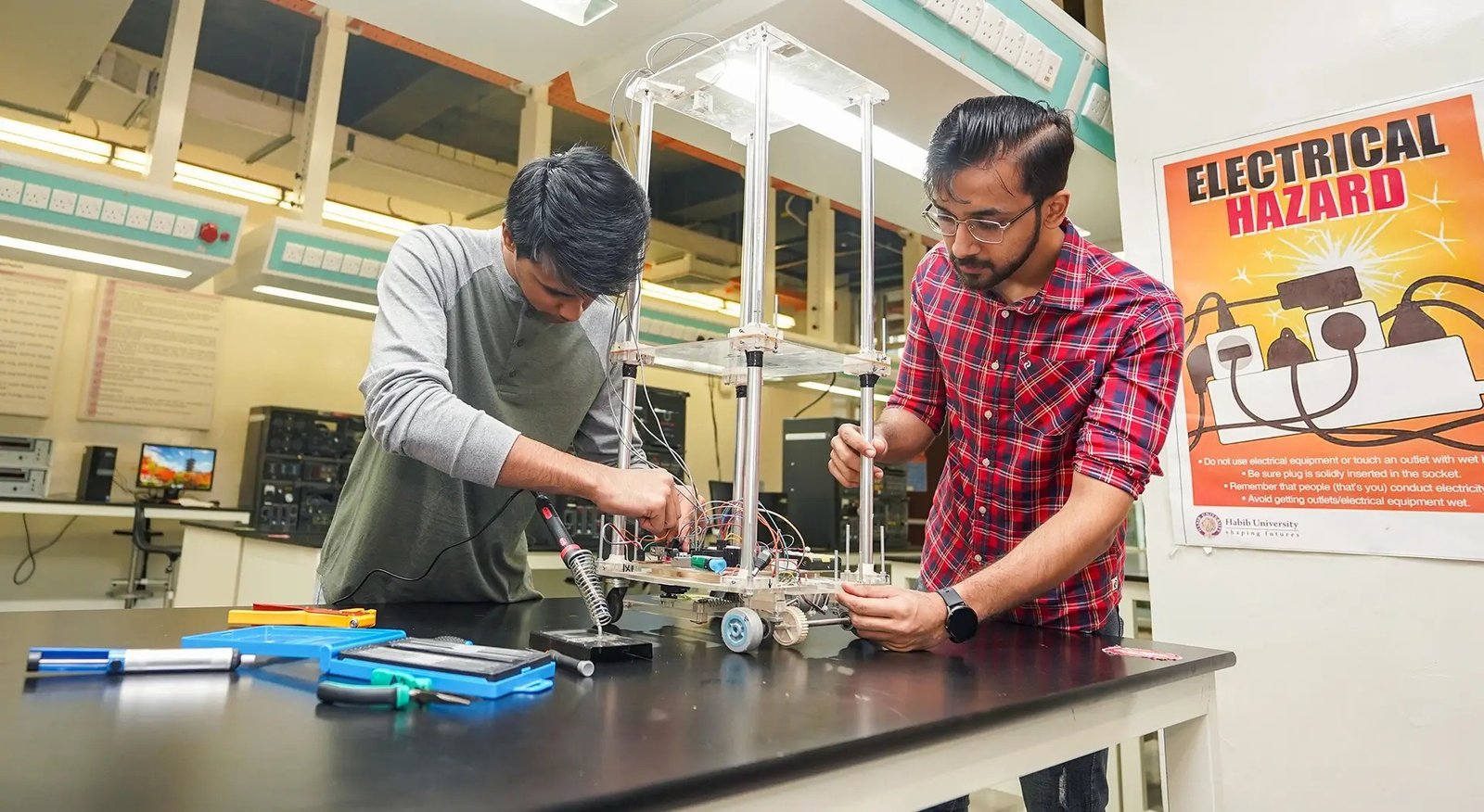
The kind of work the catapult centres are designed to carry further: two engineering students build and solder a robot prototype in an electronics laboratory at Habib University in Karachi. Photo: Habib University
The design draws on models that already exist abroad, among them the United Kingdom’s Catapult Network, Germany’s Fraunhofer Institutes, Manufacturing USA and Singapore’s A*STAR, all of which bring universities, research institutions, industry, entrepreneurs, investors and government agencies into the same facilities.
Ten priority areas, from semiconductors to space
The ten National Catapults will cover:
- Semiconductor and Advanced Electronics, the chips and circuits inside almost every modern device.
- High-Value Manufacturing and Industry 4.0, modern factory production using automation and data.
- Digital Economy and Artificial Intelligence, software, platforms and machine intelligence.
- AgriTech and Food Technology, better farming, storage and food processing.
- Health Technology and MedTech, medical devices and health technologies.
- Clean Energy and Climate Technology, power and climate solutions suited to Pakistan.
- Mines, Minerals and Materials, getting more value from what Pakistan digs up.
- Defence Technology and Dual-Use, technologies with both civil and defence applications.
- Space Technology, satellites and the industries that grow around them.
- Chemicals and Composites, industrial chemicals and advanced materials.
Alongside the facilities, the centres are expected to help universities commercialise their intellectual property, spot emerging technologies and future workforce needs, and help shape the regulations, standards and certification frameworks that new products must meet. The network will also work to attract foreign direct investment and risk capital into Pakistani technology.
IRADA leads the first step, in semiconductors
The first of the National Catapults to take shape will be the Semiconductor and Advanced Electronics Catapult, and it will be led by IRADA, a state-owned research and development agency, which will become the first state-owned enterprise formally designated to lead a catapult. The minister announced the network during his visit to IRADA’s Islamabad facility, where the agency’s engineers work on chip design, including application-specific integrated circuits and systems on a chip.
Semiconductors are a deliberate first choice. Chips sit at the heart of phones, vehicles, appliances and industrial machinery, and developing competitive local alternatives to imported technologies is one of the central aims the minister set for the network. A shared base for designing, testing and prototyping electronics gives Pakistani firms and university teams somewhere to do that work together, and to meet the international standards their products need if they are to be sold abroad.
What happens next
For now, the National Catapults are a plan on paper. Friday’s announcement did not include a budget for the network, the locations of the ten centres, or a timetable for opening them, and no catapult is operating yet. The rules that will matter most to universities and firms, including how the facilities are booked, how intellectual property is shared and how revenue is divided, have also yet to be published.
What to watch, then, is the follow-through: IRADA’s formal designation and the first facilities for the semiconductor centre, the naming of the organisations that will lead the other nine, and the first technologies to enter pilot production. If those steps land, Pakistan will have something it has long lacked, a standing bridge between the laboratory and the factory floor, and a route for more of its research to become products, exports and skilled jobs.
Read More
The catapult network is one part of a wider push to build higher-value national capability, and Pakistan’s public services are moving in the same direction. Read how Pakistan jumped 17 places to 119th in the UN E-Government Development Index 2026.
Sources
- APP via TezKhabar, Ahsan announces establishment of 10 National Catapults to commercialise research
- Business Recorder, Turning research into viable tech: PC to set up 10 national catapults, Ahsan
- Radio Pakistan, Ahsan announces establishment of ten National Catapults
- Profit by Pakistan Today, Pakistan to establish 10 technology research centres
- Featured photo: ARY News (Planning Minister Ahsan Iqbal tours IRADA in Islamabad)
- In-body photo: Habib University (engineering students prototyping in an electronics laboratory)

Umar Farooq is the founder and editor of Good News Pakistan. An engineer by profession and a writer by passion, he started the site in December 2022 to share good news from Pakistan, and has since written and edited more than 200 articles about its people, sports, science, business and world records. He believes the story of Pakistan is bigger than its headlines, and that good news, told honestly, is worth telling every day.