

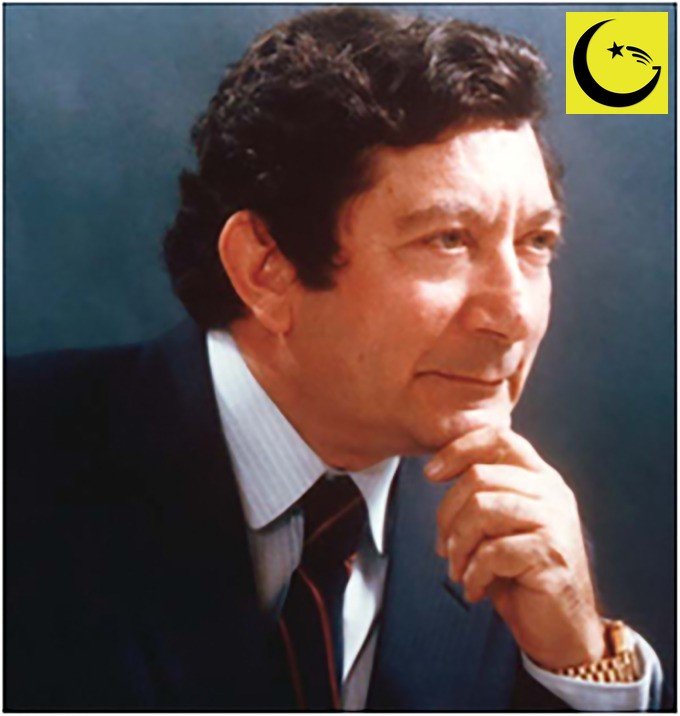
In 1963, a neurosurgeon from Mian Channu who had trained at King Edward Medical College in Lahore described something no surgeon had built before: a small, self-sealing silicone dome that sits under the scalp and lets doctors deliver medicine directly into the fluid around the brain, again and again, without repeated spinal taps. Ayub Khan Ommaya published the design in The Lancet, and the world named the device after its inventor. More than sixty years later, the Ommaya reservoir is still implanted in hospitals across the world, carrying chemotherapy to brain tumours that ordinary drugs cannot reach.
Ayub Khan Ommaya was born on 14 April 1930 in Mian Channu, in what is now Khanewal District, the son of Nadir Khan, an Indian Army cavalry officer. At the age of fourteen he read about the pioneering Canadian neurosurgeon Wilder Penfield and decided his own future on the spot. After Gordon College in Rawalpindi, he entered King Edward Medical College in Lahore, where he won the Harper-Nelson Gold Medal, debated, boxed and swam, taking the national swimming title in 1953, the year he graduated at the top of his class.
From Mian Channu to Oxford on a Rhodes Scholarship
In 1954, Ommaya won a Rhodes Scholarship to Balliol College, Oxford, where he read physiology and psychology, earned his master’s degree in 1956, rowed for his college and won the James Willis Kirkaldy University Prize. He then trained in neurosurgery under Dr Joseph Pennybacker at Oxford’s Nuffield College and the Radcliffe Infirmary, the finest apprenticeship British neurosurgery could offer, and in 1964 the Royal College of Surgeons offered him its Hunterian Professorship.
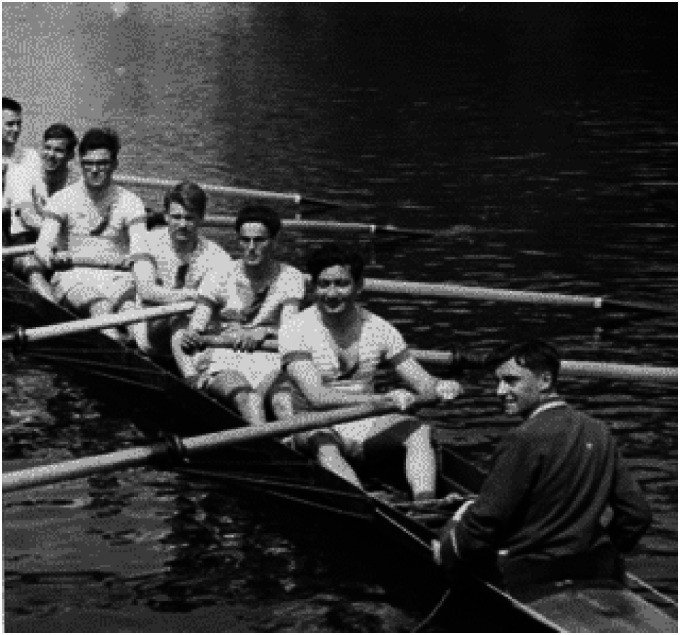
Ommaya rowing with his Oxford University crew in 1955, during the Rhodes Scholarship years at Balliol College that followed his medical training in Lahore.
Photo: Journal of Medical Biography
His great laboratory years, though, were spent in the United States. In 1961 he joined the National Institutes of Health (NIH) in Bethesda, Maryland, and rose to become chief of neurosurgery at the National Institute of Neurological Disorders and Stroke, a post he held for almost two decades. Like many Pakistani scientists of his generation, he found the laboratories and funding for his research abroad; what Pakistan gave him was the schooling, the training and the start, and his country remembered him for it later.
How the Ommaya Reservoir Works
The problem he set out to solve was simple to state and brutal in practice. The brain is protected by a barrier that keeps most medicines in the bloodstream out, and the established way to reach the cerebrospinal fluid, the clear liquid that bathes the brain and spinal cord, was the lumbar puncture: a needle into the lower back, painful, imprecise and impossible to repeat often. Ommaya’s answer, set out in his 1963 Lancet paper “Subcutaneous Reservoir and Pump for Sterile Access to Ventricular Cerebrospinal Fluid”, was a mushroom-shaped dome of silicone rubber placed under the scalp in a single operation, joined to a thin catheter passed through a small hole in the skull into a ventricle of the brain.
A needle pushed through the skin refills the dome; pressing on it pumps the drug through; the silicone seals itself after every puncture, so the same port can be used again and again for years. It was the first implantable medical port made of silicone, and it was first used to deliver antifungal medicine to patients with cryptococcal meningitis. Surgeons quickly saw its bigger use: chemotherapy for brain tumours and cancers that spread to the membranes around the brain, delivered exactly where it was needed. With Robert Ratcheson, Ommaya reported sixty treated cases in the New England Journal of Medicine, and the Ommaya reservoir became standard equipment in neurosurgery, the model for the whole family of implantable ports that modern medicine now relies on.
READ MORE:
Abdus Salam Nobel Prize: How a Boy from Jhang Became Pakistan’s First Nobel Laureate
The Surgeon Who Taught Cars to Protect Brains
Ommaya’s second great field was the injured brain. At the NIH he set out the centripetal theory of traumatic brain injury, the idea that damage begins at the surface of the brain and drives deeper as the force grows, and he showed how the twisting, rotational movement of the head tears the brain’s wiring in what is now called diffuse axonal injury. His framework still shapes how head injuries are modelled today, and he devised the first coma scale for classifying them, work he carried on as a clinical professor at George Washington University.
In 1980 he became chief medical adviser to the United States National Highway Traffic Safety Administration, the first and only neurosurgeon to hold the post, and served until 1985. There he commissioned the landmark Institute of Medicine report Injury in America, which led directly to the creation of the National Center for Injury Prevention and Control at the Centers for Disease Control and Prevention, funded with an initial 10 million dollars. Along the way he also produced, with Giovanni Di Chiro and John Doppman, one of the first reports on spinal angiography, opening the blood vessels of the spinal cord to imaging, and worked with Sir Godfrey Hounsfield on the early development of the CT scanner.
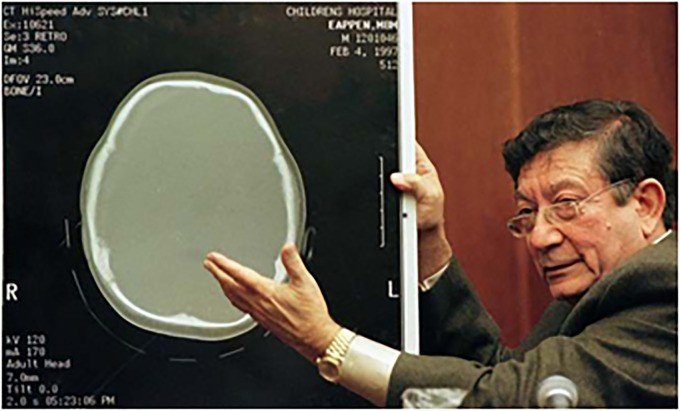
Ommaya in 1997, holding up a CT scan while giving expert testimony at the Woodward trial in Cambridge, Massachusetts, by then one of the world’s leading authorities on the injured brain.
Photo: Journal of Medical Biography
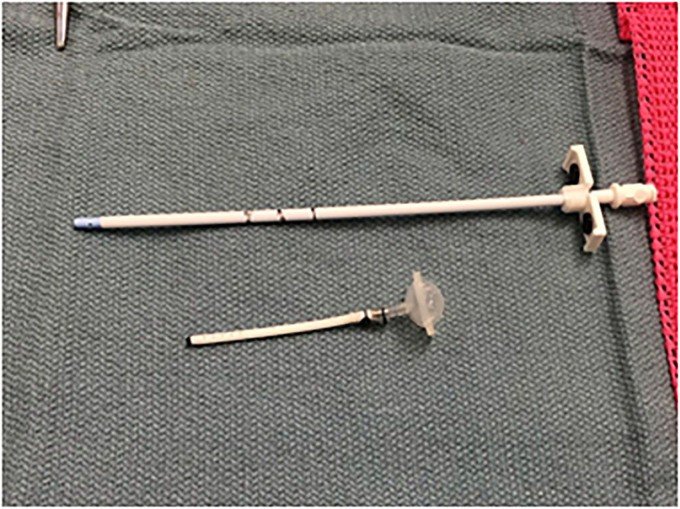
The Ommaya reservoir today: a self-sealing silicone dome and catheter that let doctors deliver chemotherapy into the fluid around the brain and take samples through the same port.
Photo: Journal of Medical Biography
A Voice, a Film Role and a Road Home
Colleagues called him the singing neurosurgeon. Ommaya had trained as an opera singer in Venice, spoke seven languages, and would sing for patients and staff around his operating lists, music being the other great discipline of his life. In 1992 he appeared as a neurosurgeon in the Hollywood film Lorenzo’s Oil, alongside Peter Ustinov, Nick Nolte and Susan Sarandon. He published more than 150 scientific papers, chapters and books across his career.
Pakistan honoured its faraway son. In 1982 the President of Pakistan awarded him the Sitara-i-Imtiaz, and he served as an honorary physician to the President. After a diagnosis of Alzheimer’s disease, he came home for good. Ayub Khan Ommaya died in Islamabad on 11 July 2008, aged 78, and The Lancet and Dawn both marked the passing of one of the most consequential surgeons Pakistan has produced. He was survived by his wife Ghazala and their six children.
Why His Name Is Still Spoken in Operating Theatres
Every neurosurgery trainee in the world learns his device before almost any other eponym in the specialty, because the Ommaya reservoir never went away. It still delivers chemotherapy to brain tumours, still treats infections of the fluid around the brain, and still lets doctors measure pressure and take samples through a port first described by a King Edward graduate in 1963. Ports across medicine, from cancer care to pain treatment, descend from his design.
That is the story this series exists to tell. A boy from a small Punjab town, schooled in Rawalpindi and Lahore, carried Pakistani training to the summit of world medicine and left his name on a device that has eased the treatment of hundreds of thousands of patients. Ayub Ommaya’s reservoir outlived him, and it is still at work today.
Sources
- The Lancet, Ayub Khan Ommaya obituary (2008)
- Neurosurgery, Ayub Khan Ommaya (1930-2008): Legacy and Contributions to Neurosurgery (2017)
- Journal of Medical Biography, Dr Ayub Khan Ommaya (1930-2008): The Eventful Life of a Revolutionary Neurosurgeon
- World Neurosurgery, Neurological Surgery at the National Institutes of Health
- Featured photo: The Lancet, via Journal of Medical Biography
- Body photo: Journal of Medical Biography
- Extra body photos: Journal of Medical Biography

Umar Farooq is the founder and editor of Good News Pakistan. An engineer by profession and a writer by passion, he started the site in December 2022 to share good news from Pakistan, and has since written and edited more than 200 articles about its people, sports, science, business and world records. He believes the story of Pakistan is bigger than its headlines, and that good news, told honestly, is worth telling every day.