

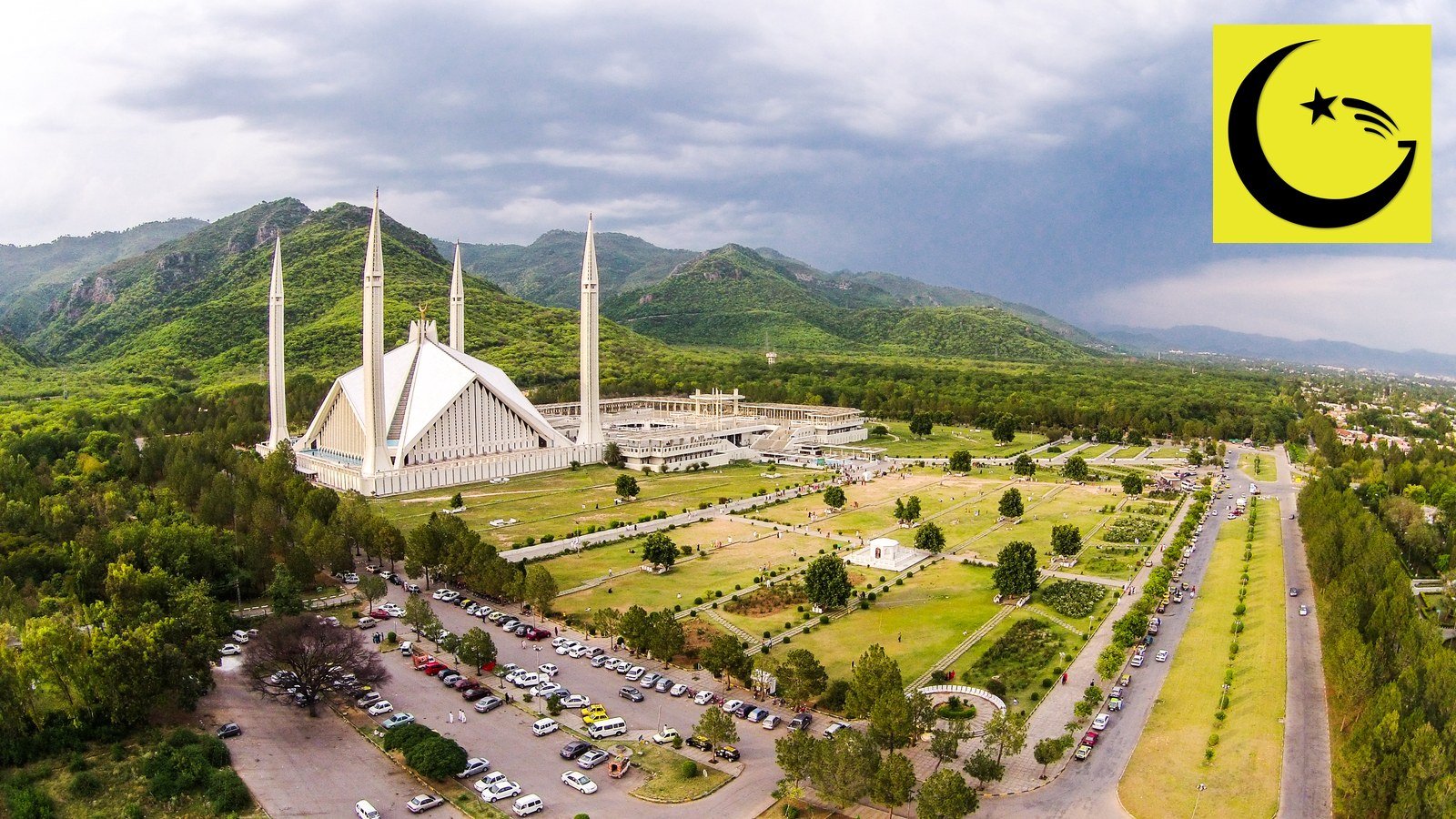
When it was completed in 1986, the Faisal Mosque in Islamabad was the largest mosque in the world, and it held that standing until 1993. The white marble landmark at the foot of the Margalla Hills is Pakistan’s national mosque, recognised across the globe as the symbol of the capital, and for seven years it stood at the very top of the record books.
A Gift, a Competition and a Turkish Architect
The idea of a grand national mosque for Pakistan’s new capital took shape in 1966, when King Faisal bin Abdulaziz of Saudi Arabia visited Pakistan and offered to help build one. In 1969 an international competition was held to choose its design, drawing entries from architects in 17 countries. The winner was Vedat Dalokay, a Turkish architect and former mayor of Ankara, whose proposal looked nothing like a traditional mosque. Construction began in 1976, funded by King Faisal, and the mosque was completed and inaugurated in 1986. The king had died in 1975 and never saw the finished building, but it carries his name to this day, and the avenue that leads to it is named after him as well.
Inside Faisal Mosque: A Tent Pitched Against the Hills
Dalokay built his design from two shapes: the cube of the Kaaba in Makkah and the peaked tent of a Bedouin dwelling in the desert. The result is a folded concrete shell, an eight-sided hall roofed by eight triangular slabs of white Thassos marble, with no dome at all, which makes the mosque unlike almost any other great mosque in the world. Four slender, pencil-shaped minarets stand at the corners of the courtyard, their visitors’ galleries almost 60 metres above the ground. Inside, the prayer hall glows beneath a chandelier of 600 bulbs, and its walls carry mosaics and calligraphy by Sadequain, one of the most celebrated artists Pakistan has produced. The whole complex sits on a raised platform with no boundary wall, open to the city on one side and backed by the dark green wall of the Margalla Hills on the other.
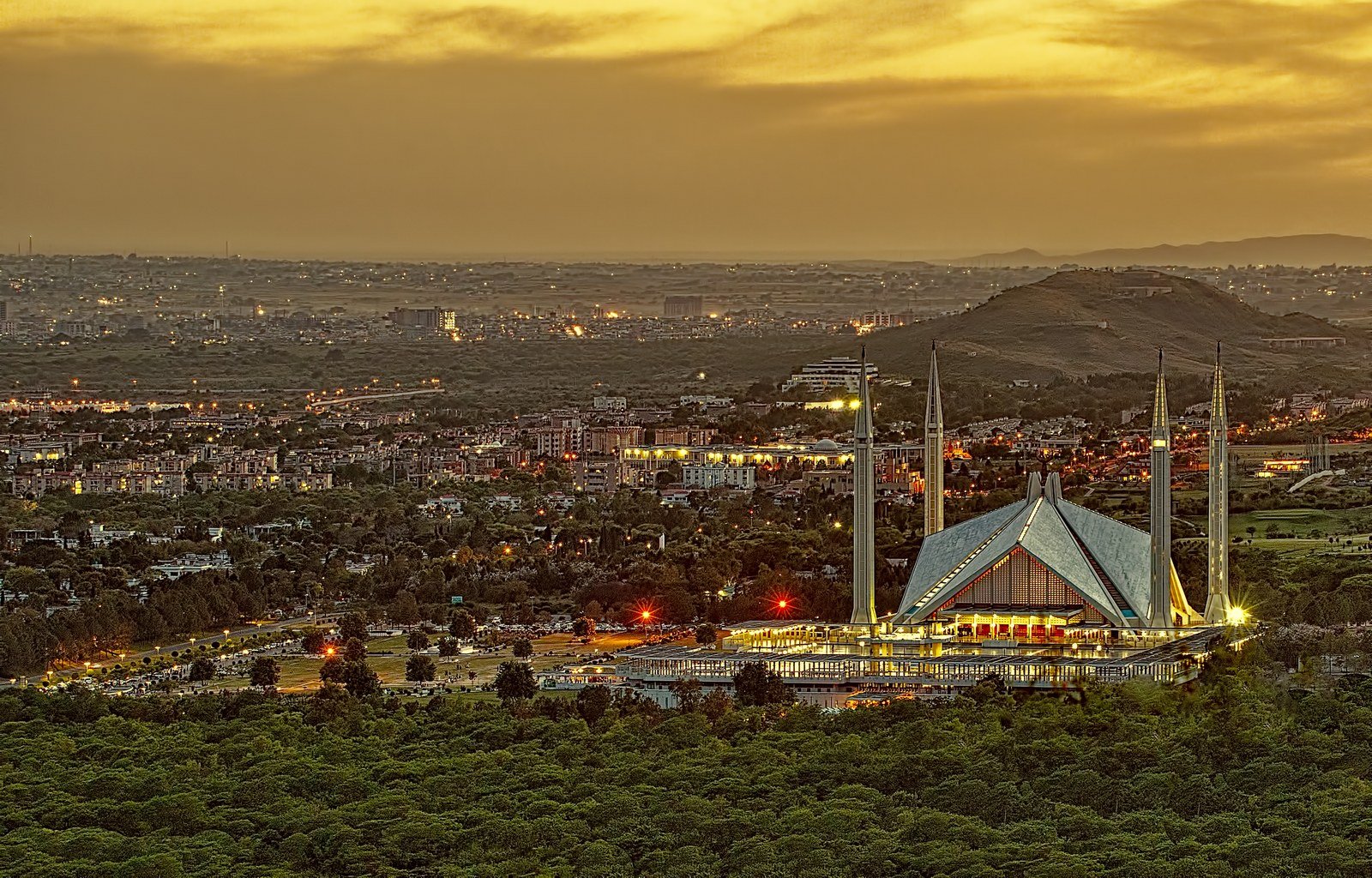
Faisal Mosque lit up at dusk above Islamabad, its folded marble roof and four slender minarets glowing against the evening sky. Photo: Tahsin Shah via Wikimedia Commons (CC BY-SA 4.0)
The Largest Mosque in the World, 1986 to 1993
Scale was built into the design from the start. The main prayer hall alone holds around 10,000 worshippers, and when the porticoes, the courtyard and the surrounding grounds are counted, the complex can hold close to 300,000 people. That capacity is why, from its completion and inauguration in 1986 until 1993, the Faisal Mosque stood as the largest mosque in the world. In 1993 the Hassan II Mosque in Casablanca, Morocco, took the title. This series keeps two kinds of facts apart, and this one is From the Record Books: the title has moved on since, but the seven years when the largest mosque on Earth stood in Islamabad are a settled part of history, and no building completed later can take those years away.
Still the National Mosque of Pakistan
The record passed, but the building’s place in Pakistani life never did. It remains the largest mosque in Pakistan and the country’s national mosque. In its early years the complex also housed the International Islamic University, before the university moved to its own campus in 2000, and Dalokay’s design went on to win an Aga Khan Award for Architecture. On a clear day the white tent and its four minarets can be seen from across the capital, a daily reminder that this was once, quite simply, the biggest mosque in the world.
Sources
- The Twentieth Century Society: King Faisal Mosque, Islamabad, Building of the Month
- Dawn via The Free Library: Man who made Faisal Mosque
- Wikipedia: Faisal Mosque
- Featured photo: Faisal Mosque against the Margalla Hills, Islamabad (Photo: Shoaib Zafar via Wikimedia Commons, CC BY-SA 4.0)
- In-body photo: Faisal Mosque illuminated at dusk above Islamabad (Photo: Tahsin Shah via Wikimedia Commons, CC BY-SA 4.0)

Umar Farooq is the founder and editor of Good News Pakistan. An engineer by profession and a writer by passion, he started the site in December 2022 to share good news from Pakistan, and has since written and edited more than 200 articles about its people, sports, science, business and world records. He believes the story of Pakistan is bigger than its headlines, and that good news, told honestly, is worth telling every day.
- Umar Farooq
- Umar Farooq
- Umar Farooq
- Umar Farooq
- Umar Farooq